Explainer · Budget & Investment · Europe
Making Europe SAFE: exploring the EU’s EUR150bn loan framework
DSEI Gateway explores how the EU SAFE loan instrument is supporting rearmament across Europe and bolstering its industrial base.

Explainer · Budget & Investment · Europe
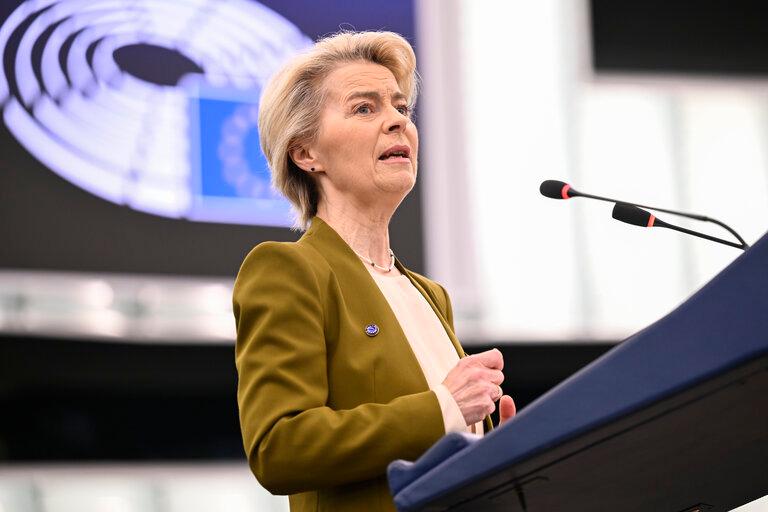
Europe is “in an era of rearmament”, according to Ursula von der Leyen, President of the European Commission.
To successfully achieve this, however, many EU member states require additional funding from external sources.
One way in which the EU is offering this support is through its EUR150 billion Security Action for Europe (SAFE) loan instrument.
SAFE offers long-maturity loans to EU member states, helping them to bolster their defence capabilities while strengthening Europe’s industrial base. It is designed to promote interoperability, while accelerating the delivery of systems and equipment.
A core principle of the SAFE loan is based on “common procurement”, which involves a minimum of two countries – at least one of which must be a member state receiving the loan. Other countries involved may include members of the European Free Trade Association, the European Economic Area, or Ukraine.
Countries provided with loans are encouraged to engage in common procurement with Ukraine, prioritising its “urgent needs”, such as drones and missiles.
Additionally, non-EU countries that have signed a Security and Defence Partnership with the EU can take part in common procurement.
“By focusing on joint procurement, we are ensuring that member states buy together, which reduces costs and ensures our equipment works seamlessly across borders,” Andrius Kubilius, EU Commissioner for Defence and Space, said.
On a transitional basis, individual member states can also procure alone, provided contracts were signed by May 2026.
As of October 2026, the European Commission has approved funding for 19 member states, while 11 countries that requested prefinancing – an upfront advance payment – have received a total of almost EUR13.5 billion.
DSEI Gateway explores the impact the SAFE loan has had on Europe, how it works in practice, and whether the instrument has been successful.
When was the SAFE loan introduced?
To counter rising geopolitical threats and respond to the Ukrainian conflict, von der Leyen introduced the ReArm Europe plan in March 2025, which outlined a roadmap to mobilise EUR800 billion for rearmament.
A core part of this plan was an instrument to loan EUR150 billion to EU member states, focused on funding “pan-European capability domains” such as air and missile defence, artillery systems, and missiles, among other things.
The commission formally proposed the instrument, naming it SAFE, under the White Paper for European Defence – Readiness 2030, a roadmap for enhancing defence across Europe published in March 2025.
The loan instrument was then officially adopted by the Council of the EU in May 2025.
How does the loan work?
Under the SAFE instrument, the European Commission raises funds on capital markets. Essentially, the commission borrows on the markets by issuing bonds, and lends the money to member states, similar to its COVID-19 recovery fund.
By lending on the EU budget, many member states can access finance on better terms than they could secure on their own.
The process runs in several stages.
For member states, the first step is to submit their national defence investment plans to demonstrate how they intend to spend the money. Following an assessment process, the commission may then approve the loan, allowing for the disbursal of funds and subsequent procurement.
Countries can then receive 15% of their allocation as pre-financing, with the remaining 85% disbursed as agreed milestones are met. All disbursements must be completed by 31 December 2030.
Countries may then release tenders or procurement notices for companies to bid for. Due to the urgent requirement of some capabilities, however, the Council of the EU says that national procurement agencies may engage in negotiated procedures without publishing a contract notice.
If a country uses a SAFE loan to procure capabilities, then at least 65% of the total costs of the components must be from suppliers within:
- The EU
- Eligible European Economic Area and European Free Trade Association countries
- Ukraine
SAFE supports the procurement of defence capabilities within two categories.
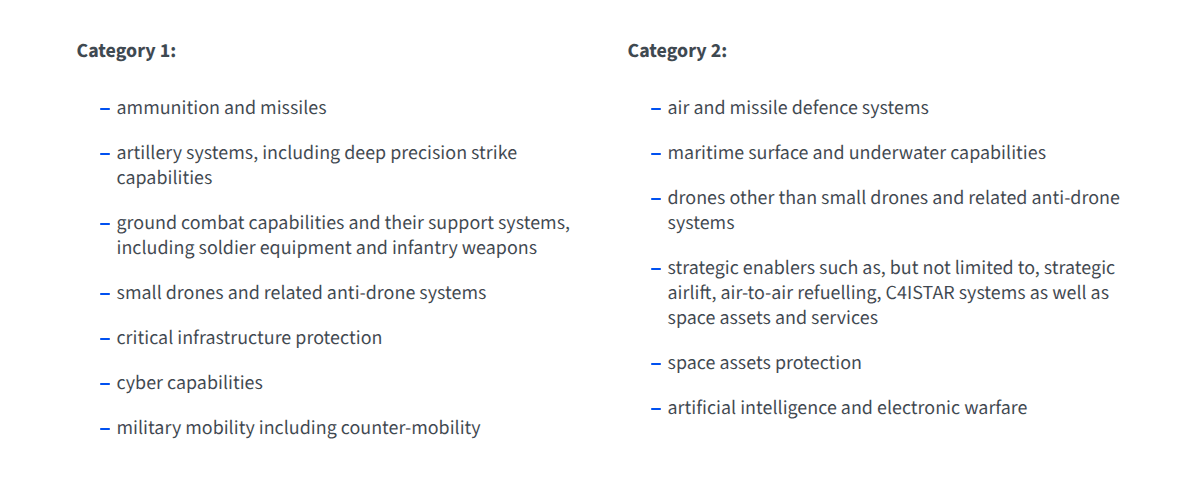
Capabilities that fall under the second category must “meet stricter eligibility conditions”, the Council of the EU says. This includes assurance that the equipment can be modified as required without restrictions from non-EU sources.
How are other countries involved?
In December 2025, the Council of the EU endorsed an agreement for Canada to participate in the SAFE instrument, making it the first non-European country to do so. This allows Canadian companies to bid for common procurements under the instrument and means components from Canada can make up to 80% of the total value of any procurement.
Canada paid around EUR10 million to participate, according to the commission.
“Canada’s participation in SAFE will fill key capability gaps, expand markets for Canadian suppliers, and attract European defence investment into Canada,” Mark Carney, Prime Minister of Canada, said.
The UK, which signed a Security and Defence Partnership with the EU in May 2025, sought a deal that would give preferential access to SAFE-funded projects. However talks collapsed in November 2025 over the size of the financial contribution requested.
According to a report from the UK House of Commons Foreign Affairs Committee, published in March, the EU initially requested a contribution from the UK of GBP5.7 billion, although later reduced this to GBP1.8 billion, while the UK offered GBP200-300 million. The report says that the EU had a “regrettable approach” to the UK’s expanded participation.
Despite this, UK companies can still take part as third-country suppliers, though are limited to supplying no more than 35% of the cost of a system’s components. The two sides are discussing UK participation in a possible second edition of the instrument.
Which countries have received loans?
The EU opened up the first call for loans in summer 2025 and allocated a total of approximately EUR128.7 billion. It approved loan agreements to all 19 member states that decided to participate.
The first country to receive a loan under the instrument was Poland, which is also due to receive the largest share of the SAFE loan.
Poland received a first payment of EUR6.6 billion under SAFE in May. According to the European Commission, this represented around 15% of its total EUR43.7 billion allocation.
The Polish Government also claimed that the loan was the “largest fund” invested in its armed forces in history.
According to the Polish Prime Minister, Donald Tusk, 36% of its SAFE loan will be directed towards purchasing “the most advanced technologies” such as drone, counter-drone, cybernetic, satellite, and space capabilities. The Deputy Prime Minister of Poland, Władysław Kosiniak-Kamysz, additionally said that the SAFE loan could enable purchases of equipment such as ‘Borsuk’ amphibious infantry fighting vehicles, ‘Piorun’ air defence missiles, ‘Wizjer’ UAVs, and mine-laying systems.
Romania, set to receive the next largest portion of the SAFE loan, was granted its first payment of EUR2.5 billion in August. This also represents 15% of its total EUR16.7 billion allocation.
Bulgaria and Lativa followed later that month, receiving EUR489.3 million and EUR524.7 million respectively, from total allocations of EUR3.3 billion and EUR3.5 billion.
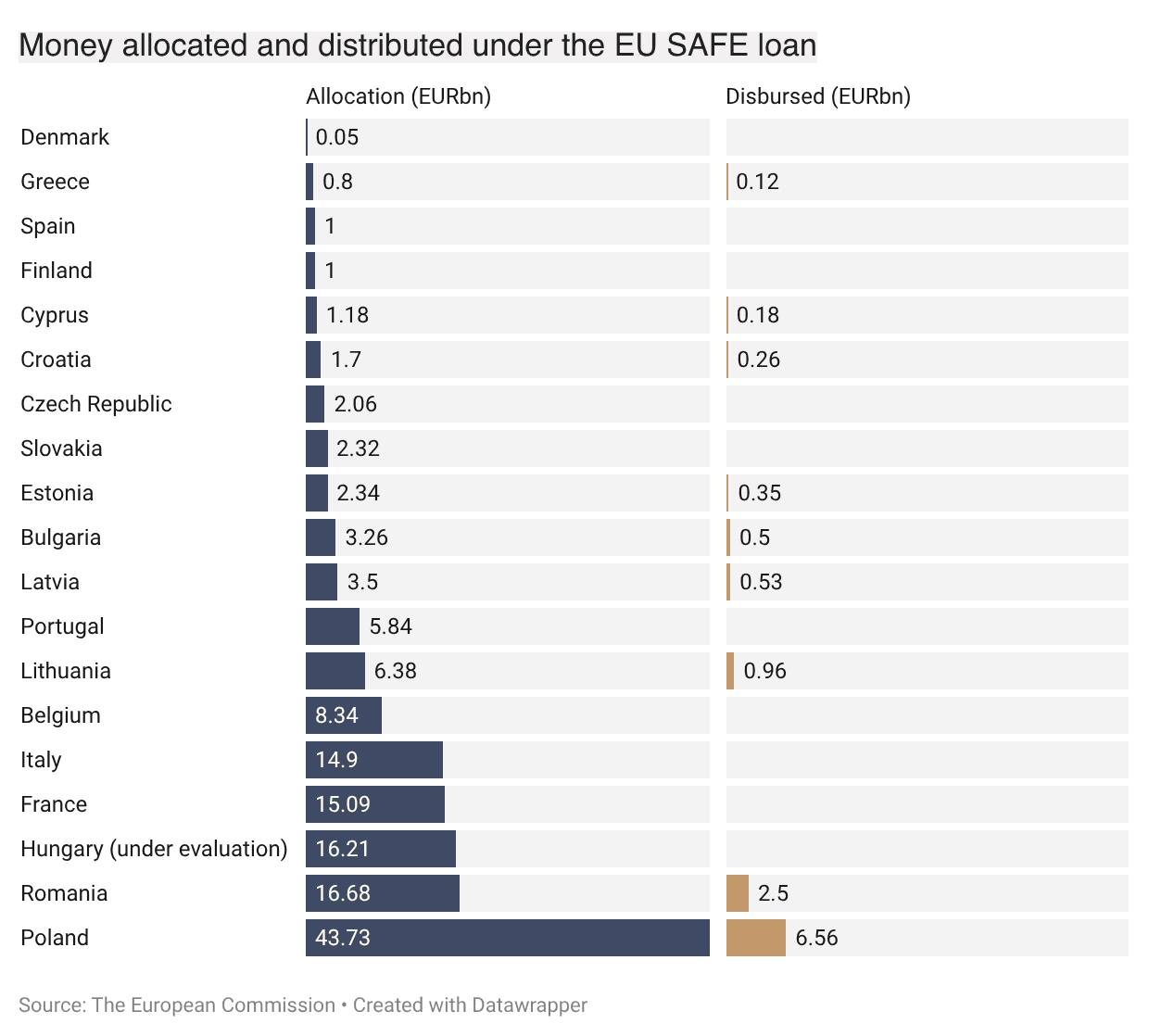
The Lithuanian defence ministry says that its loan will go towards bolstering capabilities such as counter-mobility measures and mines, alongside other things. Meanwhile, Estonia cited “military vehicles, artillery shells, and other ammunition” as key procurements to be made using the SAFE loan.
Has the loan been successful?
According to von der Leyen in December 2025, the SAFE instrument was “oversubscribed” with demand from member states higher than the EUR150 billion available under the programme.
Since then, other EU recipients have praised the loan for bolstering defence capabilities across Europe.
“The SAFE loan is first and foremost an investment in the security of Lithuania and the whole Europe,” Robertas Kaunas, Lithuania’s Minister of National Defence, said. “The financial instrument will be sufficient for half of the needs of the development of the National Division. We are fully prepared for project execution with over two thirds of the needed projects already in contracts and signed.”
Kadri Peeters, Estonian Undersecretary for Defence Capabilities at the Ministry of Defence, also said that the SAFE loan would enable Estonia to accelerate and scale up its defence plans. It would also allow for the implementation of “critical investments” from NATO.
Additionally, to help “finance production” in Ukraine, Spain agreed in March to allocate funds from its SAFE loan, while Bulgaria affirmed its interest in co-producing drones and ammunition with Ukraine through SAFE. Lithuania and Poland also agreed to use the loan to support Ukraine, supporting one of the key goals of the instrument.
It is likely too early to judge the instrument's impact on capability. All payments so far have been through pre-financing, and take-up has been uneven, with Germany choosing not to participate, while Hungary and Italy have scaled back their requests.
SAFE loans are also granted only to member states, which then award contracts to companies. As a result, company participation is largely through national governments. The route is less clear for companies hoping to join common procurements led by other countries.
What is next for the SAFE loan?
As SAFE loans continue to be disbursed, militaries across Europe will be able to purchase new equipment and strengthen interoperability, as well as support European industry.
In late October, the commission opened its second call for SAFE loan applications. This round seeks to allocate the remaining EUR21.3 billion of the total EUR150 billion.
While the commission says that it will inform countries about tentative allocations within two weeks of the submission deadline, no specific deadline was provided.
During a meeting with the Ukraine Defense Contact Group – an alliance of 57 countries – in November, Ukrainian President Volodymyr Zelensky emphasised that the remaining funds under the SAFE loan should be used for “joint projects” with Ukraine.
Poland, meanwhile, wants the 2030 delivery deadline extended and some US, South Korean, and Turkish equipment made eligible in specific cases, according to Deputy Defence Minister Magdalena Sobkowiak-Czarnecka.
SAFE has channelled significant funding towards European industry and created a framework for joint procurement, though much early spending has been national. With most deliveries not due until closer to 2030, it is likely too early to judge its impact on capability.