
(Shutterstock)
Innovative investments: the Department of War and small businesses
DSEI Gateway hears from US Department of War officials about how the support it offers to small businesses aims to increase innovation in areas from AI to autonomous systems.
16 OCT 2026

By
Gerrard
Cowan
Experienced Freelance Defence & Finance Journalist
Small companies are vital for defence innovation, with the US Department of War (DoW) awarding funding worth more than USD3 billion to such firms every year.
However, it remains a challenge for these businesses to scale their ideas and navigate complex defence procurement processes.
Agencies across the DoW are therefore deploying a range of tools to support such firms, focusing on financial investments, access to testing facilities, and networking opportunities.
Two of the most prominent avenues the DoW uses to fund SMEs are the Small Business Innovation Research (SBIR) and Small Business Technology Transfer (STTR) programmes. Known collectively as ‘America’s Seed Fund’, the programmes provide financial assistance to support the development and commercialisation of technologies across different sectors.
DSEI Gateway spoke to representatives from the DoW to learn how these investments are made and the advantages they offer small companies.
What financial support do the SBIR and STTR programmes provide?
SBIR and STTR programmes are coordinated by the US Small Business Administration and are funded through 11 federal agencies, including the DoW. While SBIR and STTR are similar, the key difference is that an STTR programme must also involve a non-profit research institution. The investments are ‘non-dilutive’, meaning the government does not take a stake in the companies.
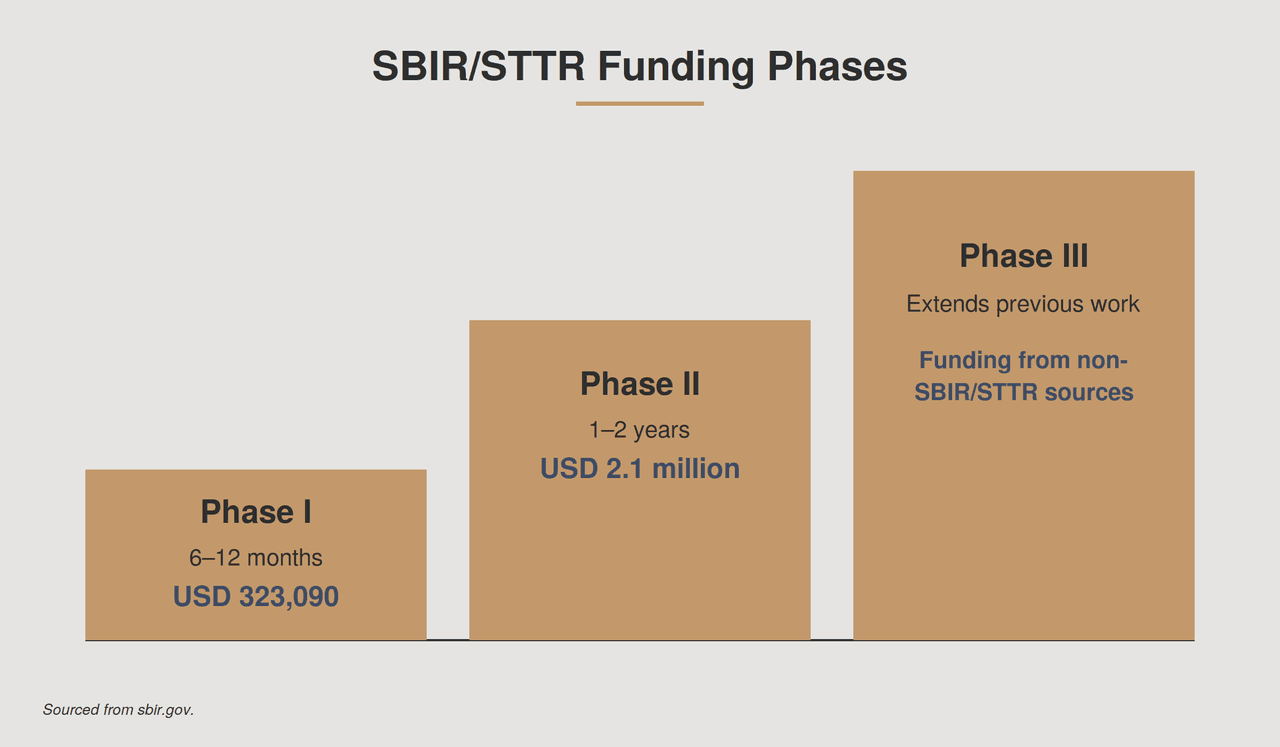
SBIR and STTR funding. (DSEI Gateway)
SBIR and STTR awards take place across three ‘phases’. Phase I is a concept development period, typically lasting six to 12 months and covering exploration of the technical merit or feasibility of an idea; it has a funding limit of up to USD323,090.
Phase II can continue for up to two years and funds more extensive R&D work; contracts can be awarded at values of up to USD2.1 million.
Phase III supports work that is derived from, extends, or completes earlier SBIR and STTR efforts, for example, through further testing or production. It is funded entirely from non-SBIR or STTR sources: other government funds, for instance, or private funding.
AFWERX investments
AFWERX, a US Air Force Research Laboratory division focused on maturing emerging technologies, is a key organisation that manages SBIR and STTR programmes on behalf of the air force.
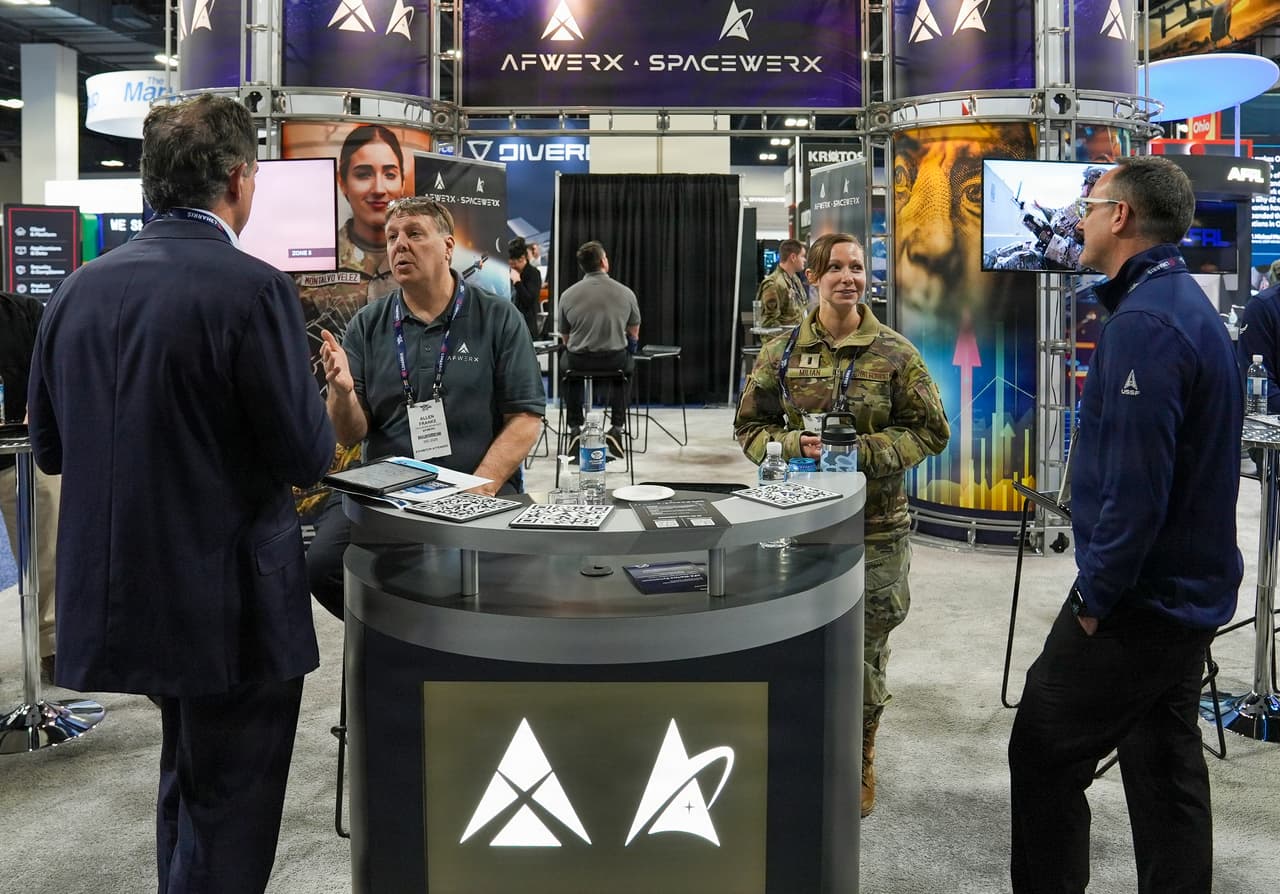
AFWERX programme managers met with industry leaders at the Warfare Symposium in Aurora, Colorado in February. (Matthew Clouse/US Air Force)
The division awards SBIR and STTR contracts to eligible small businesses – usually those with 500 or fewer employees. This funding is used to support feasibility studies, prototype development, and technology demonstrations, Carissa Grosh, programme manager at AFWERX, explained to DSEI Gateway.
As of 30 September, AFWERX had awarded 14,232 contracts valued at USD10.37 billion since 2019, Grosh added. In combination with SpaceWERX – a division of AFWERX that develops technologies for the US Space Force – it has engaged thousands of companies, with about 45% of them new to government.
These investments align with Department of the Air Force and DoW priorities, Grosh said, such as autonomous mass, collaborative combat aircraft, and resilient communications. Applied AI has surged as a focus, she noted: a review of the AFWERX portfolio since the beginning of 2025 reveals that of the 367 SBIR and STTR contracts awarded over the period - with a value of approximately USD301 million – AI accounted for 310 contracts at a value of USD236.27 million.
Other funding opportunities
The Army Applications Laboratory (AAL) is another organisation helping to support smaller companies, connecting the US Army with non-traditional providers in industry. For example, in addition to solicitations on traditional procurement platforms such as SAM.gov, the laboratory also reaches out to potential contributors through social media and email campaigns, an AAL spokesperson told DSEI Gateway.
AAL aims to shepherd companies through an often-arduous development process, the spokesperson said. For example, there are often requirements for technical pre-approval even before technologies can be tested, such as the fuses within munitions. AAL helps these companies to meet such demands.
Providing small companies with the practical opportunities they need to further refine their technologies, including through access to the end-user and testing environments, is essential, the spokesperson added. This means they are then able to receive direct feedback and iterate equipment throughout the development process.
Colonel Russ Cummings, Executive Director of AAL, told DSEI Gateway that the laboratory is “expanding the army’s accessible industrial base, with 91% of companies on our portfolio having limited or no prior DoW experience.”
AAL’s further work
Many small businesses have requested greater access to army test ranges, added the AAL spokesperson. To further support small companies, AAL has collected information on commercial test ranges and has made the database available via its website. The agency has also posted a new request form from Army Test and Evaluation Command to enable industry to directly request access to test ranges.
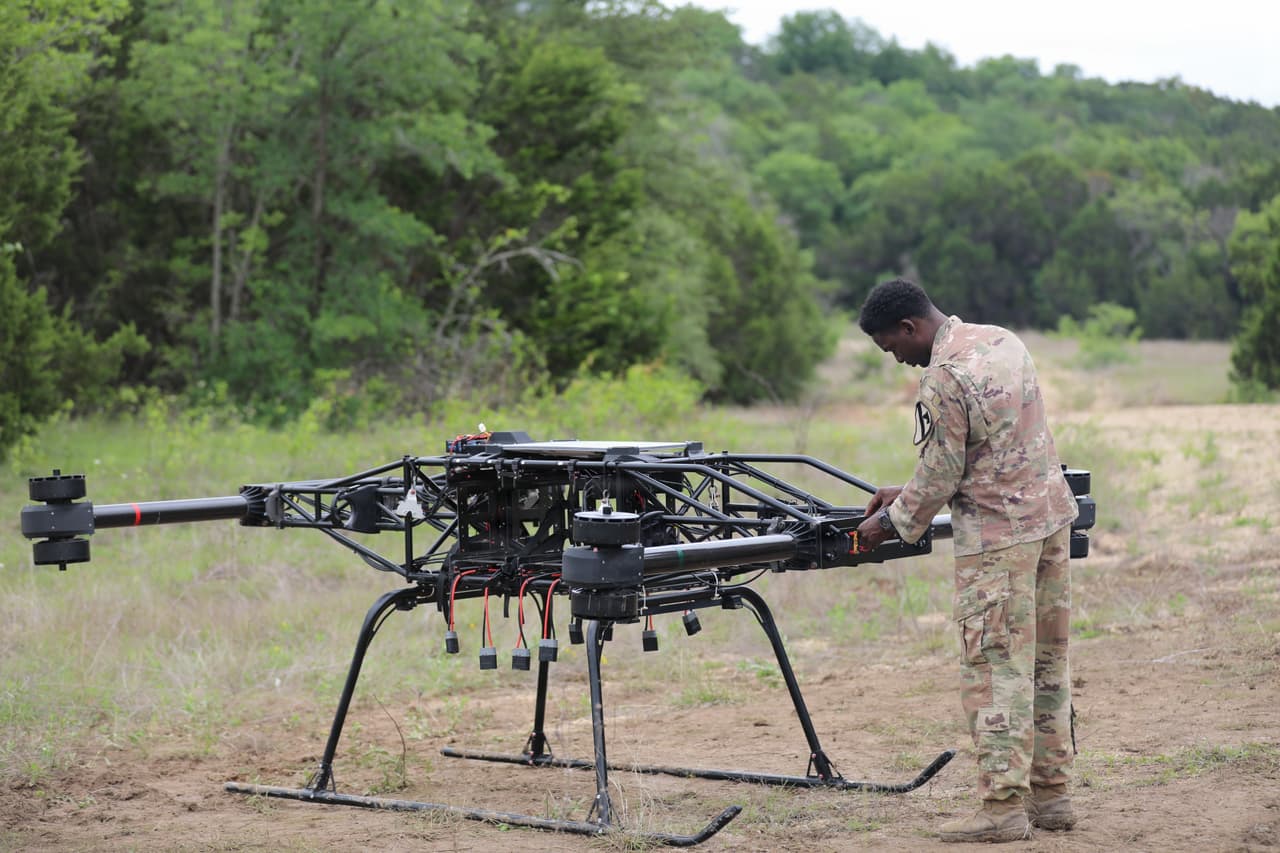
AAL’s ‘Overwatch’ programme works with businesses to develop and integrate autonomous uncrewed systems and supporting technology. (Captain Jasmine Mathews/US Army)
Pointing to further examples of AAL’s work to support smaller businesses, the spokesperson highlighted ‘Overwatch’, which develops and integrates autonomous uncrewed systems and supporting technology, such as payloads and software. This began as an ‘xTech’ competition, in which businesses compete for cash prizes and potential follow-on contracts to accelerate and transition their technologies.
Out of 640 whitepaper submissions in 2025, 40 received USD15,000 each in prize money, before pitching again at the Army Human-Machine Integration Summit in October that year. A total of 20 were further downselected, with every entry receiving an additional USD20,000 each.
Those 20 then were able to submit proposals for a Direct to Phase II SBIR, which allows companies that have already proven the feasibility of their technologies outside SBIR and STTR to skip Phase I; each received up to USD2 million per award.
The spokesperson also highlighted the ‘VERTEX’ event series. Each event is a two-day symposium focused on a different topic, aiming to present a set of use cases connected to current challenges the army faces. Feedback from event participants is then used to refine requests for proposals that industry can respond to.
Beyond traditional development
Arthur Grijalva, Director of SpaceWERX, said small businesses are particularly important for commercial innovation as the government cannot afford to rely solely on traditional development cycles.
“Through programmes such as SBIR and STTR, we can tap into technology and private-sector investment that already exists, apply it to military problems, and reduce the time and government investment required to determine whether a capability has operational value.”
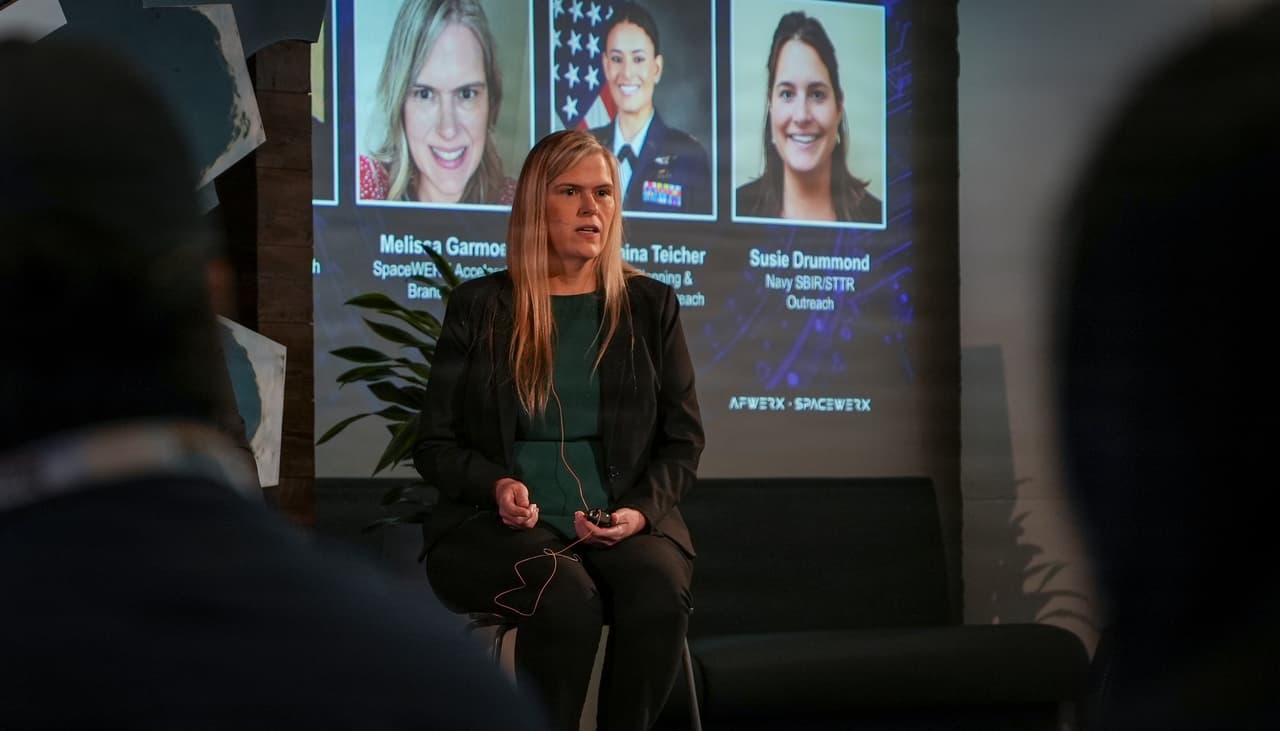
Melissa Garmoe, SpaceWERX Accelerate branch chief, at a panel on navigating the SBIR and STTR programmes at the South By Southwest conference in Austin, Texas in March. (Matthew Clouse/AFRL)
He also highlighted the importance of small organisations in developing AI, noting that the ecosystem is evolving at such a rapid pace that it is difficult to predict what the best technical solution might look like in the coming years.
“Small businesses give us access to new approaches in areas such as data processing, predictive maintenance, and decision-support tools to aid human operators, without requiring the government to develop every capability internally,” he told DSEI Gateway.
Procurement challenges
Beyond technological development, SMEs have to navigate “a government acquisition environment that was not necessarily designed around the speed, structure, or resources of a small commercial company,” Grijalva said.
This includes unfamiliar contracting processes, cybersecurity and research security requirements, government funding timelines, and a range of other issues. SpaceWERX aims to bridge this gap by providing an accessible entry point into the DoW and connecting companies with the technical, contracting, programmatic, and operational experts they need to move forward, he said.
However, getting a contract is only the beginning, Grijalva noted. The bigger challenge – and opportunity – is transition. “A successful prototype does not automatically become an operational capability. There has to be a customer who needs it, funding to continue development, and an acquisition pathway that allows the government to procure it at scale.”
The overall objective of working with small businesses is to bring together the small business with the customer, programme office, acquisition community, and other sources of funding as early as possible.
“Ultimately, our goal is not simply to help a company succeed at navigating SBIR and STTR; it is to make SBIR and STTR a bridge into the broader defence marketplace,” Grijalva said. “We want innovators to be able to bring forward a great idea, understand the mission, find the right partners, and have a clear path toward putting that technology to work.”
Looking ahead, Grijalva said the goal is not simply to increase the number of companies entering the SBIR and STTR pipeline, but to increase the number that successfully move beyond it. This means placing a greater emphasis on transition: for example, utilising programmes like Tactical Funding Increases or Strategic Funding Increases, which typically match government funding with private capital, providing more finance to enable technologies to scale.
“Ultimately, expansion should not be measured solely by the number of awards we make,” he said. “Success means building a broader industrial base, creating meaningful competition, and moving promising commercial technologies into operational capability at the speed the mission demands.”
Gerrard
Cowan
Experienced Freelance Defence & Finance Journalist
Gerrard Cowan is a freelance journalist and editor who focuses on finance, technology, and aerospace and defence. His work has appeared in a wide range of titles, including The Wall Street Journal, Janes Defence Weekly, AvBuyer and more.