

(Shutterstock)
State-backed investment: how IQT and Definvest are accelerating defence tech
DSEI Gateway explores how state-backed investment venture capital platforms bridge the gap between dual-use technology startups and national security needs.
01 SEP 2026

By
Kate
Tringham
Freelance Defence & Security Journalist
As governments seek faster access to advanced technologies, state-backed investment organisations are playing an increasingly important role in bridging the gap between innovative startups and national security customers.
While France's Definvest and US-based In-Q-Tel (IQT) were established in very different circumstances, both illustrate how governments are using strategic investment to strengthen defence capability, accelerate technology adoption and reinforce industrial resilience.
Although their structures and operating models differ significantly, both were created to solve strategic problems that conventional investment markets alone could not address. Their experiences also illustrate how the role of state-backed investors has evolved beyond simply providing finance to becoming trusted intermediaries between government, industry and private capital.
Inside IQT: sourcing commercial innovation for national security
Founded in 1999 by the US Central Intelligence Agency (commonly referred to as CIA) IQT pioneered the use of state-backed venture capital to source and adapt commercial technologies for national security applications.
At its inception, there was a growing recognition that the intelligence community was losing access to the cutting-edge technology emerging from Silicon Valley. Speaking to DSEI Gateway, Dr Jennifer Nelson, Executive Vice President International at IQT, said the organisation was stood up to bridge that gap, with the goal of preserving access to emerging capabilities that could support the needs of US intelligence and defence agencies.
IQT’s most distinctive feature is its status as an independent, not-for-profit organisation – a structure which Nelson says is fundamental to its operation. While it behaves like a traditional venture capital company in terms of sourcing and due diligence, IQT’s primary metric is not financial gain but mission impact.
Of course, we want to make great investments – that fuels the whole model. But we’re not here to maximise financial return; our success measure is whether technology is reaching government users to solve important problems
Dr Jennifer Nelson, Executive Vice President International at IQT
This enables IQT to explore risk differently to private funds. It can invest in technologies with longer development horizons or those that address niche security gaps that might not immediately appeal to a purely commercial investor.
Operational model and the ‘translation’ layer
For IQT, investment priorities are driven by capability gaps identified in consultation with government partners. “IQT is always focused on what are the emerging challenges, what are the capability gaps, and how can we address those before they become urgent operational problems,” Nelson said.
The IQT operational model is underpinned by three pillars: ‘identify’, ‘evaluate’, and ‘leverage’.
“Since our inception we’ve made over 850 investments, so we’re quite prolific,” Nelson said.
“To make those investments we’re engaging with over 1,000 startup companies globally each year. When we find something, we go through a very heavy technical due diligence to ensure it’s going to align with a mission need and a customer at the end of it.”
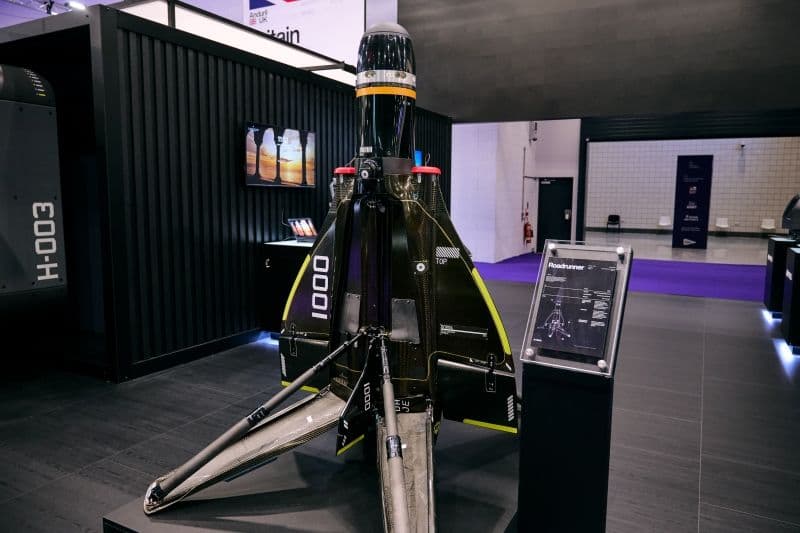
IQT was one of Anduril’s earliest seed investors. Pictured is their interceptor at DSEI UK 2025. (DSEI Gateway)
The ‘leverage’ phase of the process is critical; IQT doesn’t just provide capital but acts as a ‘translator’ between government, entrepreneurs and private investors. “The three ecosystems have very different languages and perspectives that don’t overlap clearly,” Nelson said. “The Venn diagram is pretty small until someone translates and helps build out that viewpoint, and that's what IQT sits in the middle to do.”
A critical part of this translation layer is assessing what work is required to modify or adapt commercial technologies for national security operations and coaching startups in how to navigate the complexities of government contracting.
Nelson noted that successful companies are those willing to “dive into the use case and the problem the customer is trying to solve and how their technology may achieve that… without losing sight of the broader commercial strategy.”
Scaling dual-use startups internationally
From its origins as a US-centric organisation, IQT has expanded into a global platform with offices in the UK and Australia. Today, roughly 15% of IQT’s investments are made outside the US.
The organisation has also evolved beyond its original focus on information technology to include a broad range of frontier technologies, including AI, quantum, cybersecurity, autonomy, biotechnology, space systems and next-generation communications. Increasingly, however, Nelson said the greatest opportunities lie where technologies converge, such as AI.
The challenge now, Nelson said, is not just finding a “point solution”, but understanding how technologies like AI and autonomy can be integrated into broader national capability and resilience strategies “to ensure that governments can actually operationalise them in time to maintain strategic advantage.”
Portfolio successes
To date, IQT has successfully transitioned approximately 500 technologies from its investment portfolio into active government use.
However, Nelson stresses that success is not just measured through tech adoption rates but is also found in increasing government awareness of over-the-horizon innovations. Even if a specific technology is not ultimately adopted, the learnings from the evaluation process and pilot programmes help the government refine its future requirements, she said. IQT’s current adoption rate is around 50% and it has a pilot rate of approximately 70%.

In-Q-Tel was an early backer of Keyhole, a pioneer of interactive 3D earth visualisation that later became Google Earth. (Sgt Devan Gowans/USMC/DVIDS)
IQT’s track record includes its early backing of the mapping company Keyhole, which led directly to Google Earth for public markets; and big data analytics company Palantir, which was recently valued at nearly USD450 billion as of September 2026.
IQT was one of Anduril’s earliest seed investors in 2017, helping connect the startup with US defence and intelligence customers and supporting early pilot programmes. Its backing also helped Anduril scale production and attract further funding.
Internationally, the organisation’s early backing of HEO, Australia’s first non-Earth imaging provider, helped transition the startup from trials into a trusted supplier for allied military intelligence.
Definvest: securing the French industrial base
Where IQT was created as a bridge to the commercial world, Definvest was established to strengthen France’s defence industrial and technological base (DITB). Launched in 2018, Definvest is a specialised equity fund managed by Bpifrance, the country’s public investment bank, in partnership with France’s defence procurement agency (DGA).
Speaking to DSEI Gateway, Nicolas Berdou, director of investments at Definvest, said the fund was created to address a specific market gap: private equity’s historical reluctance to touch the defence sector. “In 2018 private funds were more focused on green tech and were largely unwilling to invest in defence,” he said.
A dual approach
The partnership between Bpifrance and France's DGA is central to the fund’s operation. The DGA acts as a “first filter”, determining if a company’s technology is strategically important enough based on military priority to fall within the fund’s scope. Once a company passes this initial screening, Bpifrance handles the financial analysis and investment.

Definvest has invested in Unseenlabs, a startup which uses radio freuquency geolocation to discover ‘dark vessels’. (Unseenlabs)
According to Berdou, separating financial and defence responsibilities enables each entity to focus on its respective strengths and is fundamental to the fund’s success.
Today, Definvest’s portfolio reflects many of the technologies now shaping future military requirements. AI, cybersecurity, robotics, drones, space, and advanced communications are all priorities alongside more traditional industrial capabilities regarded as essential to maintaining sovereign defence capacity.
Definvest invests across the lifecycle from seed to leveraged buyout but primarily enters at Series A or B due to the requirement for the DGA to deem a company strategic. While designed for all stages, the DGA vetting process makes it difficult to qualify very early-stage startups, except in rare cases with long-standing, pre-existing defence technology backing, Berdou said.
Unlike IQT’s not-for-profit model, Definvest operates strictly under market conditions alongside private funds. “We always co-invest with private partners on the same terms. This rule ensures that we are not viewed as state aid or a market-distorting state actor under European regulations,” he said. “As a result, our financial considerations align almost exactly with everyone else in the marketplace.”
Going the extra mile
However, he notes that unlike purely private venture capital, Definvest can go the extra mile for highly strategic companies to attract long-term capital.
“We have a strategic mandate that allows us to dedicate more effort to a highly critical company," Berdou noted. "A private fund might give up on a company, deciding it is too complex despite its potential. In our case, if the strategic importance is strong enough, we will step up our efforts to derisk the opportunity and pull in private funds.”
For Berdou, the fund’s contribution extends beyond financing. Definvest’s joint backing by Bpifrance and the French defence ministry gives startups a stamp of credibility that would be hard to replicate.
Much like IQT, a key pillar of Definvest’s strategy is dual-use technology. Because the defence market is characterised by long cycles, heavy regulation, and a glass ceiling maintained by established prime contractors, French state policy urges startups to prioritise a primary civilian market, with the defence sector as a secondary growth engine to ensure survival.
Successes and sovereign wins
The sovereign fund measures success by generating positive financial returns to maintain an evergreen, self-sustaining model that proves defence is a profitable market for private co-investors.

Backed by Definvest, Cailabs’ Tilba Optical Ground Station uses laser technology to establish ultra-secure, jam-resistant satellite communications. (Cailabs)
Beyond financial metrics, Berdou said success is driven by securing technological sovereignty – either by injecting capital into high-risk startups that would otherwise collapse, or by actively preventing critical European defence innovations from falling into foreign hands.
Definvest’s track record includes space startup Unseenlabs, which uses nanosatellites for maritime surveillance, and photonics company Cailabs, which specialises in laser communication technologies.
“These are two startups that we remain heavily invested in as they continue to scale. Unseenlabs is now one of the world’s top two providers using space-based RF [radio frequency] geolocation to track maritime traffic and identifying ‘dark vessels’, and Cailabs is the global leader in satellite-to-ground laser communications,” he said.
These milestones underscore the fund’s proven ability to scale deep-tech startups into sovereign industrial players.
Kate
Tringham
Freelance Defence & Security Journalist
Kate Tringham is a freelance defence and security journalist specialising in the maritime domain. She has previously held roles at Janes, where she was the EMEA naval desk lead and former editor of Janes Navy International.