
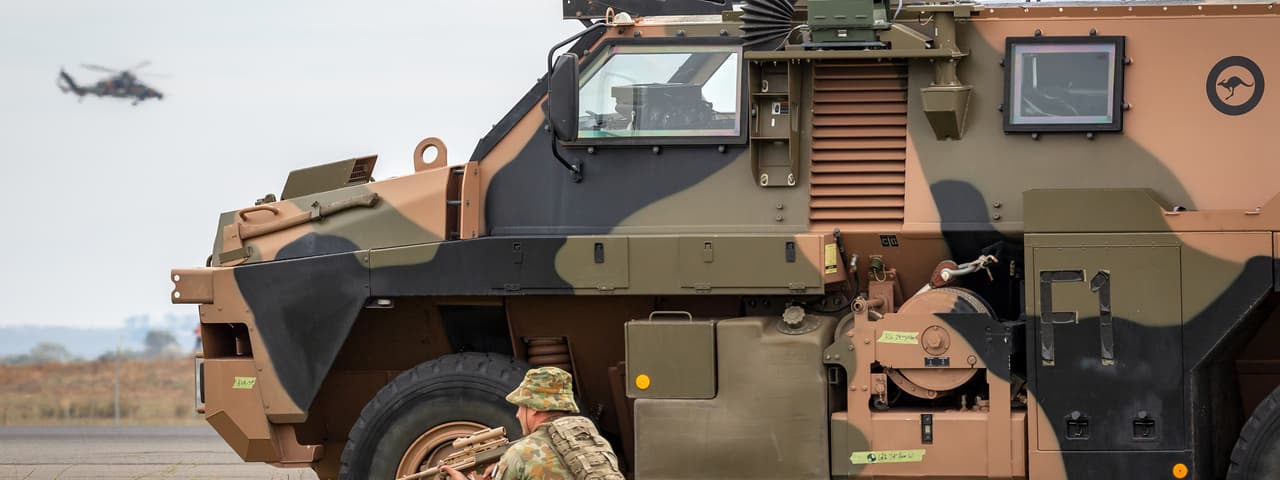
An Australian soldier beside a Bushmaster armoured personnel carrier from Thales Australia. (Ryan Fletcher/ Shutterstock)
Australia releases defence tech priorities for the coming decade
To deliver its defence priorities, Australia will focus on speed over performance.
06 AUG 2026

By
Benjamin
Howe
Defence Journalist, DSEI Gateway
The Australian Government has outlined six priority areas for capability development under its new Defence Innovation, Science and Technology (IS&T) Strategy, which seeks to support the delivery of innovations at speed.
Unveiled on 4 August – during the Australian Defence, Science, Technology and Research summit in Adelaide – the 2026 IS&T Strategy highlights the country’s focuses for the next 10 years. It prioritises:
- AI
- Autonomous systems
- High-energy lasers
- Long-range fires and hypersonic weapons
- Quantum technology
- Undersea warfare
In each of these areas, the Australian Department of Defence (DoD) is looking for systems that "are cost effective to develop and require a minimal logistics footprint to operate".
The six areas differ slightly from Australia’s 2024 IS&T priorities, which included information warfare, listed hypersonics and long-range fires separately, and covered directed energy rather than high-energy lasers. Both AI and undersea warfare are new priorities for the 2026 update.
It comes in the wake of the country’s 2026 Integrated Investment Program, published in April, which committed AUD425 billion (GBP225 billion) over a decade to deliver “accelerated capabilities”.
How will Australia deliver these capabilities?
To accelerate the delivery of these capabilities, the DoD is looking to prioritise speed over performance. As a result, acquisitions will include capabilities that “achieve the lowest acceptable level of the directed effect in the required time”, the strategy says.
This means that scalable, cost-effective prototypes, which can rapidly undergo field-testing and deployment, will be sought in pursuit of a minimum viable capability.
How can industry get involved?
The IS&T Strategy highlights both the country’s Advanced Strategic Capabilities Accelerator (ASCA) and its Defence Trailblazer unit as entry points for industry working on early-stage capabilities in particular.
ASCA is the DoD’s innovation arm, launched in July 2023 to run experiments against defined capability problems, in an effort to rapidly develop technologies.
Meanwhile, the Defence Trailblazer is a University of Adelaide and University of New South Wales research commercialisation programme, funded from 2022 under Australia’s Trailblazer Universities Program, to translate university research into defence capabilities.
Benjamin
Howe
Defence Journalist, DSEI Gateway
Benjamin is a UK-based Journalist working for DSEI Gateway, having previously worked as a Content and Community Manager on Clarion's digital products.