
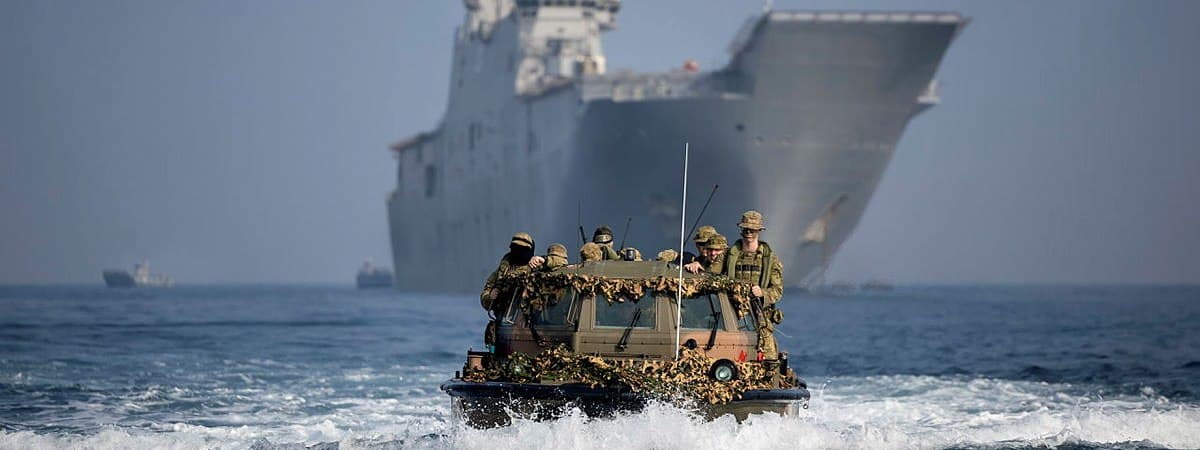
Military personnel on light amphibious craft. (Australian Government)
Australia boosts defence investment by AUD425bn over next decade
The investment will go towards developing resilient capabilities.
21 APR 2026

By
Victoria
Hanscomb
Editor, DSEI Gateway
Australia has released its 2026 defence investment plan, committing AUD425 billion (GBP225 billion) over the coming decade to deliver “accelerated capabilities”.
Released by the government on 16 April, the 2026 Integrated Investment Program outlines that this funding will be spent within 11 key priority areas.
The largest proportion will go towards undersea warfare, set to receive AUD94-130 billion, or 23% of the total funding. A majority of this – AUD71-96 billion – will support the AUKUS partnership, a trilateral agreement between Australia, the UK, and US to deliver nuclear-powered submarines.
To increase the navy’s “lethality”, Australia is also prioritising investment in bolstering its sea denial and “localised sea control operations” capabilities. This is due to receive the second largest share of investment, at AUD62-78 billion. Investment in this area will be channelled into the acquisition of sea mines, capable of being deployed from the air, surface, or undersea and autonomous mine countermeasure systems. This is partly influenced by recent events in the Middle East.
Additionally, the country is investing AUD11-12 billion on building its littoral-based amphibious capabilities.
Overall, Australia is largely prioritising investment into boosting its maritime capabilities, which are due to receive 41% of the total funding.
The other key priority areas are:
- Enhanced and resilient northern bases
- Expeditionary air operations
- Guided weapons and explosive ordnance
- Missile defence, including development of counter-UAS systems and directed energy weapons
- Targeting and long-range strike
- Theatre command and control
- Theatre logistics and health
- Space and cyber
The plan notes that, within these priority areas, “significant investment” will go towards new and emerging technologies, such as the Ocius Bluebottle uncrewed surface vessel.
Other innovations include low-cost robotic and autonomous systems, hypersonic missile technology, and tactical electronic warfare capabilities.
The Advanced Strategic Capabilities Accelerator, which helps to translate defence tech into readiness, will receive up to AUD4 billion of investment to support this goal.
Additionally, the establishment of a new Defence Delivery Agency in July 2027, announced in December, will help to “drive better budget management, cost estimation, and project assurance”.
Supporting national defence
The Integrated Investment Program supports the objectives set out in the 2026 National Defence Strategy – also released on 16 April.
The strategy notes that Australia is currently in a “dangerous and unpredictable era”, requiring the country to strengthen its resilience.
Part of this means prioritising acquisition and sustainment plans that reflect lessons learned from Ukraine and the Middle East. In particular, the strategy notes the advantages gained from rapid innovation cycles as seen over the course of the Ukraine conflict.
To help achieve these goals, the strategy added, the defence industry will receive a AUD53 billion boost in funding until 2036. This will go towards the capability objectives set out in the investment plan and is on top of an additional AUD65 billion announced in the 2024 National Defence Strategy.
As a result, Australian spending on defence is set to reach 3% of the country’s GDP by 2033.
Victoria
Hanscomb
Editor, DSEI Gateway
Victoria Hanscomb is an Editor at DSEI Gateway, reporting on the defence industry. Her previous experiences as an Editor include covering the international security market and pharmaceutical sector.