
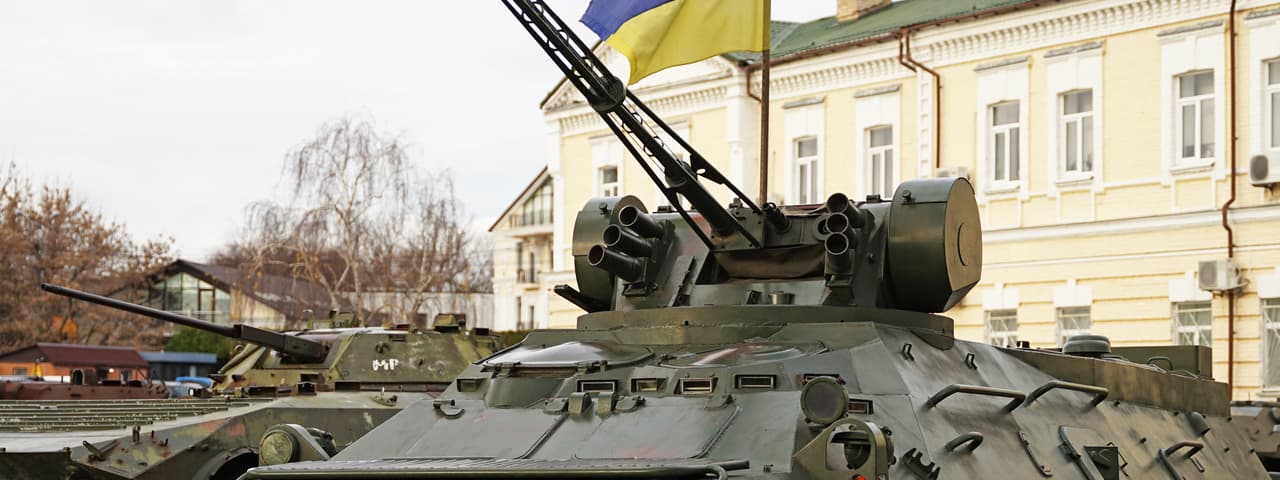
A Ukrainian BTR-3 4x4 armoured personnel carrier. (Shutterstock)
Conventional capabilities "still needed" says Ukrainian military
DSEI Gateway reports from Apex Europe in London.
14 OCT 2026

By
Benjamin
Howe
Defence Journalist, DSEI Gateway
Representatives of the Ukrainian armed forces have reiterated the importance of conventional military capabilities, in an effort to dispel suggestions that emerging disruptive technologies have made them irrelevant.
The officials – speaking during the Apex Europe conference in London on 8 October – made clear that artillery, armoured personnel carriers (APCs), and other traditional capabilities are “still needed”, if not in exactly the same way as in previous conflicts.
Since the full-scale Ukrainian conflict, some critics have argued that conventional weapons, such as main battle tanks, could become obsolete in the face of new emerging technologies such as uncrewed systems.
Dispelling the myth
One speaker, from a Ukrainian think tank, added that this perception is an over-generalisation, with many conventional capabilities enduring, despite some notable exceptions.
They explained that: “In the beginning of the full-scale invasion [people came to understand] that one USD500 [drone] can destroy a USD3 million tank, and I think that was true in very specific cases. But the reality is that it's actually not one to one anymore.”
This is because there are now more physical and electronic warfare countermeasures that can augment and protect conventional platforms, allowing them to remain of use, they said.
In turn, it now takes “more than 10, maybe more than 15, direct first-person view drone hits to disable a tank”, they added.
Which conventional military capabilities endure?
The Ukrainian military officials continued by highlighting which conventional capabilities remain vital in conflict. These include:
- APCs
- Long-range artillery and large calibre mortars
- Missiles
- Rockets
They explained that “no war can be won without having boots on the ground”, meaning that there will always be a requirement for the safe transport of troops, such as via APCs.
The difference, however, is that these vehicles are now required to be fitted with new forms of counter-drone technology, to help them survive attacks.
In another example, they highlighted the advantages of long-range artillery over drones. An “artillery shell will arrive at the target within a matter of seconds to a minute. A drone will require 15 minutes to half an hour”.
As a result, “depending on where you deploy to get to the target, and a lot of things could change” within that time, one of the military officials explained.
Which capabilities are obsolete?
When it comes to equipment that has become less useful, the Ukrainian military representatives said systems that rely on GPS technology are too vulnerable for the modern battlefield.
In addition, small calibre mortars “have become obsolete, and will likely never come back,” they added. This is due to the greater effectiveness of drones over short ranges, where less of an emphasis on speed is required.
Meanwhile, the speakers went on to note how Ukraine – which possesses no conventional navy – has managed to sink several Russian warships and force Russia’s navy to retreat, using just uncrewed capabilities and land-based missiles.
As a result, the naval domain stands out as one area where Ukraine has clearly not been disadvantaged by its lack of conventional naval forces.
Benjamin
Howe
Defence Journalist, DSEI Gateway
Benjamin is a UK-based Journalist working for DSEI Gateway, having previously worked as a Content and Community Manager on Clarion's digital products.