
News · Naval · Europe
German SMEs win European navy contract to develop USV
The submarine-launched USV is intended for intelligence and surveillance missions.

News · Naval · Europe
Germany-based SMEs Gabler and Flanq are continuing development of their novel Ranger torpedo tube-launched uncrewed surface vessel (USV), under a contract signed with an undisclosed European navy.
Speaking to DSEI Gateway at Euronaval, which took place on 3-6 November in Paris, France, Michael Rudat, Senior Sales Manager at Gabler, confirmed that the companies secured the contract in June, marking a new phase in a programme that was previously self-funded.
Ranger is a reusable platform designed for covert intelligence, surveillance, and reconnaissance (ISR) missions.
Rudat said the contract provides for a phased approach to development of Ranger. Initial work is focused on revising parts of the design with the customer and verifying the full launch sequence. The next step will be to define and integrate additional mission-specific modules.
Programme background
Gabler and Flanq first announced their partnership to co-develop a new class of submarine-launched USV in August 2025.
Alongside Ranger, the family includes Raider, a proposed one-way tactical variant intended to carry a customer-supplied effector.
Rudat said the concept originated from discussions between the companies' leadership about combining Gabler's submarine expertise with Flanq’s experience in autonomous surface vehicles.
Under the partnership, Flanq designed and built the prototype and is responsible for autonomy mission software and payload integration. Gabler leads system integration, commercialisation, and integration with host submarines.
Design and performance
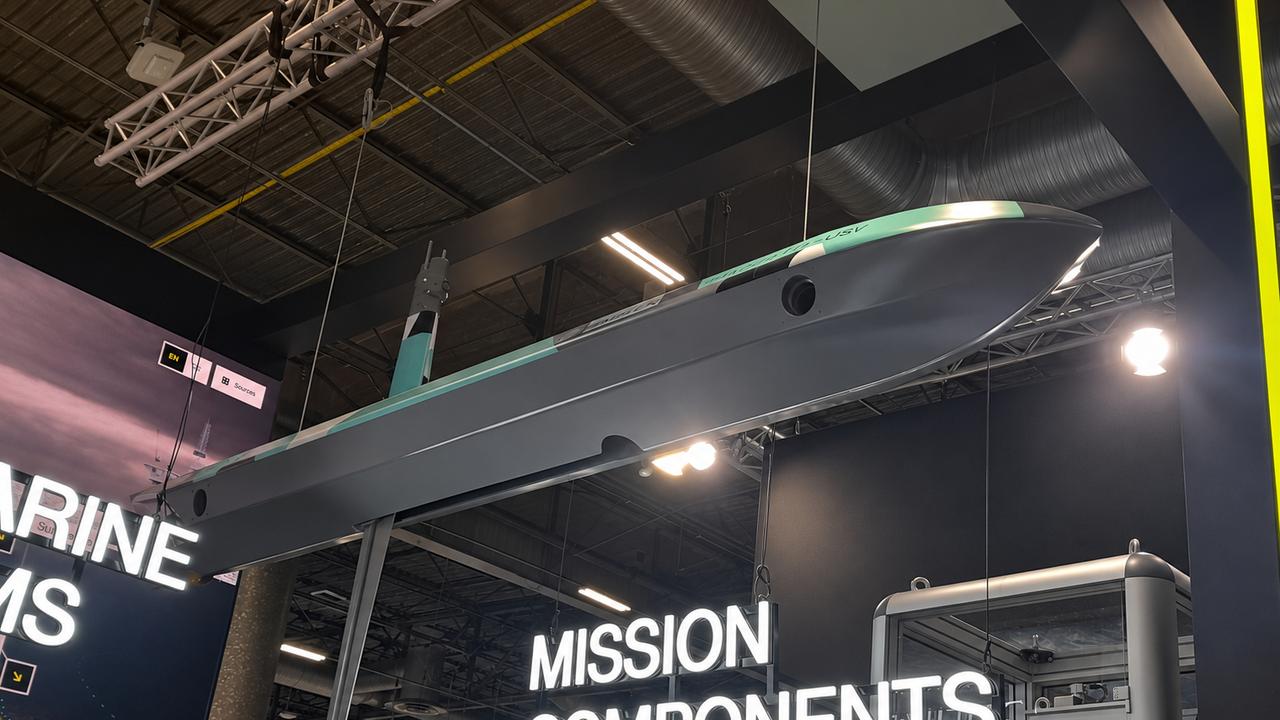
Ranger is designed to be deployed from a standard 533mm submarine torpedo tube while the host submarine remains submerged. Following launch, the vehicle ascends to the surface and deploys a folding sensor mast and keel.
The prototype is approximately 4.5m long, with a diameter of 53cm and a weight of around 100-150kg, depending on payload. Its hull is rated to a depth of 300m.
Unlike a conventional surface vessel, Ranger features a hybrid hull form that is neither a traditional boat shape nor a cylindrical torpedo. It is designed to operate at or just below the surface, with only its sensor mast, which measures less than 1m, exposed.
Rudat said achieving the correct stability and trim had been one of the challenges during initial development, requiring careful distribution of weight and buoyancy to maintain the vehicle's position in the water.
The demonstrator is currently fitted with forward- and aft-facing 120° cameras and antennas for line-of-sight communications. It can be remotely controlled or programmed to navigate autonomously between waypoints.
The existing electric propulsion arrangement uses small thrusters, delivering a speed of approximately 3-5kt and an endurance of around 10 hours at 3kt.
Rudat said the propulsion arrangement is being revised to improve performance, and that speed and endurance will depend on future battery and motor configurations.
Potential future sensor payloads include 360° cameras, low-light or infrared cameras, and electronic intelligence equipment.
The design also offers scope for additional mission modules. Rudat said standard torpedo tubes on NATO submarines are typically 8-9m long, so the vehicle could be lengthened by about a third.
Submarine integration
A key requirement of the programme is for Ranger to be compatible with existing submarine weapon handling and launch systems, avoiding the need for modifications to host platforms.
To achieve this, the vehicle is housed in a launch capsule and dedicated cables carry communications to it while it is in the tube.
The companies are currently working with their naval customer to refine the design and verify the sequence of operations involved in loading, handling, and launching the vehicle.
Operational applications and next steps
Rudat highlighted confined littoral environments such as the Baltic Sea and fjords as potential operating areas. Rather than entering such waters or raising its own masts, a submarine could deploy Ranger from a stand-off position and use the USV to monitor activity further afield.
He added that the USV’s endurance was a significant advantage over small tube-launched UAVs, which typically have much shorter operating hours.
Other potential applications could include electronic intelligence collection and communications relay functions, enabling the USV to act as a gateway between the submarine and other assets.
Rudat said the exact mission configurations have yet to be finalised and will form part of the next stages of development with the naval customer. The companies also envisage a subsequent certification process, which Rudat said could take up to a year.
Although no firm date for operational availability has been disclosed, Rudat emphasised that the companies are seeking to accelerate development in response to current naval requirements.
"We don't want to give this technology to the market in five years, we want it to be faster," he said.
A full-scale model of Ranger was displayed at Euronaval, where the project also received a Euronaval Innovation Award in the 'Engage – Operational Superiority' category.