
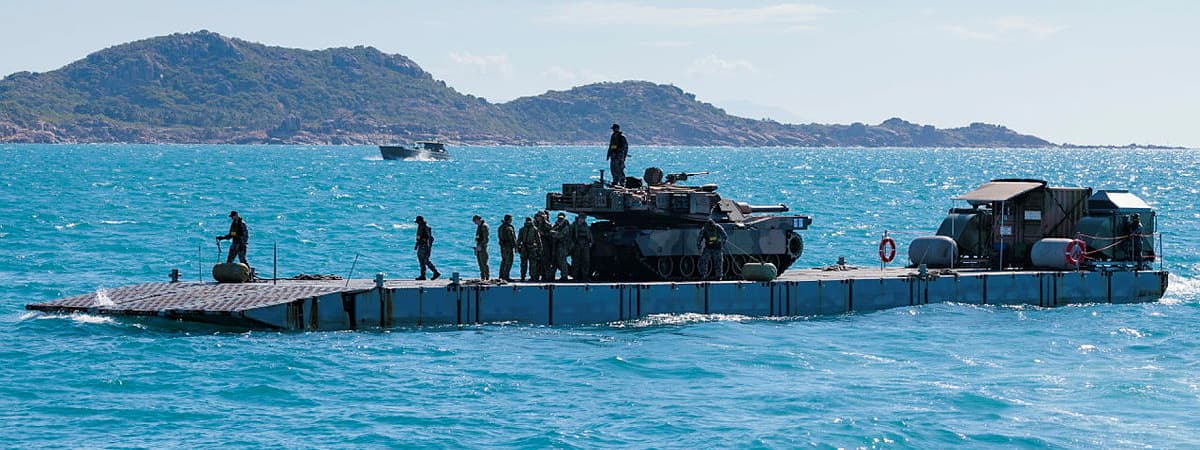
An Australian Army Mexeflote littoral-supportive platform carrying a M1A1 Abrams tank. (Commonwealth of Australia, Department of Defence 2023)
Australia issues RFI for littoral-supportive platforms
The country is seeking information on platforms that could be used in conjunction with its future landing craft capabilities.
11 AUG 2026

By
Victoria
Hanscomb
Editor, DSEI Gateway
Australia has launched a request for information (RFI) on platforms that can aid in the transfer of personnel, vehicles, and cargo between landing craft and shorelines, to enhance its littoral operations.
According to the RFI, published on the AusTender procurement platform on 10 August, the country's defence department is specifically seeking information on platforms that could support its future landing craft capabilities, which are due to be supplied by Australian defence company Austal.
A contract, awarded to Austal by Australia in February, will see the company provide eight 100m ‘Landing Craft Heavy’ vessels, with the final landing craft scheduled for delivery in 2038.
However, the Australian Department of Defence says that the ability of the Landing Craft Heavy vessels to approach shorelines may be limited by beach gradients, hull design, seabed conditions, surf zones, and vessel draught, among other factors.
Therefore, the country is seeking information on platforms that could bridge the potential gap between the vessels and shorelines.
The RFI comes against the backdrop of Australia’s wider efforts to strengthen its littoral capabilities. In its 2026 Integrated Investment Program, released in April, the country announced that it will invest AUD11-12 billion (GBP5.7-6.2 billion) over the next decade into delivering capabilities in this area.
What littoral capabilities does Australia require?
According to Australia's defence department, platforms submitted in the RFI must be capable of being transported, deployed, launched, operated, and recovered by the future Landing Craft Heavy vessels.
Responses can include littoral-supportive platforms that currently exist or are under development. These may range from bottom stabilised or supported platforms, bridging systems, causeways, floating piers, ramps, vehicles, vessels, or other concepts.
The defence department says that the littoral-supportive platforms should additionally be “adaptable” to shallow beach gradients, surf zones, and a variety of environmental and seabed conditions.
All responses to the RFI must be at a technology readiness level of two or above.
The deadline to respond to the RFI is 30 September.
Victoria
Hanscomb
Editor, DSEI Gateway
Victoria Hanscomb is an Editor at DSEI Gateway, reporting on the defence industry. Her previous experiences as an Editor include covering the international security market and pharmaceutical sector.