
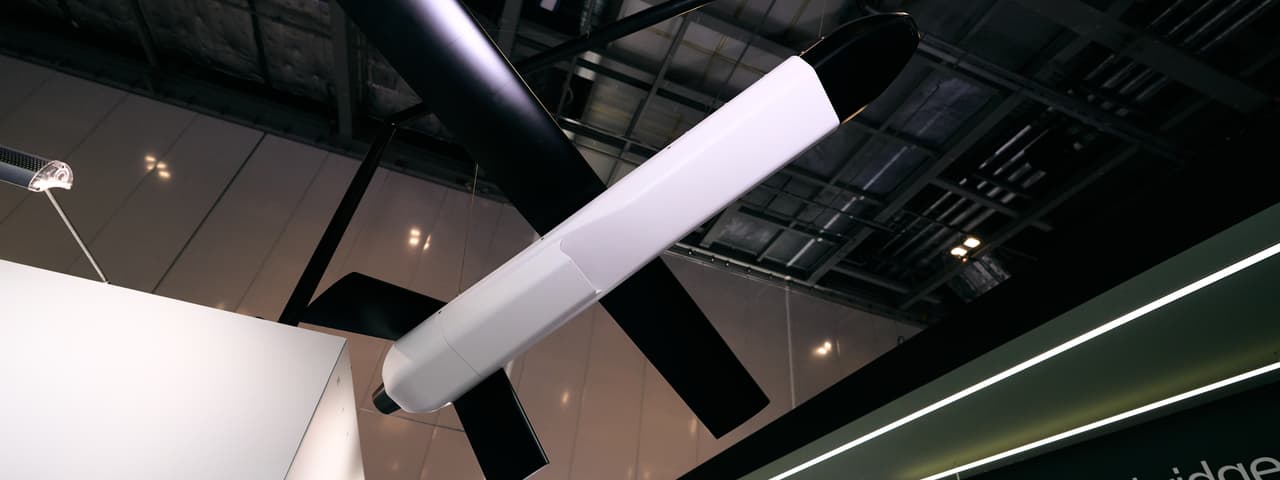
A Cambridge Aerospace Skyhammer drone interceptor. (DSEI Gateway)
UK awards GBP3.16m drone interceptor contracts to three SMEs
The contracts are part of a wider five‑nation European effort to counter large‑scale drone and missile threats.
15 JUL 2026

By
Tom
Barlow-Brown
Defence Journalist, DSEI Gateway
The UK Ministry of Defence (MoD) has awarded contracts collectively worth GBP3.16 million to three SMEs, for the supply of interceptors to counter large-scale drone and missile threats.
Announced by the MoD on 13 July, the contracts with UK-based SMEs Frankenberg Technologies, Greenjets, and Cambridge Aerospace, fall under the country’s Low‑Cost Air Defence Effectors (LCADE) programme.
LCADE is being delivered by the National Armaments Director (NAD) Group. Commercial X, a NAD Group team with the goal to reduce barriers for smaller companies in defence procurement will deliver the contracts with each SME.
As part of the new contracts, the three SMEs will now develop and trial their interceptor designs, which the MoD says will support jobs in Cambridge, Milton Keynes, Bristol, and Stevenage.
The LCADE programme is the UK's contribution to a wider European initiative, known as the Low-Cost Effectors and Autonomous Platforms (LEAP) programme. LEAP was launched by France, Germany, Italy, Poland, and the UK in February.
The UK is the first of these five countries to deliver contracts under the initiative.
European air-defence cooperation
The LEAP joint programme aims to develop advanced low-cost air defence systems, such as autonomous drones or missiles, with the goal of delivering its first project by 2027.
A further goal of the programme is to stimulate growth across the European defence industry, by enhancing collaboration between the participating nations.
"Through the LEAP programme, we are joining forces across borders to rapidly procure new systems, supporting both the UK and our allies against the growing mass drone threat."
National Armaments Director Rupert Pearce
Following national procurement competitions in each country, the next phase of the LEAP programme will focus on identifying solutions that can be produced in large numbers across the five participating nations.
Tom
Barlow-Brown
Defence Journalist, DSEI Gateway
Tom Barlow-Brown is a Defence Journalist for DSEI Gateway. Previously he worked as a reporter in the maritime sector covering developments in energy and tech.