
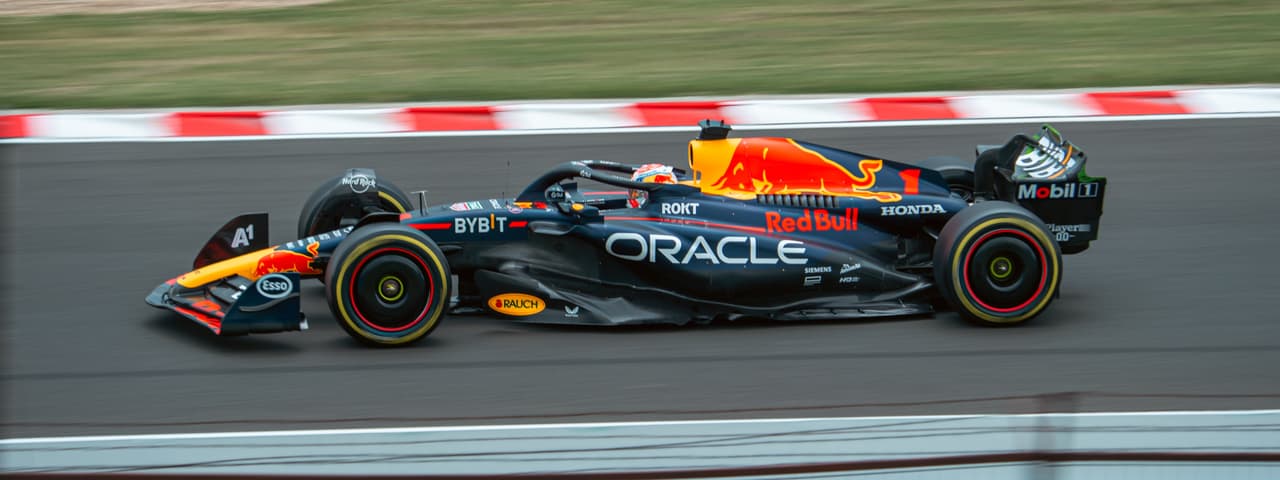
Formula 1 car. (Pixabay)
Fast-tracking progress: should defence embrace a Formula 1 mindset?
DSEI Gateway hears from industry about how the rapid iteration culture of Formula 1 could accelerate innovation and military readiness.
15 JUL 2026

By
Victoria
Hanscomb
Editor, DSEI Gateway
Maintaining an edge on the modern battlefield demands constant innovation.
Ukraine has demonstrated that rapid iteration cycles are now essential, with technologies such as drones evolving in weeks and months rather than years.
However, many militaries do not operate under this principle – despite the mounting pressure to do so.
By contrast, Formula 1 (F1) – the highest class of motorsport globally – sees swift technological evolution, driven by data. Teams can design, simulate, and integrate an upgrade into a car within a matter of weeks.
So, what could defence learn from the F1 style of technological development and how could this help militaries gain a strategic advantage? DSEI Gateway speaks with experts about the F1 process and culture that could be translated into defence.
Does defence leverage iterative development?
Ukraine’s “agile integration model” has been successful at rapidly testing and deploying capabilities, the Royal United Services Institute think tank says. By working with frontline operators, developers create a short feedback loop that enables the enhancement and redeployment of technologies in a matter of weeks.
The efficacy of Ukraine’s model has catalysed countries to try to embrace the concept of iterative development. One of the objectives in NATO’s 2025 Rapid Adoption Action Plan, which sets out how to accelerate the delivery of defence capabilities, calls for “continuous, iterative co-development and testing” of systems.
In June 2026 speech, Andrius Kubilius, European Commissioner for Defence and Space, also emphasised that Ukraine’s system should be adopted throughout Europe. He explained that this would mean making “good enough” defence capabilities that “get the job done”, rather than focusing on technologically advanced equipment that takes years to develop.
Equipment could instead be iterated and advanced throughout its lifecycle, similar to F1 development, rather than having long, multi-year procurement programmes that delay capabilities from reaching the warfighter.
However, Gary Waterfall, Senior Defence Advisor at PurpleSector, an F1 engineering-led consultancy, and the former Chief of Staff (Operations) for the Permanent Joint Headquarters of the Royal Air Force, told DSEI Gateway that the UK currently works with a strict risk tolerance that is counterproductive to progress.
“We think about making sure a capability can work even on the worst, rainiest day, as opposed to accepting some risk to get systems to our militaries that are more cost-effective, cheaper, and quicker,” Waterfall said.
With many other countries in a similar position to the UK, the practicality of incrementally improving capabilities means accepting a higher tolerance for failure – a concept embraced across F1.
The speed of racing
In F1, racing teams design and iterate technology continuously, and at a rapid pace. A 2023 policy paper from the UK Government on the country’s innovation strategy notes that the frequency with which the McLaren F1 team makes engineering changes to its cars is every 20 minutes on average.
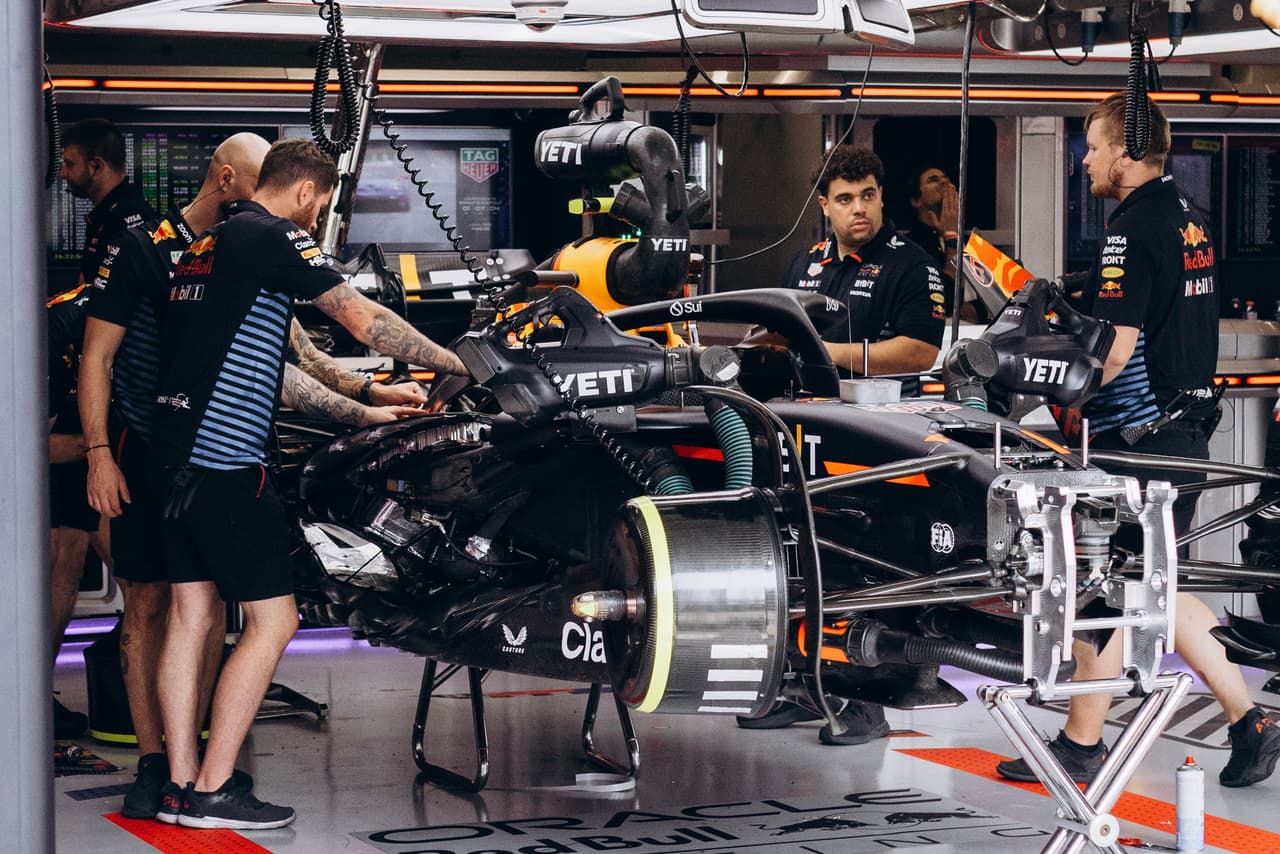
F1 mechanics working on a car in a garage. (Pexels)
Cars are continually improved throughout the racing season and key to this is the use of digital twins, essentially a virtual replica of platform or system. “Before a car even reaches a track, AI and simulated environments are combined through digital twins with real-world testing to enable data-driven engineering changes,” the paper says.
Mark Mathieson, CEO and founder of PurpleSector, told DSEI Gateway that the data collected from digital twins and testing is essential for technological progress.
He added that by empowering the people who have access to the most data, rather than simply the most senior, no context is lost when a decision is made.
“That constant check allows you to adjust your course of action as needed,” he said, enabling the consistent upgrading of technology on the car.
Implementing lessons into defence
While F1 actively promotes this idea of iterative technology development, the defence sector lags behind.
A June 2026 Industry and Regulators Committee meeting saw Kevin Craven, CEO of UK aerospace and defence trade association ADS, provide evidence on the relationship between the government and defence industry. In the meeting, Craven noted that for defence companies producing more complex capabilities, there needs to be a “form of commercial wrapper that allows both failure and iteration over time.”
While F1 principles may not be commonly seen in defence, other sectors have been able to apply rapid engineering and iterative tests, demonstrating the feasibility of how these could be adopted.

Penlon ‘ESO 2’ Emergency Ventilator. (Penlon)
One example in particular comes from Mathieson, who was tasked by the Cabinet Office during COVID-19 to provide ventilators that addressed a shortfall in the UK. By using F1 principles, his team adapted a prototype ventilator into a new design, rapidly reengineering around 55% of the system, before beginning full-scale production within a four-week timescale. This, Mathieson says, serves as a case study of how the F1 model could be applied to other sectors, including defence.
However, Waterfall argued that, for defence to embrace this data-driven mindset, a cultural transformation is required. Sometimes, he said, leadership bias can influence decisions, but data needs to become the priority.
Although a widespread shift in culture towards iterative development could help to accelerate the delivery of advanced technologies, this change will not happen overnight. In the meantime, there are other ways in which the motorsport sector can directly benefit defence.
Uniting motorsport and defence
One organisation helping to translate F1 engineering principles into defence is the UK’s Motorsport Industry Association (MIA), a trade organisation for the motorsport and high-performance engineering sectors.
Helen Jones, Head of Operations at the MIA, told DSEI Gateway that by facilitating conversations between the motorsport industry and defence, “expertise, technologies, and innovation” can be exchanged.
Specifically, a Motorsport to Defence initiative run by the MIA enables these conversations. Nick Wills, Defence Development Director at the MIA added that this programme is a “conduit”, allowing defence companies to understand how they can leverage the agility and technical expertise that comes from motorsports.
Jones said that through the Motorsport to Defence initiative and in-person events run by the MIA, the two sectors can connect, which can be a catalyst for partnerships and innovation.
Original equipment manufacturers and mid-tier businesses should also be “more open” about opportunities for partnerships when working on defence projects, Wills said, so that motorsport companies can more easily enter the market.
Bridging the gap
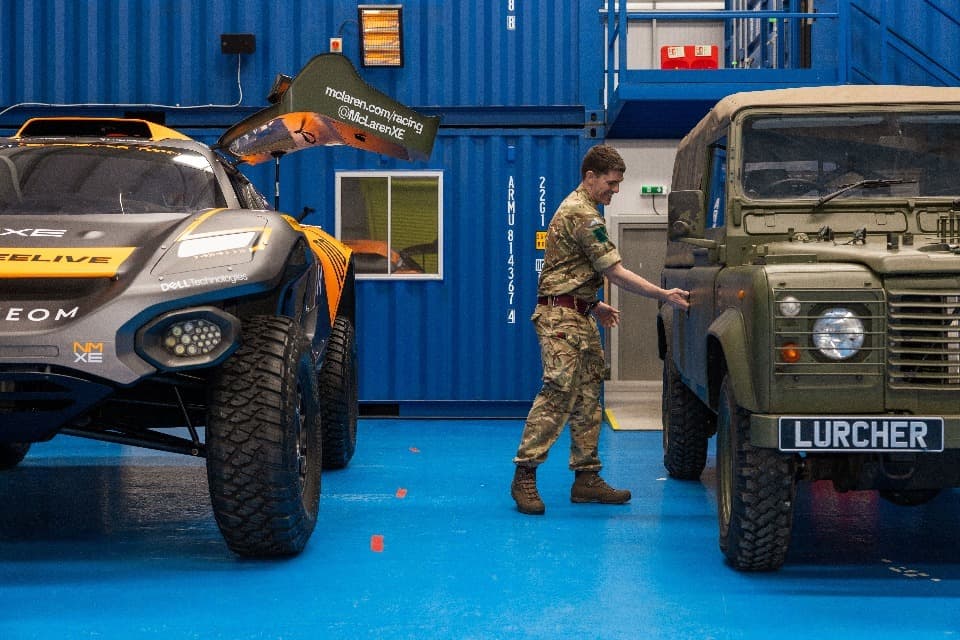
The ‘Neom’ McLaren Extreme E race car and a British Army land rover with an electric engine. (MoD Crown Copyright 2024)
A partnership announced in 2024 between the UK Ministry of Defence (MoD) and McLaren Racing’s Accelerator team illustrates how these two sectors could collaborate. The aim, according to Corporal Bryan Munce of the British Army’s Armoured Trials and Development Unit, was for the project to create a digital twin of the vehicles to expedite the development process.
While DSEI Gateway understands that this project was shelved by former UK Defence Secretary John Healy, it serves as a proof-of-concept that data-driven and agile engineering expertise can be transferred from motorsports into defence.
What can defence learn from F1?
While the F1 principles of data-driven decisions and iterative development have yet to be broadly embraced by defence, the value of these concepts is growing throughout the sector.
“We've proven the impact of applying F1 principles outside of F1,” Mathieson said. “It would be a mistake not to pivot that into defence.”
Victoria
Hanscomb
Editor, DSEI Gateway
Victoria Hanscomb is an Editor at DSEI Gateway, reporting on the defence industry. Her previous experiences as an Editor include covering the international security market and pharmaceutical sector.