
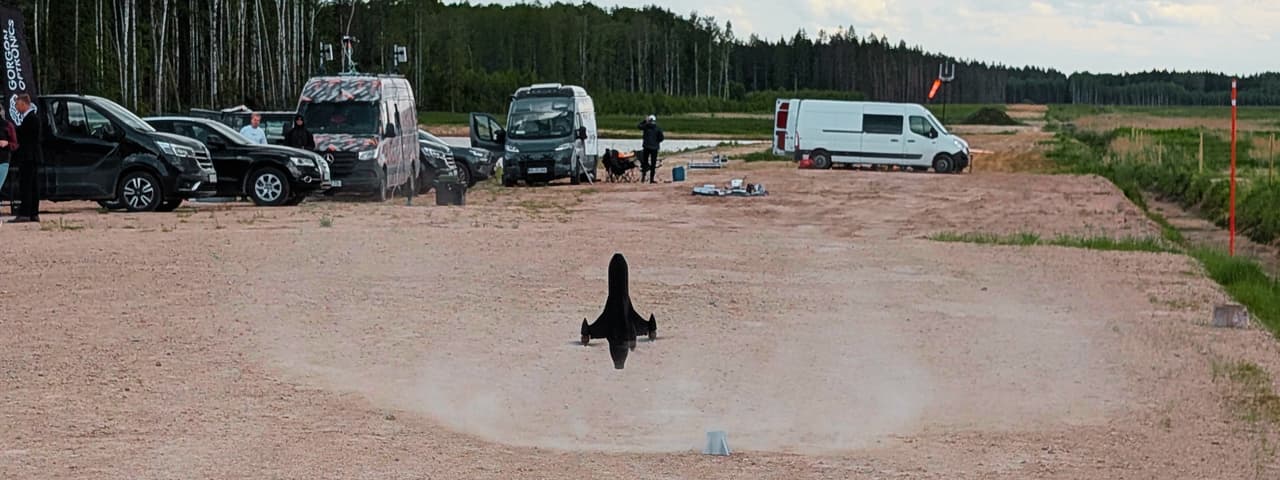
The Raven interceptor counter-drone system from company RDC at NATO's drone trial in May 2026. (DSEI Gateway)
NATO launches C-UAS Data Challenge
The competition is looking for AI-based sensor fusion technologies that improve drone detection and tracking.
14 SEP 2026

By
Olivia
Savage
Editor in Chief, DSEI Gateway
NATO is launching a new ‘Data Challenge’ to identify novel “AI-based solutions” that can fuse data from counter-UAS (C-UAS) sensors into a single coherent air picture.
Published on 9 September, the challenge aims to improve drone detection, including tracking and classification, and is being run by NATO's Communications and Information Agency together with NATO's Defence Industry, Innovation and Armaments Division.
It follows a series of high-profile drone incursions into NATO’s eastern flank this year, including in Estonia, Latvia, Poland, and Romania.
Detecting small drones remains one of the toughest aspects of countering the aerial threat.
Speaking to DSEI Gateway in Latvia in May during a NATO uncrewed drone trial, Major Modris Kairišs, head of Latvia’s Autonomous Systems Competence Centre, said small drones are a “real problem” that are difficult to detect and capable of significantly disrupting both military operations and civil society, adding that they are the greatest uncrewed threat facing Europe’s eastern flank.
What are the challenge’s requirements?
The C-UAS challenge specifically seeks novel technologies that can fuse data from radar, radio-frequency detectors, cameras and acoustic systems, while also eliminating duplicate tracks and classifying detected objects as friendly, hostile or unknown.
NATO will provide participants with curated and anonymised datasets derived from NATO exercises.
Industry and universities are encouraged to submit their proposals by 21 December, with the winners announced in February. A total of EUR100,000 is earmarked for the challenge, which will be distributed to the top three winners.
The Data Challenge forms the latest strand of NATO innovation efforts to accelerate C-UAS capability delivery across the alliance.
Olivia
Savage
Editor in Chief, DSEI Gateway
Olivia Savage is the Editor in Chief of Clarion Defence & Security, organisers of DSEI and other defence events. Previously, she was a Senior Defence Journalist at Janes, specialising in electronic warfare, uncrewed systems, and space.