
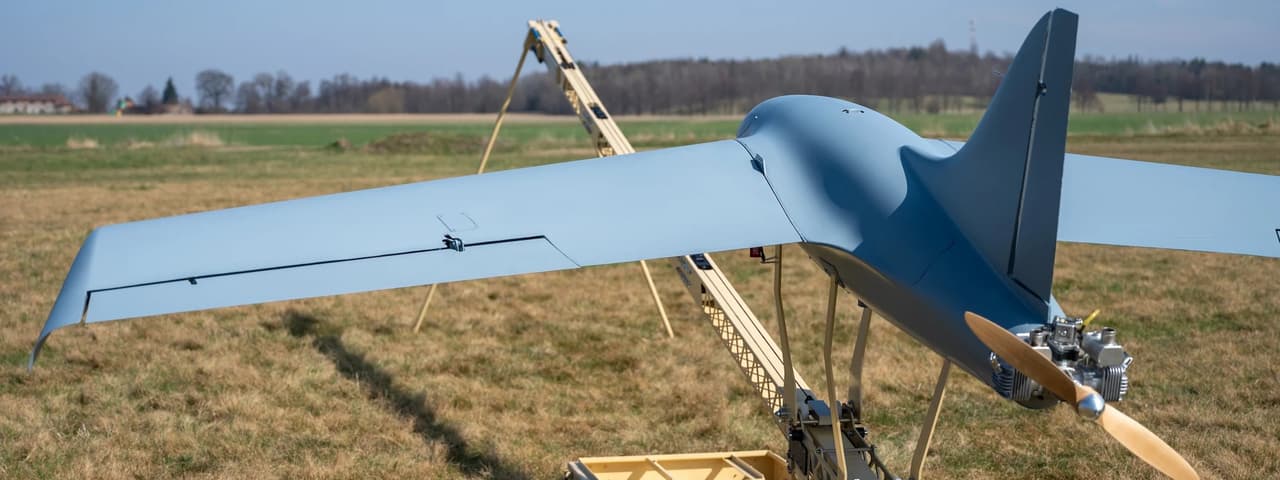
LPP Holding’s ‘MTS’ UAV strike system. (LPP Holding)
NATO reveals persistent airfield denial challenge winners
The winning team presented a long-range uncrewed strike system.
15 SEP 2026

By
Victoria
Hanscomb
Editor, DSEI Gateway
NATO has named the winning teams of a challenge that sought capabilities to prevent, disrupt, and complicate the ability of an adversary to generate and sustain air operations.
Announced by NATO on 4 September, LPP Holding, a defence technology group from the Czech Republic, was selected as the winner among nine other challenge finalists.
Polish SME Supercluster and an unnamed Ukrainian company were respectively selected for second and third place.
Participants in the Persistent Airfield Denial challenge were specifically asked to create effects that strike multiple airfield targets, such as runways, fuel, maintenance, munitions, ground support, and other infrastructure. This combined approach aims to make adversary airfield recovery significantly slower and more costly.
While the challenge was technology-agnostic, submitted capabilities were required to work in contested environments.
Which capabilities won the challenge?
MTS, the winning capability of the Persistent Airfield Denial challenge from LPP Holding, is an autonomous long-range uncrewed strike system. Combining autonomy and alternative navigation, NATO says that the system is intended to support “scalable precision effects” against airfields.
Meanwhile, Supercluster’s ‘StratoAIM’ capability presented under the challenge utilises high-altitude balloons to deploy autonomous gliding systems for long-range airfield denial.
The unnamed Ukrainian company presented an AI-based autonomy system for uncrewed aircraft operating in contested environments. NATO says that the system has a focus on resilient navigation, target recognition, and integration across platforms.
The alliance highlights that the winning teams may go on to receive and enter development, experimentation, and testing within the wider ecosystem of NATO’s Allied Command Transformation (ACT).
The capabilities from other finalists submitted in the challenge included collective swarm behaviour and distributed decision-making, while others focused on automated mission planning and coordination among platforms.
Operational effect
According to NATO, Ukrainian expertise was used to help define the challenge, assess proposals, and identify the conditions systems would face in contested environments. This was intended to provide participants with “a specific operational problem to solve rather than a broad request for new technology”.
Proposals were assessed on affordability, scalability, resilience, and how rapidly deployable they may to be.
“What distinguished the strongest options was not novelty alone, but their ability to deliver the required operational effect under realistic battlefield conditions,” Matej Machacek, ACT Force Lethality Enhancement Analyst and challenge judge, said.
“The judges looked for resilient and scalable approaches with a credible path from demonstration to rapid fielding.”
Victoria
Hanscomb
Editor, DSEI Gateway
Victoria Hanscomb is an Editor at DSEI Gateway, reporting on the defence industry. Her previous experiences as an Editor include covering the international security market and pharmaceutical sector.