
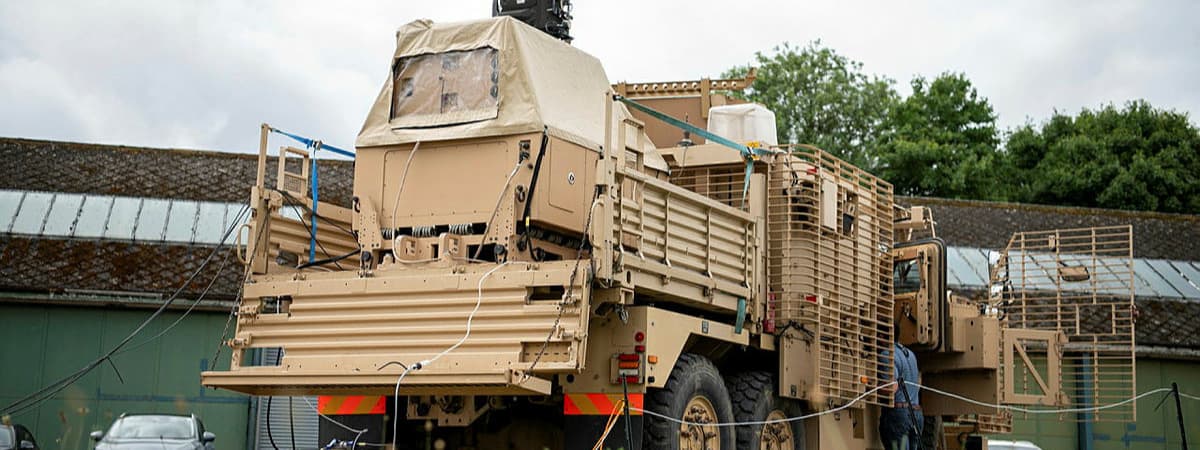
A vehicle mounted laser directed energy weapon during counter-UAS testing in 2024. (UK MOD © Crown copyright 2024)
UK seeks vehicle-mounted counter-drone system
Laser directed energy weapons are of particular interest.
07 SEP 2026

By
Tom
Barlow-Brown
Defence Journalist, DSEI Gateway
The UK has launched a new competition for the supply of vehicle-mounted counter-drone systems to protect deployed forces and defence infrastructure.
The competition, known as ‘Project Panoptes’, was launched by UK Defence Innovation (UKDI) – part of the UK Ministry of Defence – on 2 September. It is calling for autonomous systems that can detect, track, identify, and defeat mass and low-cost threats, without being “overwhelmed or exhausting stockpiles”.
Specifically, the systems would be used to counter Class 1 UASs, defined by NATO as drones under 150kg, and other small aerial threats.
UKDI adds that the systems should be built using open architectures, platform-generated power, and modular designs. Integration into future uncrewed ground vehicles is also a “planned objective” for the systems.
Of particular interest to UKDI are capabilities centred on laser directed energy weapon effectors, although the organisation says it remains open to "credible alternative novel approaches".
Core project requirements
Key requirements for the systems include the ability to intercept drones at a minimum distance of 500m, although a range of 1km is preferred.
A complete system, including payload, must weigh no more than 1,200kg and fit within the footprint of a standard NATO air pallet. It also must draw no more than 150kw of power from the host platform at its peak.
Future pathways
Project Panoptes is divided into multiple phases, with the first intending to provide UKDI with an “evidence-based” plan for the eventual delivery of a complete capability. Later phases will involve further work to mature the proposed systems into deployable equipment.
Under the first phase, a share of up to GBP5 million is available immediately to successful applicants, with UKDI anticipating the award of multiple contracts.
Bidders must be registered in the UK, although do not need to be UK-owned. Initial applicants are asked to provide a brief technology review and outline proposal.
Submissions close on 23 September. Contracts are expected to start in November or December, subject to change, and run for no more than six months.
Tom
Barlow-Brown
Defence Journalist, DSEI Gateway
Tom Barlow-Brown is a Defence Journalist for DSEI Gateway. Previously he worked as a reporter in the maritime sector covering developments in energy and tech.