
(NATO)
Exclusive: NATO to procure new capabilities to counter uncrewed maritime threat
The procurement programme will adopt a challenge-based approach.
02 MAR 2026

By
Olivia
Savage
Editor in Chief, Clarion Defence & Security
NATO members are planning on procuring new off-the-shelf capabilities to counter the pervasive threat from maritime uncrewed systems, DSEI Gateway has learnt.
The procurement will be based around an operational challenge led by NATO, enabling members to rapidly identify, test, and procure relevant industry capabilities, rather than pursuing a multi-year development programme, Rear Admiral Paul Flos, the Chairman of NATO’s Naval Armaments Group (NNAG), told DSEI Gateway.
The initiative directly follows a NNAG meeting held at the end of last year, which concluded that countering uncrewed systems was their top priority, he said.
Why now?
Conflicts in the Black and Red Sea have highlighted the pervasive threat uncrewed systems – both in the air and on the sea – can pose to naval forces. Ukraine, in particular, has demonstrated this, having successfully countered Russia’s entire Black Sea Fleet through its deployment of uncrewed surface vessels (USVs).
These operations are key reasons why the procurement programme is being launched, the rear admiral acknowledged, which is being led by Canada. Italy, the Netherlands, and the UK are some of the other countries involved.
The UK recently held a naval counter-uncrewed systems trial – exercise Sharpshooter – in February with the Type 45 air-defence destroyer HMS Dauntless, where it faced attacks from surface and aerial drones.
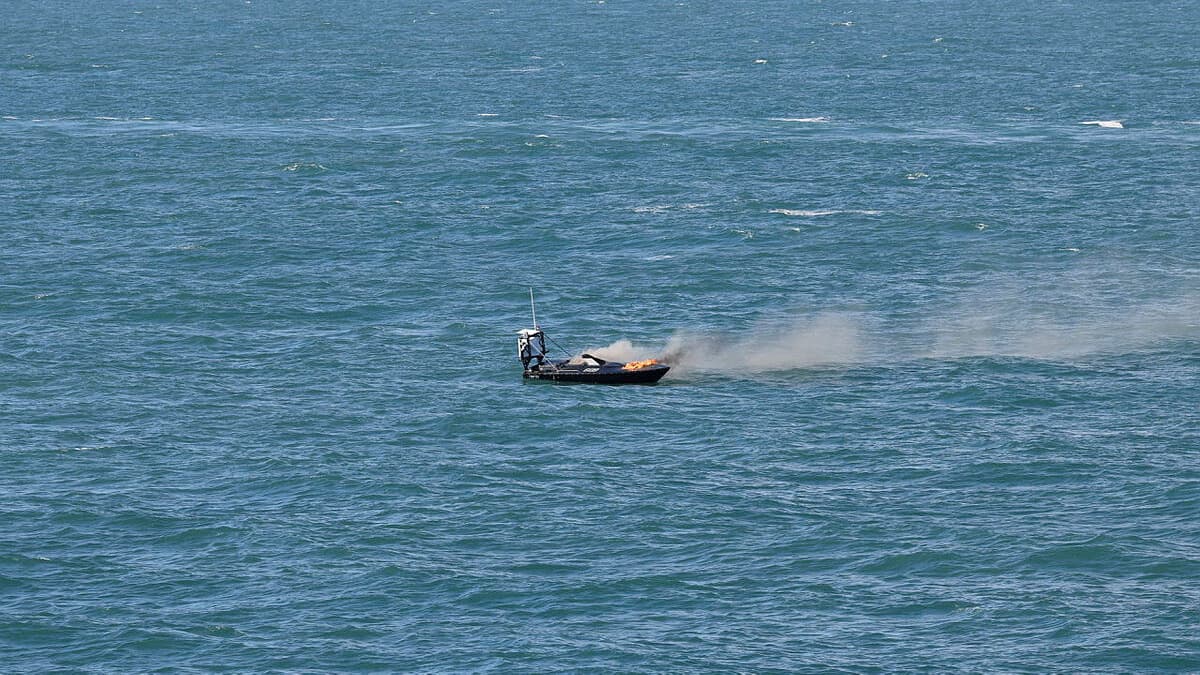
A disabled USV burns during Exercise Sharpshooter, which tested attacks on Royal Navy destroyer HMS Dauntless. (UK MoD Crown Copyright 2025)
According to the Royal Navy, it was designed to replicate the intensity of real-life operations, such as the conditions faced by Type 45 destroyer HMS Diamond in the Red Sea as the Houthis fired drones and missiles from Yemen in 2024.
Next stages
A meeting is due to be held in March for the procurement programme, which will define the exact approach as well as the operational requirements and challenge, he continued. Although no money has been defined yet.
Industry will then be formally informed of the programme, ahead of the challenge, which he hopes will take place before the summer.
A contract is then expected, although he admitted that it is not yet clear how the equipment will eventually be acquired, with the meeting in March set to discuss this.
While there may be “bumps” in delivering the challenge, given it’s a new procurement approach with multiple countries involved, he acknowledged that it should demonstrate the efficacy and speed with which certain procurement programmes can be managed.
The challenge-led procurement approach is already being trialled by certain individual countries such as the Netherlands and UK. Yet scaling it internationally could present some hurdles. Countries often have differing requirements and preferences when acquiring equipment – let’s see what happens.
Olivia
Savage
Editor in Chief, Clarion Defence & Security
Olivia Savage is the Editor in Chief of Clarion Defence & Security, organisers of DSEI and other defence events. Previously, she was a Senior Defence Journalist at Janes, specialising in electronic warfare, uncrewed systems, and space.