
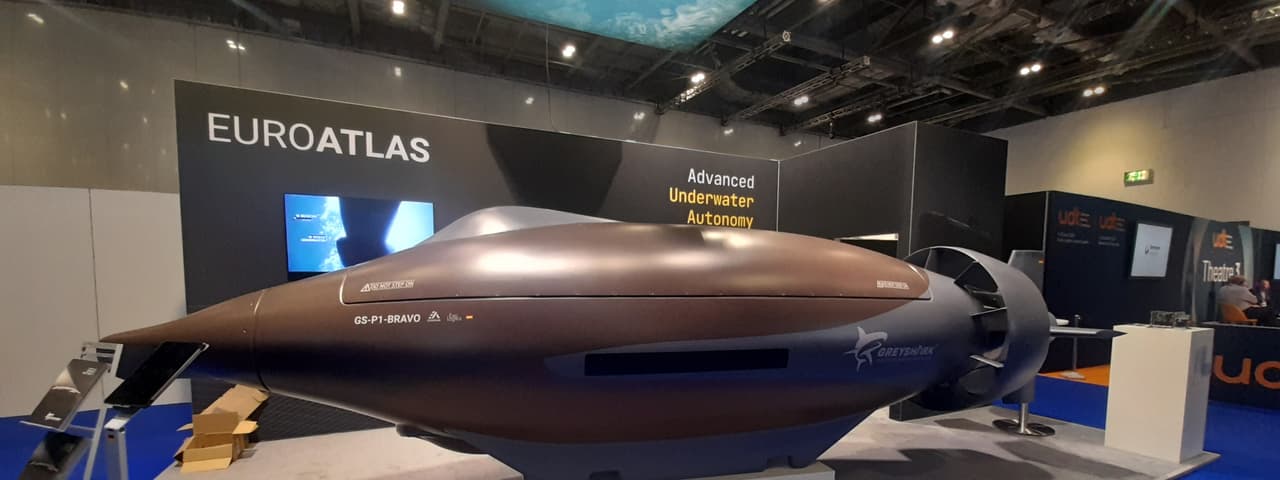
Euroatlas' Greyshark AUV at UDT 2026. (Kate Tringham)
Exclusive: Euroatlas' Greyshark AUV gears up for serial production
The platform is drawing significant attention from international navies.
20 APR 2026

By
Kate
Tringham
Freelance Defence & Security Journalist
The inaugural variant of Euroatlas’s new Greyshark autonomous undersea vehicle (AUV) is poised to start serial production in the coming months, a company official has confirmed.
Speaking to DSEI Gateway at UDT 2026 on 15 April, Verineia Codrean, Euroatlas’s head of strategy and partnership, said that serial production of the battery-operated variant, dubbed ‘Bravo’, was planned to start in late July/early August.
The first units of Bravo are being produced for two undisclosed European governments under contracts signed in October 2025. The orders are for “multiple” units, Codrean said, with deliveries expected to be completed by the end of 2026.
What is Greyshark
Initially unveiled at the Euronaval 2024 exhibition in Paris, Greyshark was developed by Euroatlas in partnership with EvoLogics. It is a multimission AUV designed to perform a wide range of missions, including short- and long-range intelligence, surveillance and reconnaissance, critical undersea infrastructure monitoring, mine countermeasures and anti-submarine warfare.
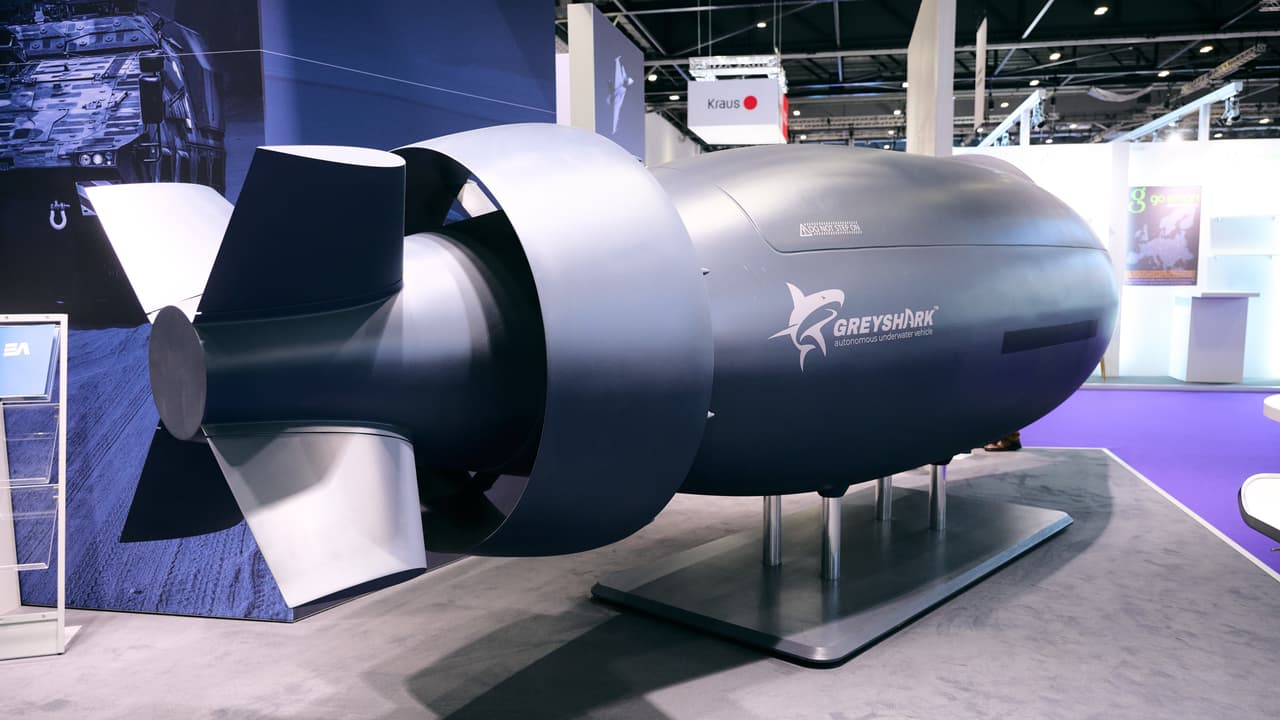
The Bravo Greyshark at DSEI UK 2025.
Greyshark is offered in two versions that feature the same capabilities but differ in range and autonomy. Bravo is a 6.5m lithium-ion battery-powered version with an endurance of up to five and a half days and a maximum range of 550 nautical miles at 4kt.
Foxtrot, meanwhile, is a slightly larger 8m long fuel-cell-powered version that has a submerged endurance of up to 16 weeks and has a maximum range of up to 11,000 nautical miles at 4kt – making it well-suited to more persistent operations such as in the Arctic region, Codrean said.
The baseline platform is equipped with an integrated suite of 17 active and passive sensors and a modular AI software stack developed with EvoLogicvs that manages data fusion, navigation and real-time mission adaptation.
Both versions are equipped with 'IMO Level 5' autonomy and can operate either individually or as part of a swarm in all conditions without human intervention.
The current depth rating is 650m, although Euroatlas is targeting a depth rating of 4,000m in the next stage of development.
Following its unveiling at Euronaval 2024, Bravo went on to complete open water trials in May 2025 and made its debut at NATO’s REPMUS 2025 (Robotic Experimentation and Prototyping with Maritime Unmanned Systems) maritime exercise in Portugal in September.
Bravo has reached a maturity level of technology readiness level eight and is now in the final phases of its operational trials programme, Codrean said. This includes participation in the SeaSec (Seabed Security) 2026 Data2Sea challenge week, which is underway in Rostock, Germany, followed by the 2026 iteration of REPMUS in September.
Meanwhile, the Foxtrot prototype achieved a significant milestone when it entered the water for the first time during the second week of April, Codrean said. The AUV is currently being tested at SeaSec and following completion of the exercise will begin an extensive period of open-water operational testing that will culminate in participation in REPMUS in September.
Under current planning Foxtrot will complete development in 2027.
Codrean said the Euroatlas has received a “very high” level of interest in the platform from international navies, although she declined to disclose further details.
The company is planning to reach a production capacity of 150 units per year by the end of 2026.
Kate
Tringham
Freelance Defence & Security Journalist
Kate Tringham is a freelance defence and security journalist specialising in the maritime domain. She has previously held roles at Janes, where she was the EMEA naval desk lead and former editor of Janes Navy International.