
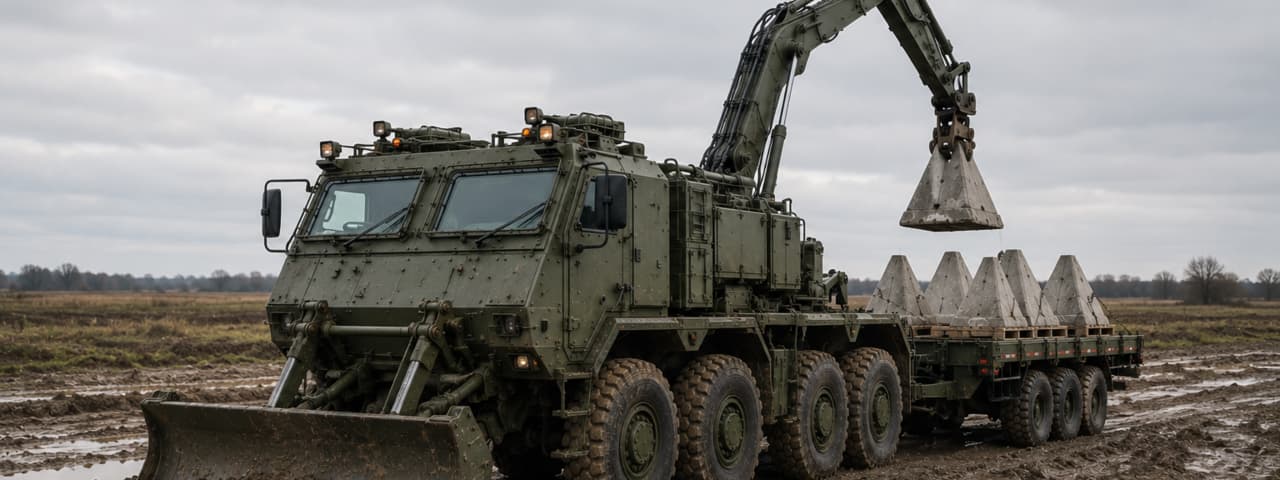
Image generated with ChatGPT based on the vehicle concept.
The Netherlands requires counter-mobility vehicle system
The Dutch MoD is seeking a multi-role system to emplace obstacles that slow adversary movements.
14 JUL 2026

By
Tom
Barlow-Brown
Defence Journalist, DSEI Gateway
The Netherlands Ministry of Defence (MoD) is seeking a counter-mobility vehicle system to emplace obstacles that restrict the movements of adversary forces.
A market consultation for the vehicle system, to inform a proposed future tender, was published on 26 June by the MoD's Command Materiel and IT organisation (COMMIT) via the Mercell procurement platform. Through the consultation, COMMIT is gathering information on vehicles that consolidate tasks currently carried out by separate specialist systems, such as excavation and cargo transport.
COMMIT says that the Netherlands requires a total of 10 counter mobility vehicle systems with 15 years of maintenance support from the supplier.
Dutch MoD requirements
According to COMMIT, the vehicles must be able to:
- Transport 5,000kg of obstacle materials such as wire, steel, or concrete across at least six NATO pallets
- Load and unload cargo without manual handling
- Lift and move objects of up to 2,000kg
- Move earth at a minimum rate of 30 cubic metres per hour
- Create cavities 450mm in diameter and depth through paved and unpaved surfaces within two minutes, within an 8m radius
Fully loaded, the systems must be able to sustain speeds of at least 57km/h on unpaved roads, covering distances of 400km within eight and a half hours, including refuelling stops. However, the ability to sustain speeds of approximately 83km/h while travelling over distances of 600km in eight and a half hours is preferred.
A multi-role engineering vehicle
The vehicles would be used for operations 10-30km from the main line of resistance.
To carry out the aforementioned tasks, the vehicles will need to be equipped with various appliances. These include a crane which can be fitted with separate attachments, and a loader attachment at the front of the vehicle.
COMMIT notes that the MoD intends to carry out maintenance of the vehicles in-house, drawing on external service contracts only where internal capacity falls short.
Responses to the market consultation are due by 21 July.
Tom
Barlow-Brown
Defence Journalist, DSEI Gateway
Tom Barlow-Brown is a Defence Journalist for DSEI Gateway. Previously he worked as a reporter in the maritime sector covering developments in energy and tech.