
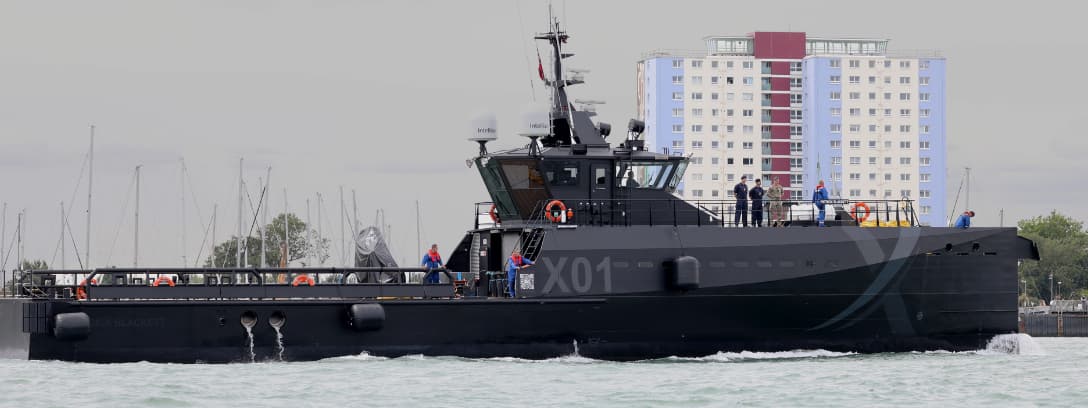
The experimental vessel XV Patrick Blackett is used by the DCTO as a testbed. (UK MoD Crown Copyright 2023)
The DCTO roadmap: the Royal Navy commander outlines his plans for innovation
DSEI Gateway speaks with the head of the Royal Navy’s new rapid prototyping office about its plans for accelerating the delivery of advanced tech.
19 MAR 2026

By
Kate
Tringham
Freelance Journalist
In October 2025, five Rattler-class uncrewed surface vessels (USVs) remotely operated from 500 miles away successfully intercepted and escorted two UK Royal Navy (RN) warships off the coast of Scotland that were acting as foreign vessels.
Employing swarm tactics, the USVs shadowed the target ships in a proof-of-concept demonstration showcasing how such technology could support future operations.
The exercise marked an important milestone in the Royal Navy’s (RN’s) journey towards a hybrid navy of crewed and uncrewed platforms and was the first major success of the force’s newly formed Disruptive Capabilities and Technologies Office (DCTO) – which led the project to deliver and field the RN’s first custom-built USVs in record time.
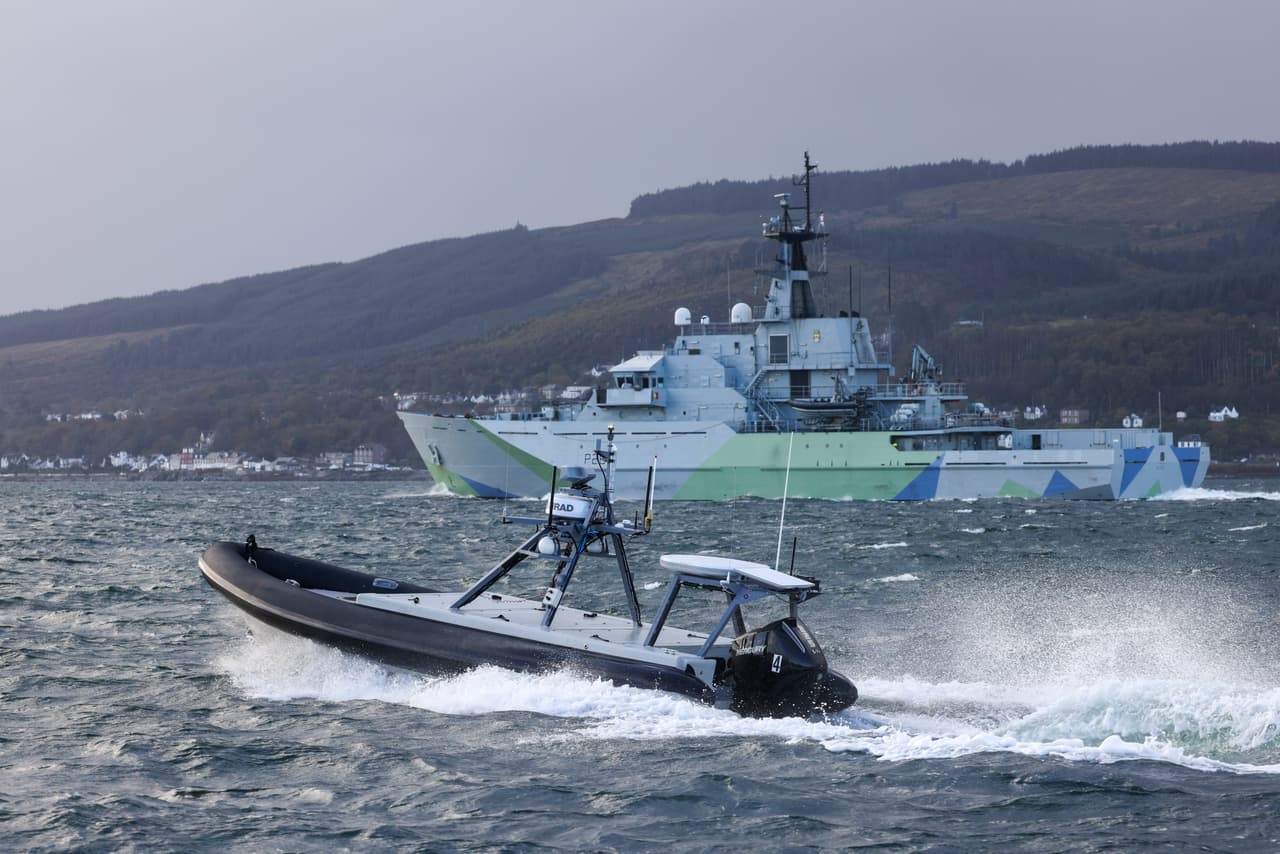
A Rattler USV escorts HMS Tyne off the coast of Scotland. (UK MoD Crown Copyright 2025)
The first iteration of the platform was taken from concept to a globally deployable capability in less than 100 days.
Speaking to DSEI Gateway, Brigadier Jaimie Roylance, Head of the DCTO, said the pace was enabled by a radical new procurement approach with industry – and signalled the office’s intent going forward.
“The aim is to continue on this fast drumbeat of prototype development that gets delivered as a deployable capability into a different part of the RN to progress,” he said.
“We’ve done that with Rattler, and now we need to repeat that with something else, and then something else again - because that’s the point of the DCTO.”
Key drivers of DCTO
Established in December 2024 and achieving full operational capability in April 2025, the DCTO combines the expertise of RN specialists from NavyX, the Office of the Chief Technology Officer (OCTO), and the Navy AI Cell (NAIC) into a single innovation unit aimed at speeding up the adoption of advanced technologies into frontline operations.
There were three main drivers behind the creation of the DCTO, Brigadier Roylance said
The first was a need to consolidate parts of the navy’s technology innovation landscape that were causing confusion – not just for industry looking in, but internally as well. This was particularly the case with OCTO and NavyX – the two biggest entities that were amalgamated to make up the DCTO.
Both entities “were constantly being hit up by the same parts of industry. Sometimes that made sense, sometimes it didn’t,” Brigadier Roylance said.
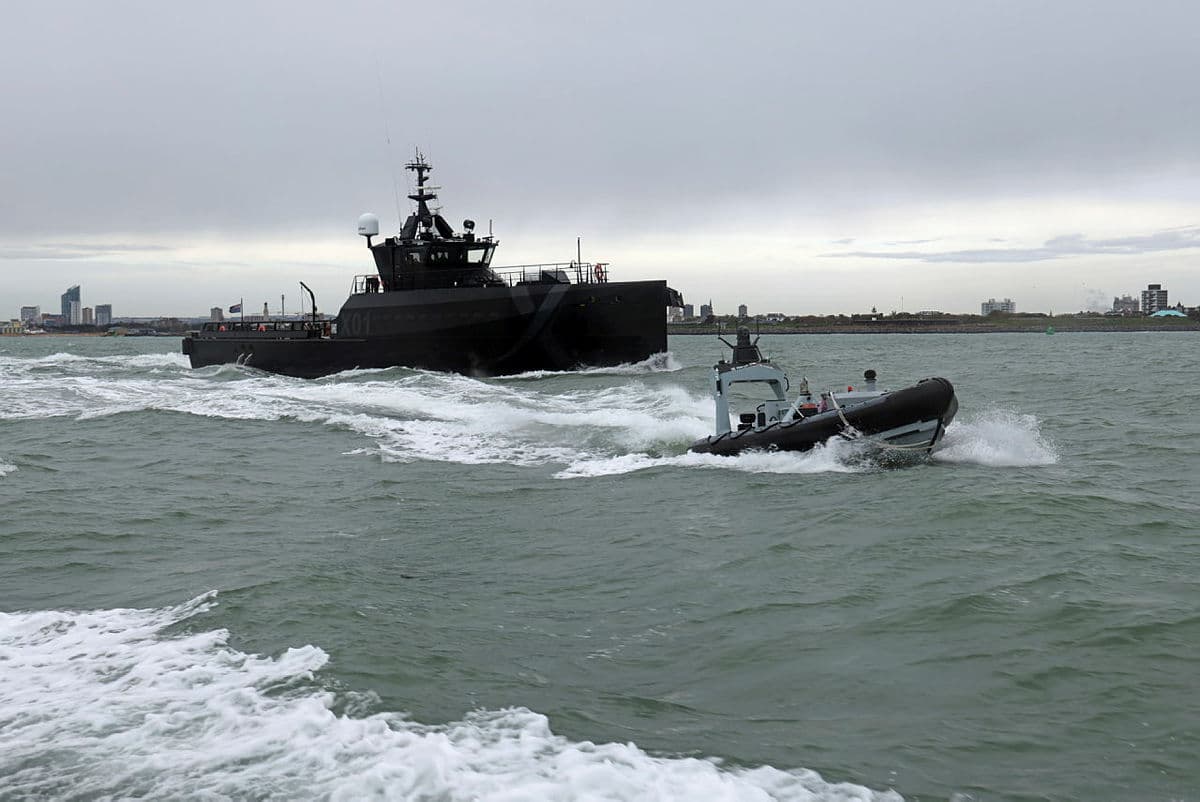
XV Patrick Blackett alongside an uncrewed Pacific 24 craft. (UK MoD Crown Copyright 2024)
While now merged, discrete elements remain: the former OCTO has been rebranded as DCTO Futures, with some NavyX personnel integrated to support its mission.
Meanwhile, NavyX’s experimental platform XV Patrick Blackett, together with its integral crew plus the platform authority, constitutes the DCTO’s seagoing element, known as the Fleet Experimental Squadron.
NAIC, which identifies and advances AI capability across the RN, is the team within the DCTO that is the most self-contained.
Other elements include the Operational Experimentation hub, composed of four civil servants responsible for planning, delivering, and cohering all of the DCTO’s experimentation activity; and the London Tech Bridge, which connects naval needs and industry to accelerate technology.
Consolidating parts of naval innovation into a single hub also served a second purpose: which was to connect more cleanly into the Ministry of Defence’s (MoD’s) wider defence reform structure.
“We knew it would be really helpful to the MoD if we could give the UK Defence Innovation [UKDI], as it stood up, a single plug-in point to the navy’s tech innovation enterprise, with the DCTO being a hub in the middle of that."
Brigadier Roylance said.
The third reason for creating the DCTO was to keep the construct at navy depth but move it physically closer to frontline warfighters. Formerly situated in the Navy Command Headquarters, the DCTO team has been relocated to the Portsmouth dockyard next to the Surface Flotilla, parts of the Commando Force, and the Maritime Warfare Centre – a particularly important relationship for the DCTO.
The move was mostly about being “cheek by jowl” with frontline sailors, marines and others that are closer to the coalface to close the feedback loop and ensure the right capabilities are delivered, Brigadier Roylance explained.
Achievements to date
Based on a 7.2m rigid inflatable boat equipped with advanced autonomy packages and modular payloads, the Rattler USV platform was originally developed to provide additional protection for the UK Carrier Strike Group 2025 (CSG25) at strategic points of its Operation ‘Highmast’ deployment to the Far East last year.
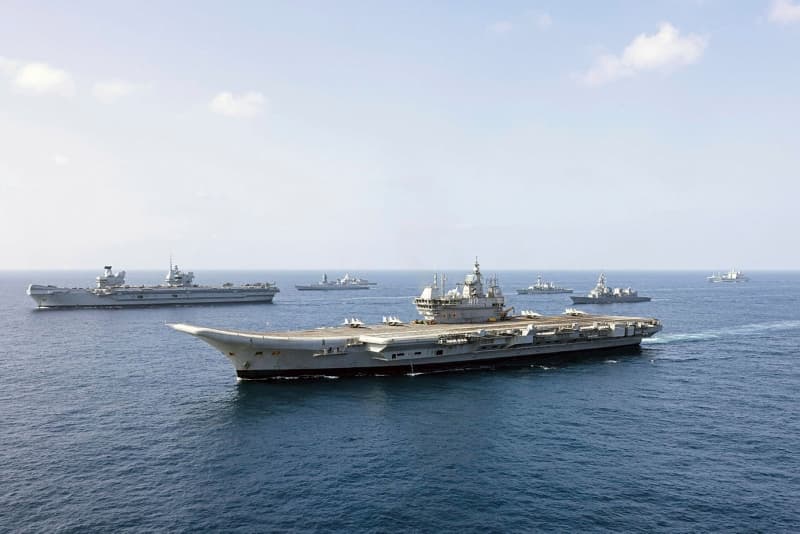
The UK's Carrier Strike Group 2025 on deployment in the Indo-Pacific. (UK MoD Crown Copyright 2025)
“We were asked to develop at pace an additional layer of protection that was essentially underpinned by a swarming, improved USV capability,” Brigadier Roylance said.
It was the first time the RN has procured a fleet of customised USVs, and the speed of development was enabled by rapid co-design and iteration.
The fleet of seven USVs were designed, developed and tested by a mini-consortium of small companies – with SYOS Aerospace as prime contractor – working in collaboration with the DCTO and the Fleet Experimental Squadron.
By the 100 day mark the USVs were deemed ready to deploy with CSG25. In the end, a decision was taken not to deploy the platform in that particular setting and instead prepare them for a fleet-ready escort tasking exercise, but this was a geopolitical decision – not related to the maturity of the vessel itself, he said.
As a result, the DCTO-led team were able to continue maturing the prototype over a further five months, ultimately bringing the platform up to a Mk 4 standard (meaning the fourth iteration of a product).
Training testbeds
The Rattlers were used by the Surface Flotilla as training testbeds to inform the acquisition of 20 follow-on USVs under Project Beehive: a joint RN/UKDI programme to support the hybrid navy transition.
Following a competitive process involving 11 other bidders, UK-based startup Kraken Technology Group won the contract to supply its K3 Scout USV for the programme on 10 March. The vessels will be delivered over the next 12 months and will have an open architecture to support spiral development.
While Rattler was the DCTO’s key project and main focus for 2025, it is also making headway with several other efforts.
One of the NAIC’s key outputs is the development of a new assurance tool for AI projects and programmes. “That rolled out in an Alpha form last summer and is now well on the way to rolling out in a more mature form across the navy,” Brigadier Roylance said.
Future tech
DCTO Futures, meanwhile, has continued its work trialling quantum technologies, and has a headmark of maturing quantum-enabled inertial navigation technology to technology readiness level (TRL) seven by 2027. It also has several other live projects underway centered around novel sensors, effectors, and alternative communications.
“These involve collaborations with spin-outs, SMEs [small and medium-sized enterprises], and universities - but it’s more speculative, so it’s lower-tech…it might be game-changing, we’re not sure, therefore we’re investing some time into it.”
DCTO is working in partnership with Loughborough University spin-out company Laser Optical Engineering, for example, on a variety of different interesting laser technologies.
In 2025 the company was part of a DCTO collaborative effort to quickly and cheaply manufacture laser-filtering visors for pilots deployed on CSG25.
Meanwhile, the London Tech Bridge has been responsible for helping to bring numerous useful technologies developed by SMEs into the frontline quickly. Systems now being deployed include a portable fuel analyser, and a portable simulator developed by Vasco that enables sailors to practice bridge watchkeeping while deployed.
Next steps
After completing the Rattler project, the DCTO’s main effort for 2026 is focused on developing a requirements blueprint for International Maritime Organisation (IMO) Degree Four Autonomy for surface vessels; a classification representing a benchmark for fully autonomous vessels. The DCTO has set a stretch target of July to complete the first element of the blueprint, which is focused on Degree Four navigation autonomy.
To advance its efforts, the DCTO is also looking to procure a second experimental platform to use alongside Patrick Blackett, and in February launched an early market engagement for a new multi-role USV testbed.
The desired solution is a commercial-off-the-shelf platform which is already in or soon to be in production and capable of operating to IMO degree three or four autonomy.
How can SMEs get involved?
Brigadier Roylance said there are several mechanisms via which SMEs can engage with the DCTO.
The first is via the UKDI, which was set up around three pillars to help accelerate the adoption of novel technologies – two of which are particularly applicable to the DCTO.
The ‘prove and exploit’ pillar is focused on higher TRL capabilities. “You just need to prove it’s operationally useful, impactful and viable and then we ‘exploit’ or scale it. So that aligns well with the main bulk of what DCTO does,” Brigadier Roylance said.
Meanwhile the ‘find, grow and encourage’ pillar under UKDI focuses on finding lower but relevant TRL technology and developing it in a way that reduces uncertainty about viability.
“My DCTO Futures team clutches into that part of the UKDI enterprise, and that’s where a lot of the opportunities for SMEs are.”
SMEs can access these opportunities by contacting the DCTO through its own digital front door, or by contacting UKDI directly, which also acts as a single point of contact for the MoD.
A second route to get involved with the DCTO would be through the London Tech Bridge, which also acts as a front door for the office.
The third route depends on how closely an SME’s technology aligns with the vision of the hybrid navy, Brigadier Roylance said.
The hybrid navy programme teams have been developing their plans in detail ahead of the forthcoming Defence Investment Plan.
“They will be scheduling a series of roadshows, workshops and hackathons featuring open calls for solutions to problems they’ve got that are going to enable them to deliver their programme,” Brigadier Roylance said.
SMEs will be able to track upcoming opportunities through the Navy Commercial webpage, where upcoming engagement events will be advertised.
Kate
Tringham
Freelance Journalist
Kate Tringham is a freelance defence and security journalist specialising in the maritime domain. She has previously held roles at Janes, where she was the EMEA naval desk lead and former editor of Janes Navy International.