
(Shutterstock)
Eyes on the ocean: how New Zealand is investing in persistent surveillance
DSEI Gateway explores how New Zealand is deploying uncrewed technology to monitor one of the world's largest maritime areas.
20 JUL 2026

By
Tom
Barlow-Brown
Defence Journalist, DSEI Gateway
New Zealand’s geographic isolation means the country has previously been able to adopt a relatively modest defence posture, but that buffer is eroding amid intensifying Indo-Pacific strategic threats.
The country’s 15,000km coastline makes protecting its borders a difficult challenge. New Zealand also administers an exclusive economic zone that covers at least 4 million square km.
New Zealand’s persistent surveillance programme
In response, the New Zealand Defence Force (NZDF) is investing in uncrewed systems through a new Persistent Surveillance Programme, designed to expand coverage, enhance deterrence, add operational mass, and reduce the manpower burden of monitoring the country’s maritime domain.
The Persistent Surveillance project is investigating options to increase the NZDF's awareness of maritime activity across the South-West Pacific and Southern Ocean.
NZDF spokesperson
The programme is a key initiative under the New Zealand Ministry of Defence’s (MoD’s) wider 2025 Defence Capability Plan (DCP 25), which is committing NZD12 billion (GBP5.2 billion) over the next four years to modernise its military, lifting defence spending from just over 1% of GDP to more than 2% within eight years.
The DCP 25 splits this effort into two workstreams with separate budget lines. Under the maritime segment, NZD50–100 million (GBP21.7–43.5 million) is being allocated for uncrewed surface vessels (USVs) between 2025–2028 to augment traditional crewed ships.
A second investment, listed under the aerospace section of the plan, allocates NZD100–300 million (GBP43.5 million - 130.5 million) for new long-range remotely piloted aircraft.
Both aim to extend intelligence, surveillance, and reconnaissance (ISR) coverage over the Pacific and Southern Ocean.
“Uncrewed capabilities will provide better visibility of activities in the region, enhancing deterrence through detection. Such capabilities will also reduce the risk posed to personnel conducting operations.”
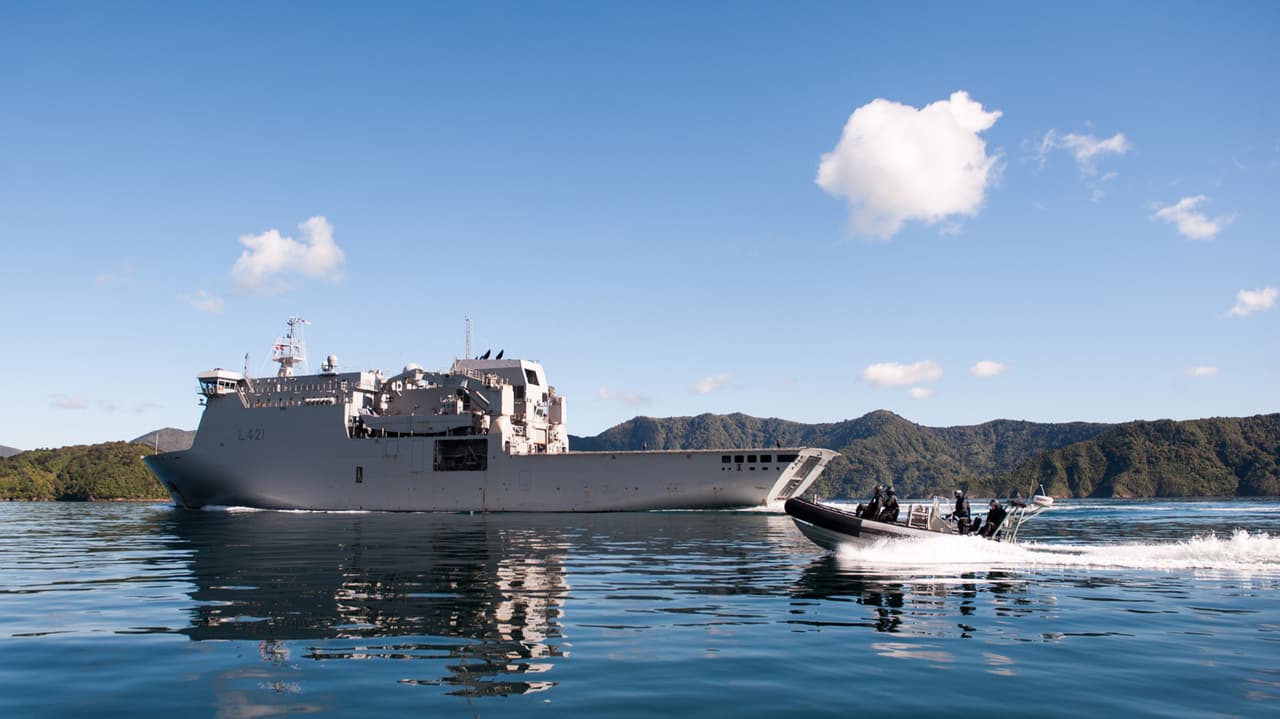
HMNZS Canterbury, which the two Ocius Bluebottles routinely operate from. (NZDF)
Scaling uncrewed maritime surveillance
The maritime element of the programme has already undergone development. Prior to procuring physical capabilities, the Royal New Zealand Navy (RNZN) leased a 6.8m Bluebottle USV from Ocius for a seven-month trial in 2024.
Following the trial, the navy, alongside the New Zealand Customs Service, acquired two larger 7.4m Bluebottles – Tahi and Rua, in April 2025, according to the NZDF.
The vessels are owned by the navy, with the Customs Service contributing funding as a primary stakeholder for missions to counter transnational crime.
According to Robert Dane, CEO of Ocius, the vessels have been operating for over a year, providing persistent surveillance to the RNZN.
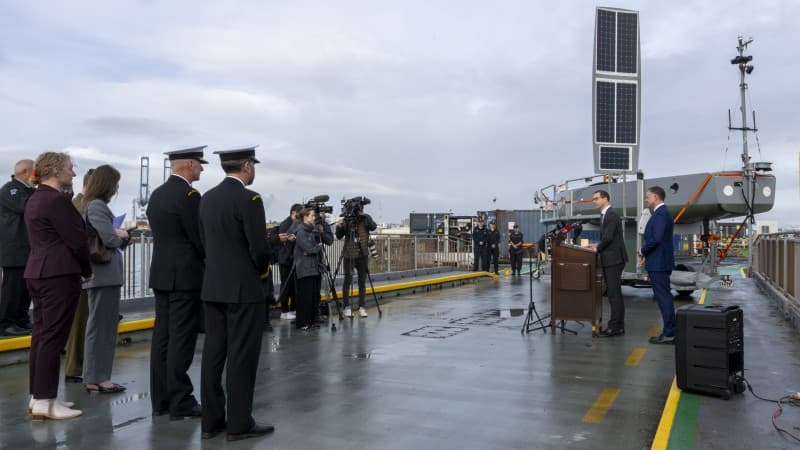
Defence Minister Chris Penk at the Devonport Naval Base in front of an Ocius Bluebottle in May. (NZDF)
Navigating the Southern Ocean
The vessels’ operating area – spanning tropical Pacific waters and the Southern Ocean – brings challenges that must be addressed by suppliers to the NZDF.
“Environmental conditions and endurance are probably the two major things for New Zealand. It's a unique operating profile,” Mark Harvey, Business Development Manager at Babcock, told DSEI Gateway. The company is assisting the NZDF in its move towards a hybrid navy.
Ocius has adapted its vessels to meet these demands. For New Zealand’s southern waters, it has fitted a smaller storm sail alongside the standard sail; the full sail drives the 7.4m Bluebottle vessel in winds of 5-25kt, while the storm sail allows it to keep sailing in the 25-35kt winds common further south. Additionally, Ocius has adapted the vessel’s rudder for better handling in the southern seas.
Joint operations and interoperability
"The feedback's been very positive, particularly from [the] navy, but also from the Ministry of Fisheries and Coast Guard during other operations," Dane said.
Working alongside the navy, fisheries and customs have shown how the Bluebottles could be part of a layered approach to security, he said.
That layered role was demonstrated during the 2024 trial. According to the NZDF, a USV played a critical role in an operation to recover a steel box holding 7kg of cocaine concealed on the hull of a commercial vessel bound for Auckland. New Zealand Customs said the joint operation used “a range of technology, including remote controlled equipment”, to gather information on the box before it was safely removed.
While the Bluebottles are owned and operated by the New Zealand government, they rely on Ocius’s team for support. “We are supporting New Zealand with spares, and upgrades of software and of components, but they're operating [the USVs] themselves and they're maintaining them themselves,” Dane said.
Part of the USV’s surveillance value lies in allowing a single operator to control multiple vessels. New Zealand currently uses one operator to cover two or three vessels, Dane explained, with Ocius working on an AI solution which will allow the same operator to monitor up to 20 Bluebottles.
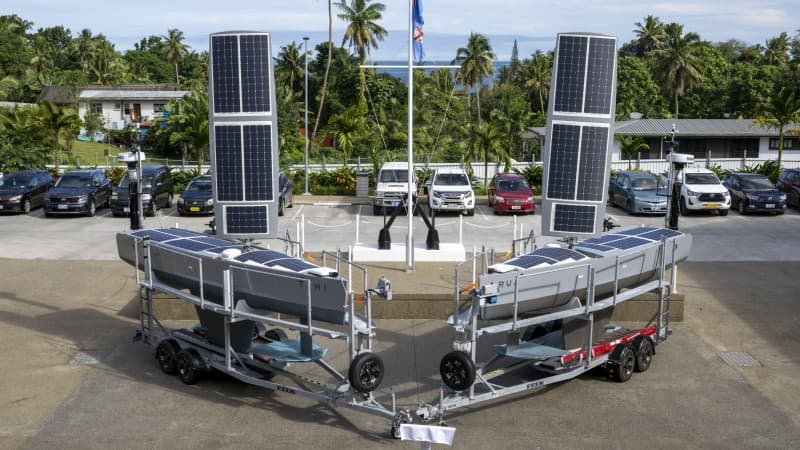
Ocius USVs Tahi and Rua. (NZDF)
Additional uncrewed investment
As well as acquiring uncrewed and autonomous surface platforms, the DCP 25 also outlines a projected investment in subsurface systems for persistent ISR from 2029 to 2039, to complement existing platforms.
Interoperability with Australia is also a consideration when looking at options for uncrewed surveillance systems. The spokesperson said the force would consider a fleet of vessels able to operate alongside the Royal Australian Navy.
Interoperability with Australia is also a consideration when looking at options for uncrewed surveillance systems. The spokesperson said the force would consider a fleet of vessels able to operate alongside the Royal Australian Navy.
New Zealand’s 2026 defence budget has also set aside additional funding for two uncrewed systems as part of the Maritime Fleet Renewal programme, which is assessing options to deliver “a modern and capable navy”. One of the platforms will be used in the South-West Pacific to provide long-duration ISR.
Watching from above
The second uncrewed system funded in the defence budget is for a "polar capable" UAS, designed to operate from RNZN vessels in a range of challenging conditions in the Southern Ocean. New Zealand's MoD issued a request for information to industry in March 2026 for the system.
The military is expanding its investment in aerial systems to support its ISR efforts, as part of the Persistent Surveillance (Air) project.
The money set aside in the DCP 25 for long-range remotely piloted aircraft between 2025-2028 will allow the NZDF to purchase new systems that will support land and maritime forces with improved and persistent surveillance over long distances, including in the Pacific and Southern Ocean.
The plan frames this as complementing New Zealand's recent acquisition of four P-8A Poseidon maritime patrol aircraft. Crewed aircraft will remain in service, the plan states, but in some situations, particularly during long-duration missions, it will be preferable to use uncrewed aircraft.
The Persistent Surveillance (Air) project aims to improve the NZDF's ability to collect high fidelity ISR data, for longer durations, against a range of targets...Detailed capability decisions remain subject to project development and future government decisions.
NZDF spokesperson
Industry engagement is underway. In January 2026, the MoD invited local and foreign businesses and researchers to a series of workshops to inform an indicative business case for the procurement project later this year.
The MoD’s approach to uncrewed procurement
According to the plan, investment in new equipment must take a range of factors into consideration. These include possible interoperability with Australia, partnerships with industry to deliver capabilities differently, and identifying the most cost-effective and durable options.
In March, the MoD stated that any supporting supply chains must “absorb disruption and enable rapid adaptation”. As a result, the MoD will favour “modular and open architecture” designs that can be updated or replaced quickly.
The Persistent Surveillance Programme is taking an “iterative approach to investment in uncrewed systems”, the spokesperson confirmed.
“[The NZDF] are closely monitoring current operational and technological developments for any lessons that can be applied to New Zealand's future fleet,” the spokesperson said.
For now, operations with Ocius’ USVs have demonstrated what the starting point looks like. By investing in a small number of capabilities and conducting small-scale trials, the NZDF can refine its requirements ahead of more substantial procurements expected in the 2029-39 period.
Tom
Barlow-Brown
Defence Journalist, DSEI Gateway
Tom Barlow-Brown is a Defence Journalist for DSEI Gateway. Previously he worked as a reporter in the maritime sector covering developments in energy and tech.