
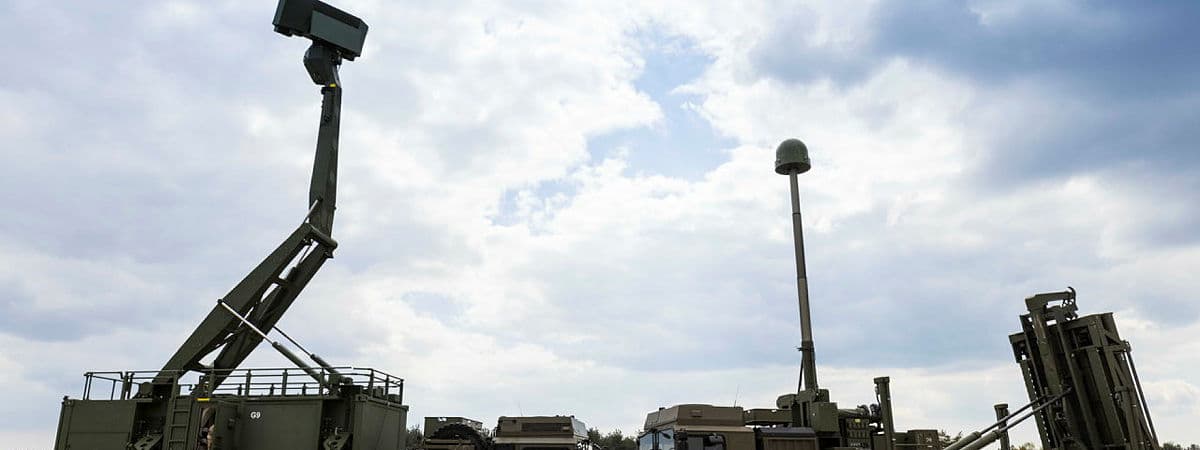
A British Army Sky Sabre air defence system, with a Saab Giraffe radar on the left. (UK MoD Crown Copyright 2023)
US seeks highly mobile air defence radars
The radars must have the capacity to be rapidly and easily relocated to support distributed operations.
20 AUG 2026

By
Victoria
Hanscomb
Editor, DSEI Gateway
The US is seeking innovative, highly mobile radar prototype concepts to detect and track “increasingly sophisticated” missile threats.
A pre-solicitation notice from the US Department of War – published on US procurement site Sam.gov on 10 August – says that the static and semi-mobile radars currently in use “are vulnerable to counterattack”. Additionally, these radars cannot be moved with ease to support distributed operations.
Therefore, the US requires prototype radar systems that can be rapidly transported to help counter “complex” and “high speed” threats such as ballistic, cruise, and hypersonic missiles.
What are the technical requirements for the radar?
The US Department of War says that the radar system must be capable of high-sensitivity detection, persistent tracking, and discrimination of threats in contested environments.
The systems should also have the capacity to be transported via US C-17 Globemaster III transport aircraft and tactical ground vehicles. Once at a specific location, units must be able to set up the radar within hours and dismantle it within minutes to “maximise survivability”.
The ability to operate as singular sensors, or as multiple distributed arrays, is also essential to allow for increased coverage. An open architecture design is critical, to enable “rapid” hardware and software upgrades.
A “viable pathway” to high-volume production must additionally be demonstrated by the radar prototypes.
Demonstrating capabilities
Promising prototype submissions will enter into a four-stage development and demonstration cycle, which will assess the engineering pathways, manufacturing readiness, and hardware performance of the radar prototypes, among other factors.
While the US Department of War emphasises that the pre-solicitation is not a request for proposal, following the cycles, non-competitive follow-on contracts may be agreed with specific candidates.
No deadline has been provided to respond to the pre-solicitation notice.
Victoria
Hanscomb
Editor, DSEI Gateway
Victoria Hanscomb is an Editor at DSEI Gateway, reporting on the defence industry. Her previous experiences as an Editor include covering the international security market and pharmaceutical sector.