
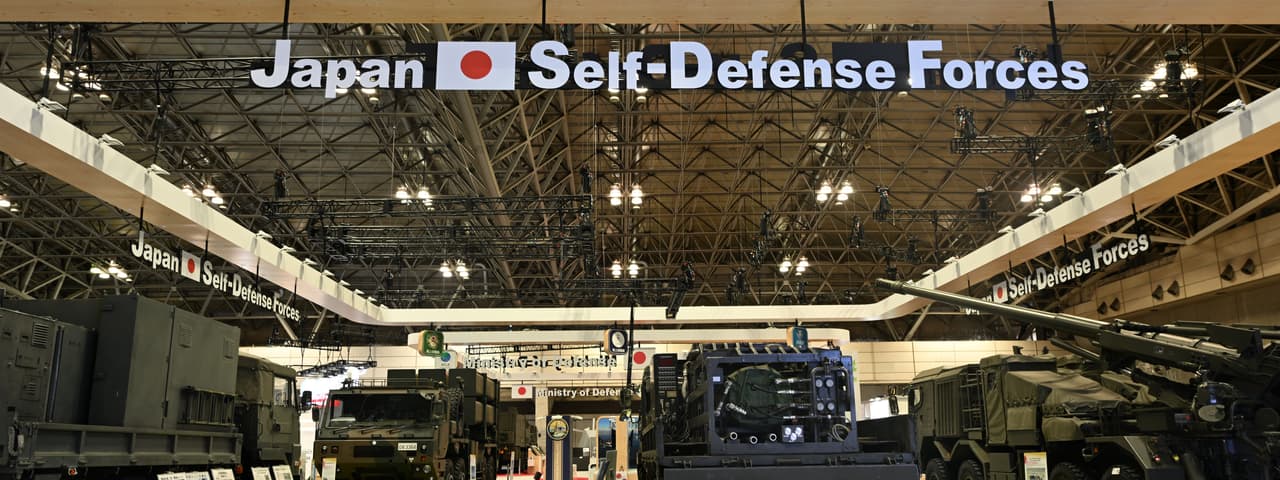
Japan Self Defense Forces at DSEI Japan 2025. (DSEI Gateway)
Japan requests record 2027 defence budget
The budget request includes new programmes focused on AI, hypersonics and counter-drone capabilities.
11 SEP 2026

By
Tom
Barlow-Brown
Defence Journalist, DSEI Gateway

By
Olivia
Savage
Editor in Chief, DSEI Gateway
Japan's Ministry of Defense has submitted a record JPY8.9 trillion (GBP42.1 billion) FY2027 defence budget request, up nearly 1% from 2026, as it seeks to strengthen the country’s international “indispensability”.
This follows a record FY2026 defence budget of JPY8.8 trillion.
The FY2027 budget request, published on 31 August by Japan's Ministry of Defense, is built around specific priority investment areas and contains several new, notable programmes.
AI integration
AI is one of the priority areas, with the ministry noting that it must be introduced rapidly into command and control systems to speed up decision making. A central element of this is the “AI Orchestrator” a "next-generation AI platform" designed to integrate multiple AI systems.
Additionally, the ministry is looking to invest in a “decision-support system” for the Joint Operations Command that rapidly integrates and analyses data to support target selection and visualisation. The system will be fielded early using “existing overseas technology, while domestic technology is strengthened.”
Uncrewed systems
The ministry is ambitious on autonomy, setting out plans to make "the most use of uncrewed assets in the world".
To support this, it has requested at least JPY36.3 billion to acquire three variants of small attack UASs, a minimum of JPY8.7 billion for medium-range vertical take-off and landing UAS, and at least JPY7.6 billion for interceptor UAVs.
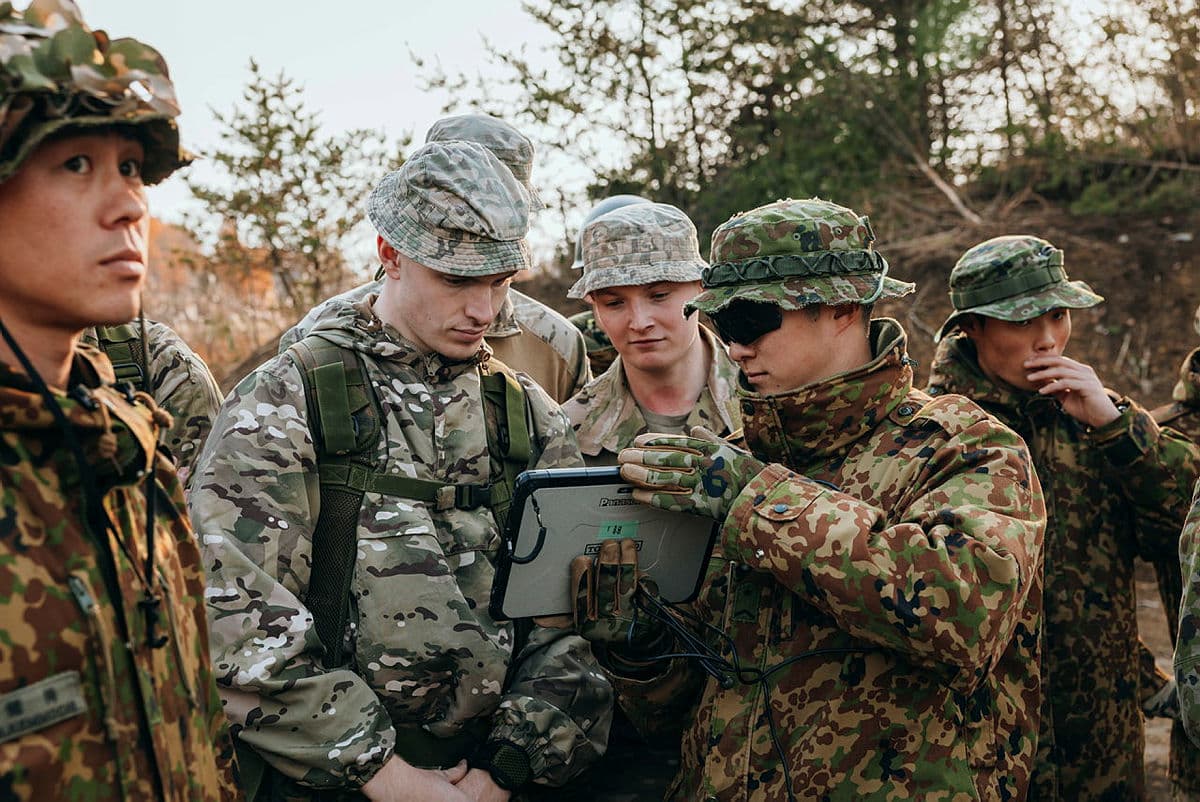
Japanese Ground Self Defence Forces’ showcase their drones' view on a tablet to British troops. (UK MoD Crown Copyright 2025)
Notably, the ministry has filed unpriced item requests for research into a stand-off missile launch module for uncrewed undersea vessels, and development of a low-cost, mass-producible stand-off UAV.
A further JPY9.5 billion is earmarked for development of a general-purpose small uncrewed ground vehicle.
Stand-off missiles
Hypersonics dominate the stand-off priority area, with a combined JPY181.5 billion requested for hypersonic guided missile development and acquisition, while a separate, unpriced item request notably seeks a new “highly survivable” undersea-launched hypersonic guided missile.
Alongside this, the ministry has filed unpriced item requests for the domestic development of a low-cost stand-off missile to complement its more expensive high-performance munitions, and tactical AI satellite research.
Integrated air and missile defence
Within the air and missile defence priority area, the ministry is interestingly calling for a new “Close Range Air Defense System” to counter the growing threat from drone swarms. The system is intended to “combine guided missiles, autocannon and laser to deal efficiently with a range of air threats including cheap, mass-deployable uncrewed aircraft.” It remains unpriced for now.
Alongside this, more conventional requests include the acquisition of interceptors, including surface-to-air missiles, continued joint development with the US of the Glide Phase Interceptor, and upgrades to the Patriot system.
"Cross-domain operations”
The cross-domain operations section sets out several interesting budget requests in the space and electromagnetic warfare domain.
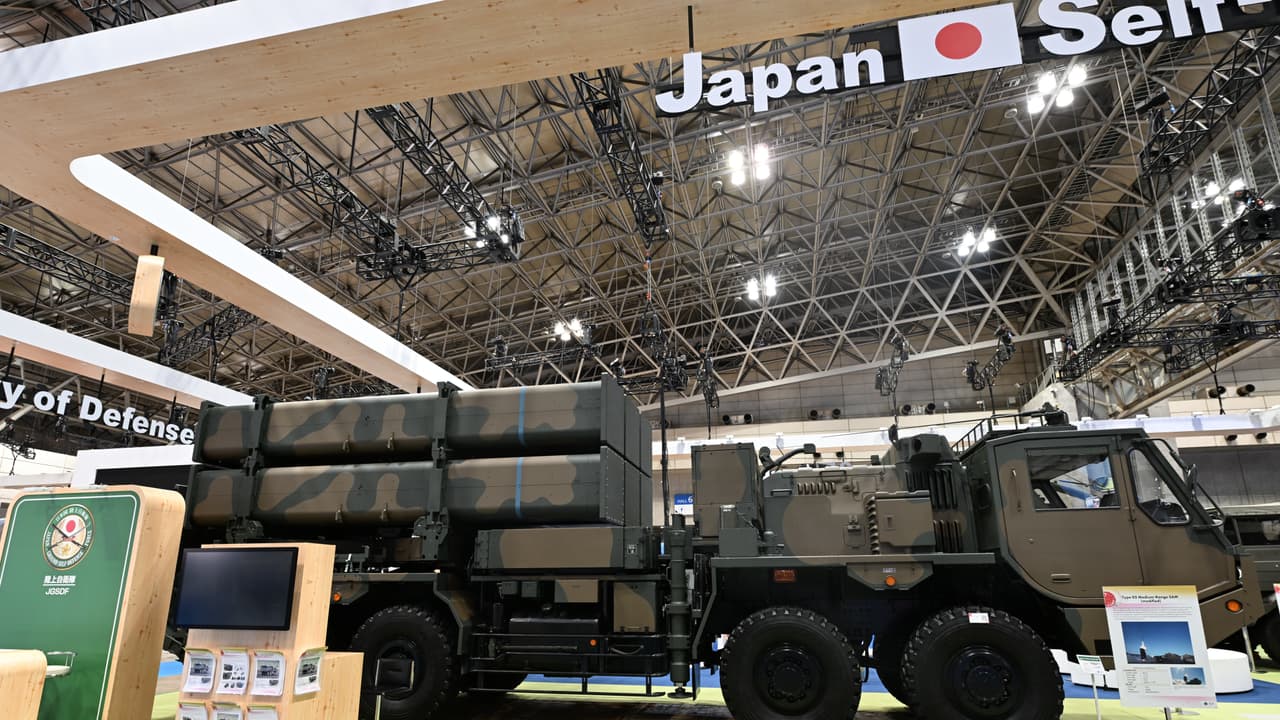
Japan Self Defense Forces stand at DSEI UK 2025. (DSEI Gateway)
For space, the ministry is specifically calling for JPY9.9 billion to upgrade Japan's space situational awareness system, along with the acquisition of a second space domain awareness satellite, although this is an unpriced item request.
Additionally, the ministry has requested JPY3.4 billion for “satellite interference monitoring equipment” and plans to establish a new Satellite Development Office.
In the electromagnetic warfare domain, the ministry is calling for a new “stand-off electronic warfare aircraft,” another unpriced item request.
Command, control and intelligence functions
Within this area, the ministry has requested JPY11.2 billion for a new "inter-unit information-sharing tool," part of a wider push to move data securely across the force.
Additionally, a new "high-confidentiality sovereign cloud" (provisional name only) is noted as a top priority in the document, which will be “introduced to aggregate, share and exploit data securely and rapidly, alongside a high-speed, high-capacity, multi-layered communications network able to sustain command and control under jamming in a contingency.” The request remains unpriced for now.
Another notable request addresses submarine detection. Submarines are widely considered difficult to detect, as they can operate almost silently and remain underwater for months at a time. Considering this, the document outlines an unpriced request to acquire a drone-mounted quantum magnetic sensor for submarine detection.
How will Japan support SMEs?
As part of its priority areas, Japan will also invest in defence production and manufacturing. The ministry plans to expand its domestic production base by establishing a “support scheme” for defence companies to strengthen their production capacity. The government will additionally acquire manufacturing facilities and lend these out to companies.
To aid smaller businesses, Japan says that it will use the Small Business Innovation Research model from the US to contract multiple companies simultaneously. This will enable the comparison of capabilities and support more “agile procurement” by allowing for iterative technical improvement.
A new government-backed scheme will also invest in venture funds to “promote private capital supply” in startups.
Revising its key national security documents
Aside from outlining its capability and budget requests, the document says that its three defence strategies – National Security Strategy, National Defense Strategy and Defense Buildup Program – all adopted in December 2022 will be revised in response to the worsening geopolitical situation and rising regional tensions.
The overall requested budget is expected to increase further as currently uncosted items are approved during the budget announcement at year end.