

Plugging the gap: How to become a strategic partner for global primes
Here are the strategic routes to working with defence primes and making your SME part of the UK MoD's 2028 target.
10 APR 2026

By
James
Quilter
Senior Contributor, Clarion Defence & Security
In the defence sector, the role of SMEs is shifting from peripheral to pivotal. For good reason.
SMEs are the backbone of the UK economy, representing 99.9% of all private sector businesses. Many are already innovating for the defence sector.
Furthermore, the Ministry of Defence (MoD) and major prime original equipment manufacturers (OEMs) are actively seeking to diversify their supply bases, increase national resilience and accelerate the adoption of new technology.
In March, the UK Government announced it is aiming to spend a total of GBP7.5 billion with SMEs, either directly or indirectly, by May 2028 .
However, only 5% of direct MoD procurement spend went to SMEs in 2024.
Rather, the vast majority of funding is awarded to primes, with spend subsequently filtering down through the supply chain to SMEs.
But working with a defence prime is no longer just about fulfilling a sub-contract. Large prime contractors are refining their strategies to become better partners for smaller businesses.
A good example of this is BAE’s partnership with Oxford Dynamics, a UK-based AI SME.
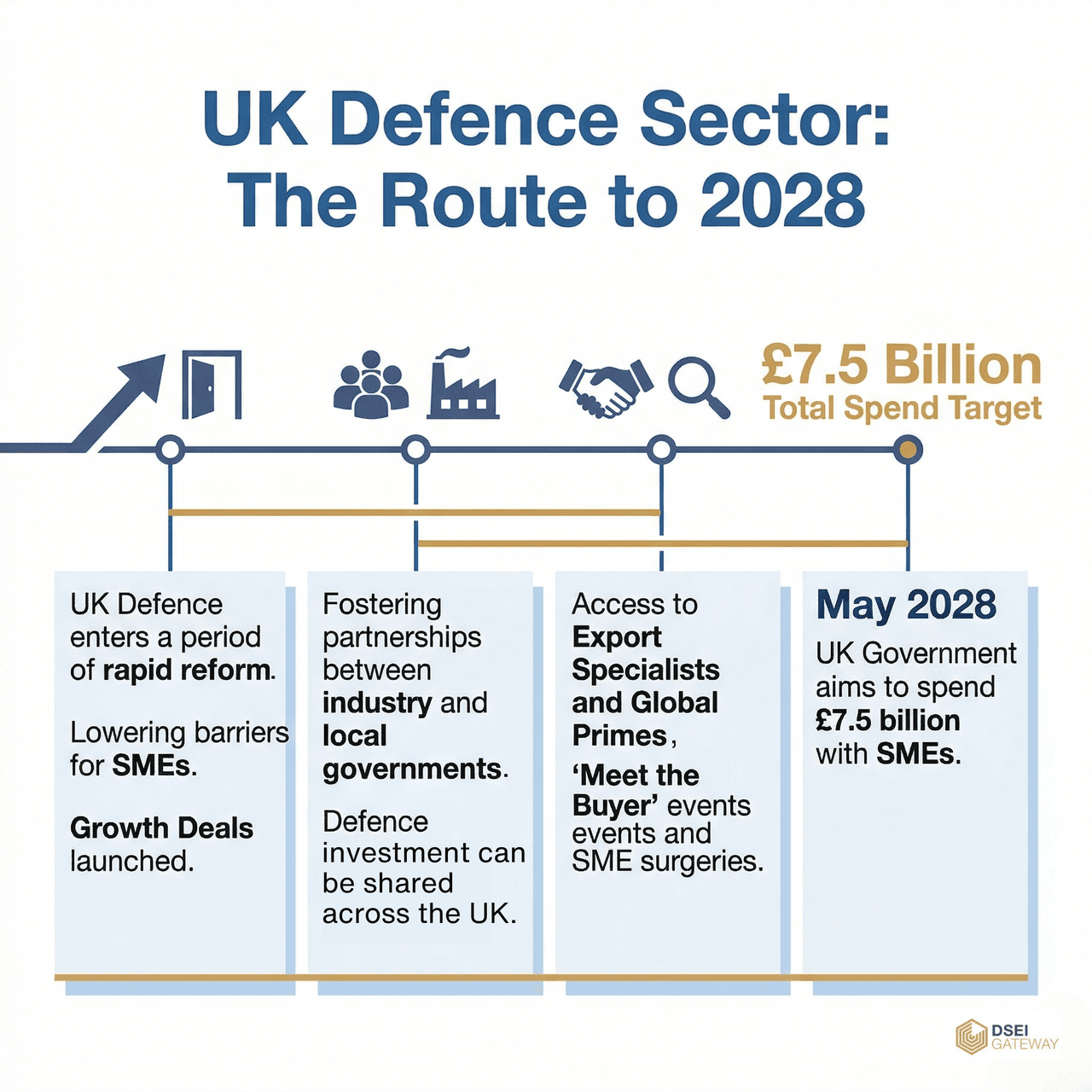
While these initiatives offer opportunities and guidance for SMEs navigating the defence sector, it can still be hard to make sense of it all.
Strategic routes to market: finding your level as an SME
One of the most common errors for an SME is "target fixation". Many companies believe that a direct contract with a Tier 1 prime is the only measure of success.
In reality, the UK defence supply chain is a multi-layered ecosystem. For the majority, the most sustainable growth occurs by identifying exactly where their technology or service sits within the tiers.
The tier trap: avoiding target fixation
A Tier 1 prime contractor, such as those managing the UK’s submarine or fighter jet programmes, acts as a systems integrator. They manage thousands of moving parts.
If your business produces a specific electronic component, a specialised sensor, or a high-precision machined part, your natural "customer" may actually be a Tier 2 or Tier 3 supplier.
Approaching a prime with a component that belongs in a sub-assembly line wastes resource.
It often leads to a "no" simply because the prime does not buy that specific item directly. By targeting the right level, your efforts are directed where they have the most impact.
Supporting organisations, such as regional trade bodies, can help you diagnose where your products realistically fit within these complex hierarchies.
The "Thin Prime" model: a new path for SMEs
The traditional "top-down" hierarchy is being challenged by the "thin prime" model.
In this framework, an SME takes total contract responsibility for delivering a specific capability or piece of equipment.
They then sub-contract larger OEMs to provide the heavy infrastructure or project management support required.
This model empowers smaller, agile firms to move up the value chain. It is particularly effective in fast-moving sectors like drone technology, AI-driven data analysis, and rapid prototyping.
Under a thin prime arrangement, the SME retains the intellectual property and strategic lead. In other words, it uses the prime’s resources as a "force multiplier" rather than being subsumed by them.
Utilising defence portals and frameworks
Visibility is the currency of the defence supply chain. Primes and the MoD use specific tools to manage risk and compliance.
So to be "seen" by the right buyers, SMEs must engage with established industry networks. Here are a few:
- JOSCAR (Joint Supply Chain Accreditation Register): Th is accreditation system is used by the largest UK defence primes to identify "ready-to-work" suppliers. Maintaining an up-to-date profile here is essential for pre-qualification.
- Defence Sourcing Portal (DSP): This is the official source of MoD opportunities. It provides access to tender notices for contracts over GBP10,000.
- Regional Growth Zones: New initiatives, such as the Industry Growth Zones, focus on UK-based production and skills development. These zones align with the Defence Industrial Strategy and offer SMEs a platform to showcase innovation to both government and industry leaders.
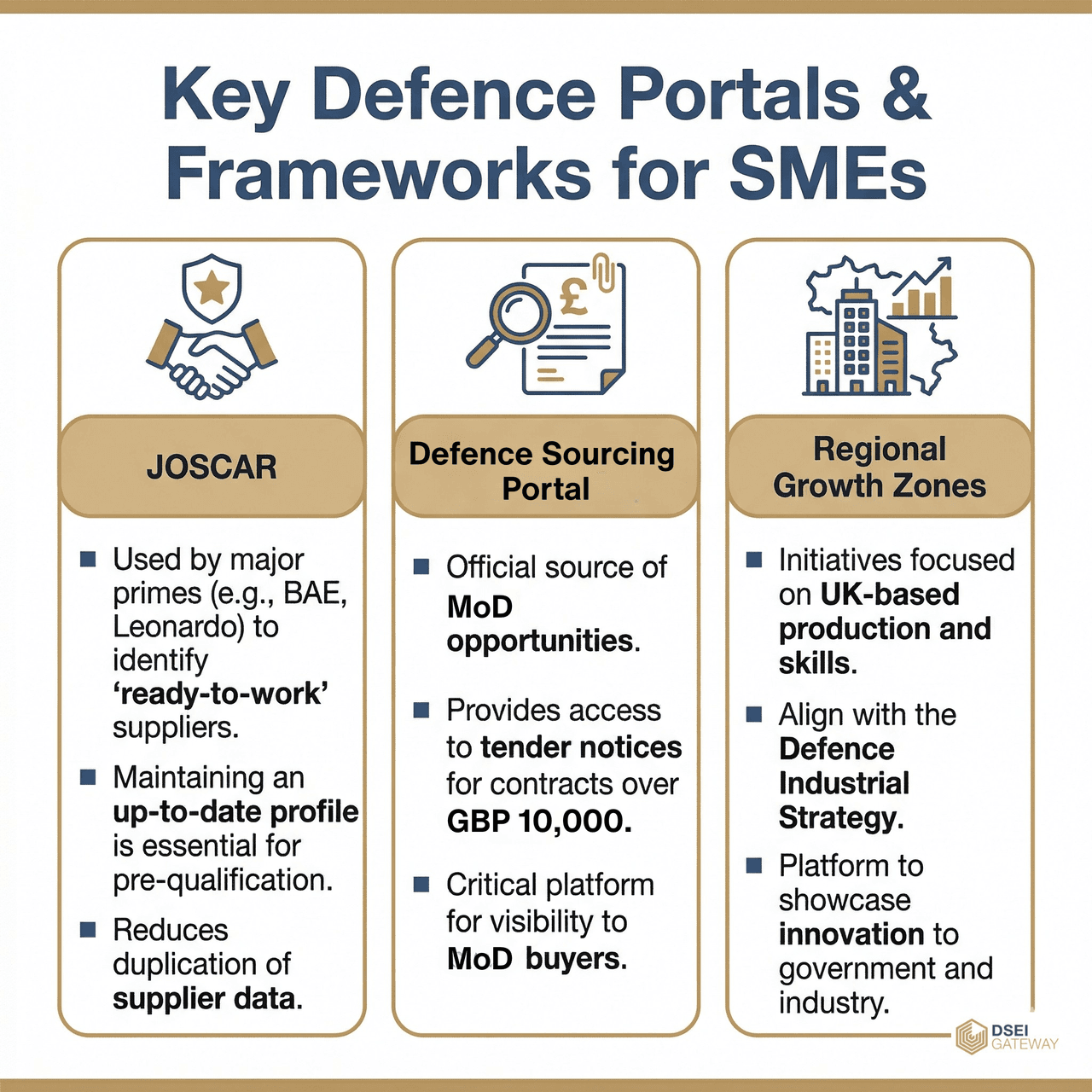
Effective engagement means going beyond the basic enquiry to provide clear, accurate data through the right channels.
Primes are increasingly looking for "peer-to-peer" connectivity; where they can connect an innovative SME directly with one of their own Tier 1 or Tier 2 partners.
This gets back to our win-win scenario. The SME grows, the supply chain becomes more resilient, and the prime ensures the best technology reaches the frontline.
Practical positioning for the modern supply chain
The UK defence supply chain is looking for more than just technical innovation.
To work with a prime contractor, an SME must demonstrate that it is "fit for business." This involves meeting stringent security, compliance, and social standards that primes use to mitigate risk.
Here are some of the areas to regularly monitor.
Compliance as a competitive edge: JOSCAR and ISO
Bidding can feel like an overwhelming task for the uninitiated SME. But steps are being taken to make it easier.
Prime contractors are trying to simplify things through standardised accreditation systems like JOSCAR, which acts as a single "source of truth" for supplier data.
By maintaining a validated profile on this platform, an SME can simultaneously demonstrate its credentials to multiple major primes (BAE Systems, Leonardo, and QinetiQ).
This reduces duplication and ensures that your business is visible when a buyer searches for specific capabilities. Key areas of focus within these assessments include financial stability, health and safety records, and quality management systems such as ISO 9001.
Cyber security: the non-negotiable baseline
It’s no secret we’re living in a world of digital threats. So cyber security is a fundamental requirement for any firm handling MoD-identifiable information. Most defence contracts now mandate Cyber Essentials or Cyber Essentials Plus certification as a minimum baseline.
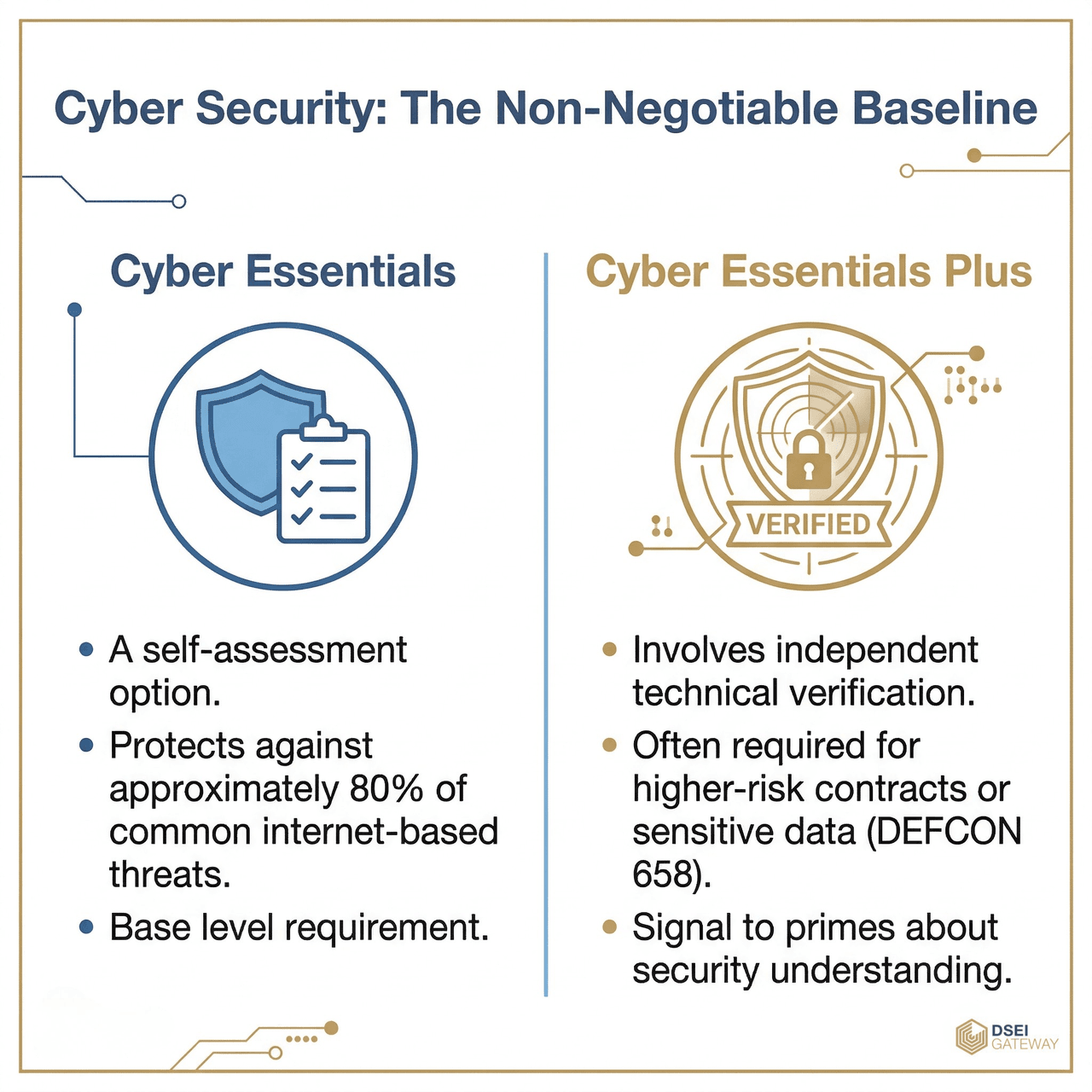
They cover:
- Cyber Essentials: A self-assessment option that protects against approximately 80% of common internet-based threats.
- Cyber Essentials Plus: Involves independent technical verification and is often required for higher-risk contracts or those involving sensitive data (governed by DEFCON 658).
Achieving these certifications goes beyond being a "box-ticking" exercise. It signals to a prime that you understand the importance of national security and have the technical controls in place to protect shared intellectual property.
Articulating social value and "additionality"
The Social Value Model (introduced via PPN 06/20) has transformed how tenders are evaluated.
At least 10% of the marks in an MoD contract award are now typically allocated to social value. Primes are looking for SME partners who can help them deliver on these targets.
To stand out, your SME should focus on "additionality". What extra benefit can you provide beyond the core contract?
This could include:
- Regional prosperity: Creating apprenticeships or high-skilled jobs in specific UK "levelling up" areas
- Environmental stewardship: Providing a clear Carbon Reduction Plan or demonstrating how your manufacturing process reduces waste
- Supply chain resilience: Showing how you support even smaller suppliers or diverse-led businesses within your own network
Effective engagement: moving beyond the "broad enquiry"
Primes receive thousands of enquiries every year. To get a meaningful response, your engagement must be targeted and evidence-based.
Avoid sending general brochures. Instead, identify a specific programme like the Global Combat Air Programme. Explain exactly how your solution solves a known challenge within that project.
Build relationships early. Use "Meet the Buyer" events not just to sell, but to listen.
You may be surprised at the prime's pain points, whether they are looking for more agile software development or specialised machining.
Align your business information with the prime's strategic pillars and there’s a good chance you’ll move your business from a "cold lead" to a valued potential partner.
SMEs: the future of sovereign capability
The relationship between SMEs and defence primes is no longer one of simple sub-contracting. It is a strategic necessity.
As the UK moves toward a target of spending GBP7.5 billion with SMEs by 2028, the opportunities for agile, innovative companies have never been greater.
Success in this sector requires a dual approach: maintaining the highest technical and security standards while being realistic about where your business fits within the supply chain. Whether you are aiming for a direct MoD contract, joining a prime-led consortium, or operating as a "thin prime," the goal remains the same: to provide the innovation that keeps the UK secure.
Your SME can move from the periphery of the defence sector to the heart of its most critical programmes. But it needs to target primes correctly and engage with new UK Government support structures, such as the Defence Office for Small Business Growth and regional growth zones.
Shifting towards a resilient, SME-heavy supply chain is a win-win for both national security and the UK economy.
Frequently Asked Questions
What is the UK Government’s spending target for SMEs in defence?
The UK Government aims to spend £7.5 billion with SMEs by May 2028. This target helps the MoD diversify its supply base and adopt new technology faster.
What is "target fixation" in the defence supply chain?
Target fixation is the mistake of believing a direct contract with a Tier 1 prime is the only measure of success. Sustainable growth for an SME often occurs by supplying Tier 2 or Tier 3 firms within the wider ecosystem.
How does the "Thin Prime" model benefit smaller firms?
In a "thin prime" model, an SME takes total contract responsibility. The SME subcontracts larger OEMs for infrastructure support. This allows the SME to retain its intellectual property and act as the strategic lead.
What are JOSCAR and DCO?
- JOSCAR: An accreditation system used by major primes like BAE Systems and Leonardo to identify "ready-to-work" suppliers.
- DCO (Defence Contracts Online): The official MoD source for tender notices on contracts valued over £10,000.
Is Cyber Essentials certification mandatory for UK defence work?
Yes. Cyber security is a non-negotiable baseline. Most contracts require Cyber Essentials or Cyber Essentials Plus to protect MoD-identifiable information.
James
Quilter
Senior Contributor, Clarion Defence & Security
James is a UK-based writer for Clarion Defence & Security. His background spans journalism, editorial leadership and content strategy. He has worked for leading B2B titles and global brands including EDF and X (formerly Twitter).