
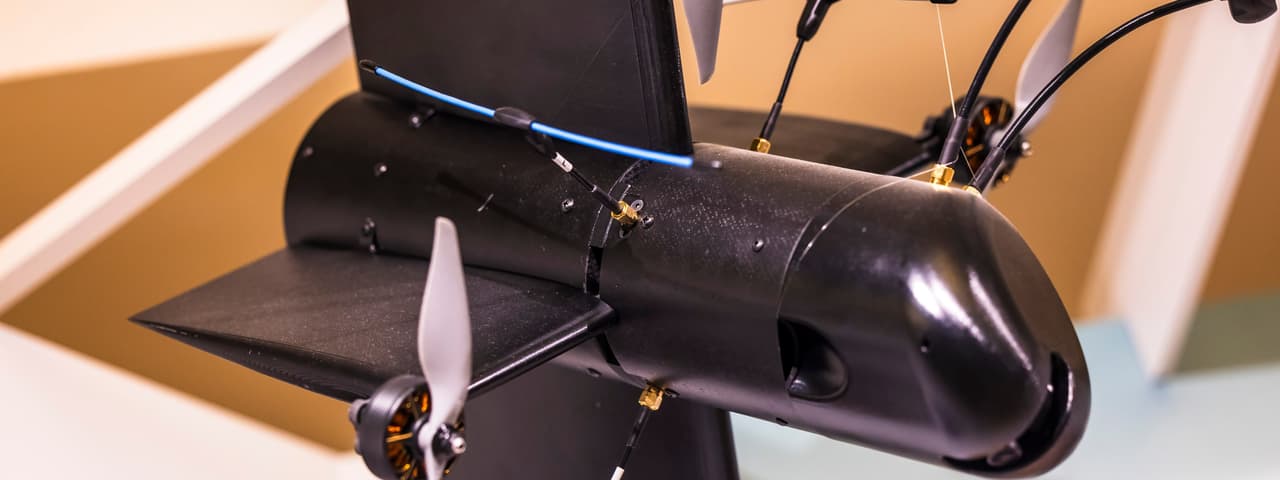
A drone interceptor from Switzerland's ENS Dynamics. (Shutterstock)
France launches competition for drone interceptor solutions
Selected companies will join a government-industry partnership.
14 APR 2026

By
Victoria
Hanscomb
Editor, DSEI Gateway
France has launched a competition for an ‘innovation partnership’ to develop interceptor drones that can be deployed without heavy equipment.
Announced via the EU’s Tenders Electronic Daily on 8 April, the Lightweight Autonomous System Interception Equipment (ELISA) partnership will see the phased development of the solutions.
The competition notice says that the anti-drone equipment France currently uses is not adequate to sufficiently defend against current and future threats, from both a quantity and cost perspective.
Therefore, the competition has been launched to identify “interceptor systems” that can neutralise drones “by impact or by an onboard pyrotechnic charge.” Targets include drones weighing over 100kg and with maximum flying speeds of 600km/h.
Approximately 1,000 units are expected to be acquired.
How will ELISA work?
Once eligible partners have been identified from the competition, a maximum of eight bids will be selected to enter into a framework agreement.
In the first phase, estimated to last two months, the maturity of existing drones that will form the basis of ELISA will be evaluated. During this phase, companies will also submit bids to continue onto phase two. France will subsequently offer a maximum of four contracts based on the technical results and the cost-effectiveness of the submitted proposals under phase one.
Phase two will see the remaining drones developed to meet target performance. Some may also be used by the French armed forces to “cover short-term needs”. The estimated duration of this phase is six months.
To enter phase three, participating suppliers will be sent an invitation to tender. Bids will be subject to negotiation, at the end of which the partners will submit a final offer.
The final phase will see the scaled-up production of the interceptor systems, as well as their continuous improvement. This phase is expected to last six years.
The next steps
The total estimated value of the ELISA partnership is EUR18.7 million, with the three phases reportedly worth EUR400,000, EUR5.8 million, and EUR12.5 million respectively. This will be further split between each company taking part.
The deadline for requests to participate in the competition is 7 May. It is open to any company in the European Economic Area.
Interested parties looking to bid should do so via Place.
Victoria
Hanscomb
Editor, DSEI Gateway
Victoria Hanscomb is an Editor at DSEI Gateway, reporting on the defence industry. Her previous experiences as an Editor include covering the international security market and pharmaceutical sector.