
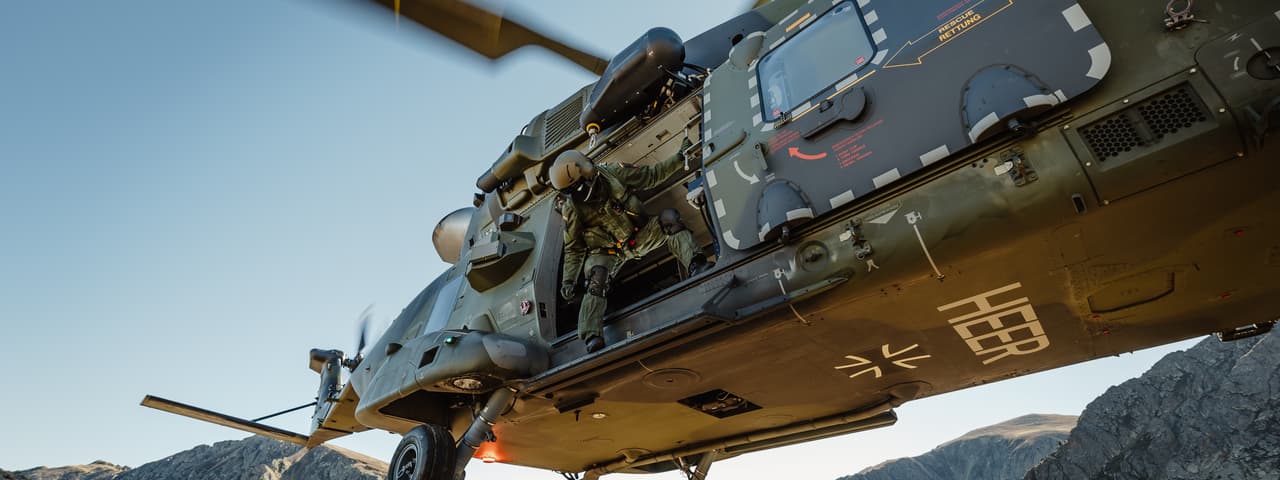
A Bundeswehr NH-90 multi-purpose helicopter. (German Armed Forces)
Germany releases first military strategy since WWII
At its core, the strategy outlines Germany’s plan to assume strategic defensive responsibility for Europe.
23 APR 2026

By
Olivia
Savage
Editor in Chief, DSEI Gateway
Germany has released its first military strategy since WWII as the country looks to take a more prominent role in European defence.
This follows a major increase in defence spending, funded partly througha a EUR400 billion borrowing programme.
Announced by the Bundeswehr (armed forces) on 22 April, the military strategy acknowledges that “German society as a whole is under threat”, particularly from Russia, which is the “greatest threat to our security in Europe.”
Given its position as Europe’s largest economy, Germany intends to "take on conventional strategic responsibility for Europe.”
This includes forming the “strongest conventional army in Europe”, to prepare for “the escalation of warfare.”
Three phases to 2039
The military strategy lays out three phases for achieving this by 2039:
- Phase one: rapidly increase deterrence and defence, through the “focused deployment of available resources”
- Phase two: the armed forces must be able to credibly deter attackers together with its allies and, if necessary, defend within the alliance
- Phase three: expand the Bundeswehr into the strongest conventional army in Europe through the consistent use of innovative technologies
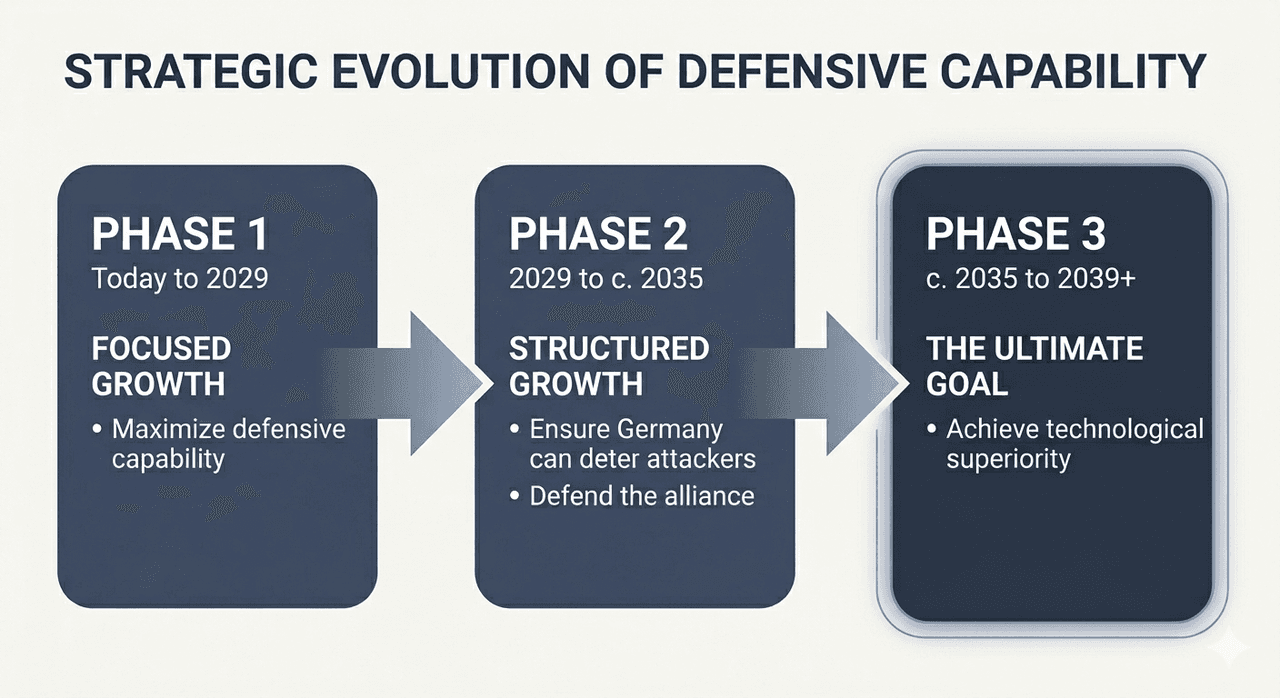
Germany's phased military strategy timeline to 2039. (DSEI Gateway)
Personnel and capability priorities
To support this, Germany plans to increase active-duty personnel from approximately 186,000 to 260,000 by the mid-2030s, while expanding its reserves from 70,000 to at least 200,000.
While specific capability requirements remain classified, the strategy highlights the development of capabilities aligned with Germany's new “conventional-strategic role.”
Key priorities include expanding its “territorial missile defence” assets, establishing a “multidimensional reconnaissance and engagement network for the deployment of long-range precision weapons”, and ensuring a blend of high-end capabilities and affordable mass-produced systems.
Consistent with broader NATO doctrine, the strategy identifies the digitisation of the battlefield and the blurring of conventional warfare as critical areas requiring immediate attention.
Military mobility is also listed as a priority that must be addressed to ensure Germany can operate “increasingly independently” within NATO’s territory.
While the strategy remains high-level regarding specific capabilities, it is significant for formalising Germany's intent to assume strategic defensive responsibility for Europe.
Olivia
Savage
Editor in Chief, DSEI Gateway
Olivia Savage is the Editor in Chief of Clarion Defence & Security, organisers of DSEI and other defence events. Previously, she was a Senior Defence Journalist at Janes, specialising in electronic warfare, uncrewed systems, and space.