
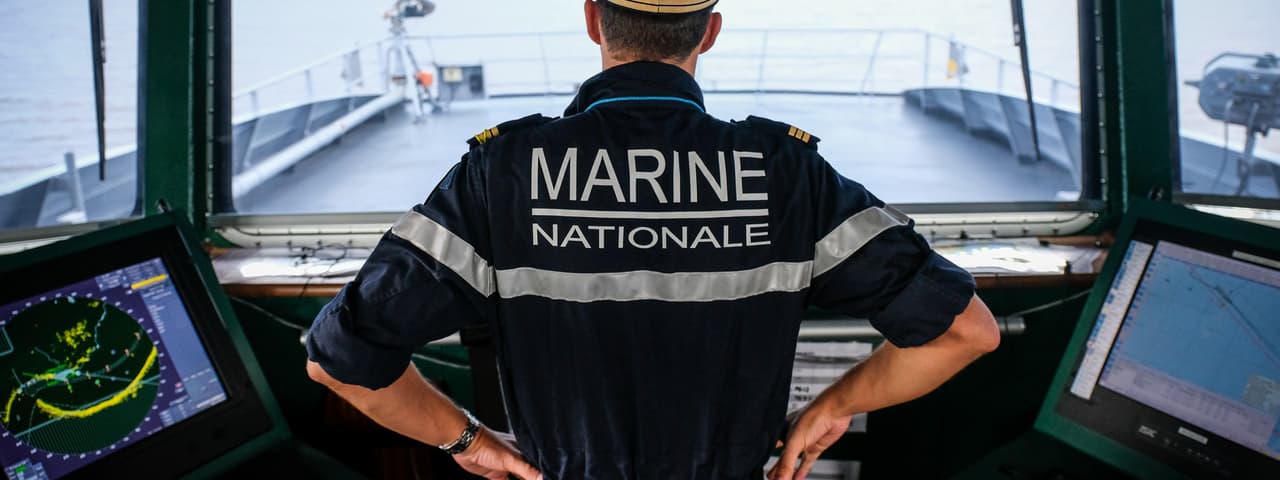
A sailor in the French Navy. (Shutterstock)
France requires optronic identification systems
The systems must have the capacity to integrate AI.
27 JUL 2026

By
Victoria
Hanscomb
Editor, DSEI Gateway
France has launched a competition for the supply of optronic recognition and identification systems, to improve the detection and tracking capabilities of its navy.
Announced via the EU’s Tenders Electronic Daily on 21 July, the competition is specifically seeking 10 to 20 systems that will be installed on France’s Floréal class surveillance frigates, patrol boats, and scientific vessels.
The optronic identification requirement
According to the competition, the systems must include “at least one day channel and one infrared channel”, to enable operations 24/7.
The systems must also be able to detect objects at over seven nautical miles away and identify objects at distances greater than five nautical miles. Once detected, the system should have the capacity to automatically track the objects.
A laser rangefinder must additionally also be included as part of the system, alongside the ability to receive target designations from a navigation radar or other combat system.
The competition also notes that the optronic systems must be able to integrate AI, for the incremental improvement of detection and identification.
The ability to operate in harsh environmental conditions, including polar or tropical climates, is also essential for the systems.
Competition details
France says that a framework agreement lasting seven years and with a maximum value of EUR10 million will be awarded to the winner of the competition.
Alongside the supply, France requires the winning company to install and maintain the optronic systems, while also providing any associated services.
Companies that wish to enter the competition must be based within the EU or European Economic Area.
The deadline for applications is 20 August.
What are optronic recognition and identification systems?
Optronic – or electro-optical – systems are used to detect, track, and identify objects using visible and infrared light.
This differs from radars, which use radio waves to detect objects. By utilising light-based sensing, optronic systems are more passive than radars. This provides a layer of protection against electronic jamming.
Common components of optronic systems often include cameras, thermal or infrared imagers, laser rangefinders, and gimbal mounts. Some include automatic tracking software.
Victoria
Hanscomb
Editor, DSEI Gateway
Victoria Hanscomb is an Editor at DSEI Gateway, reporting on the defence industry. Her previous experiences as an Editor include covering the international security market and pharmaceutical sector.