
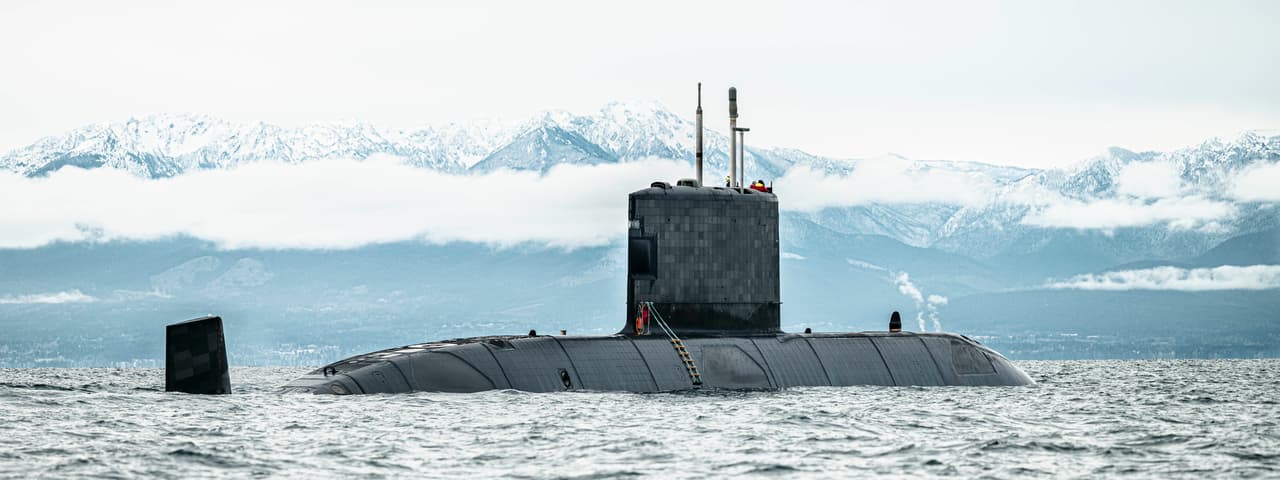
The RCN submarine HMCS Corner Brook. (Department of National Defence, Canada, 2025)
Towards a hybrid navy: Canada’s naval commander sets out his plan
The head of the Royal Canadian Navy informs DSEI Gateway how the service plans to build a hybrid force of uncrewed and crewed systems.
16 MAR 2026

By
Dr Lee
Willett
Independent naval writer and analyst
To quickly build mass at sea, NATO navies are investing in uncrewed platforms to work in tandem with crewed vessels – an approach often called ‘manned/unmanned teaming’ (M/UMT).
Uncrewed platforms add mass in both capacity and capability, helping to offset previous force level reductions being felt today across NATO’s crewed fleets, particularly at a time of returning naval contest and conflict.
M/UMT is central to many NATO navies’ wider evolutionary transformation into ‘hybrid navies’, generating a new force structure built around harnessing uncrewed autonomy to enhance crewed platform outputs.
One NATO navy starting down this pathway is the Royal Canadian Navy (RCN). Tasked with building deterrence across three separate and geographically vast oceans – the Arctic, Atlantic, and Pacific – the RCN is seeking to bolster its deterrence through force recapitalisation covering its submarine and surface forces. Central to this strategy is the development of a ‘hybrid navy’.
On the surface, the incoming River-class destroyers will be the centre of the RCN fleet. Developed under the Canadian Surface Combatant programme, the 15 ships are being built using the UK Royal Navy’s (RN’s) Type 26 City-class anti-submarine warfare (ASW) frigate design.
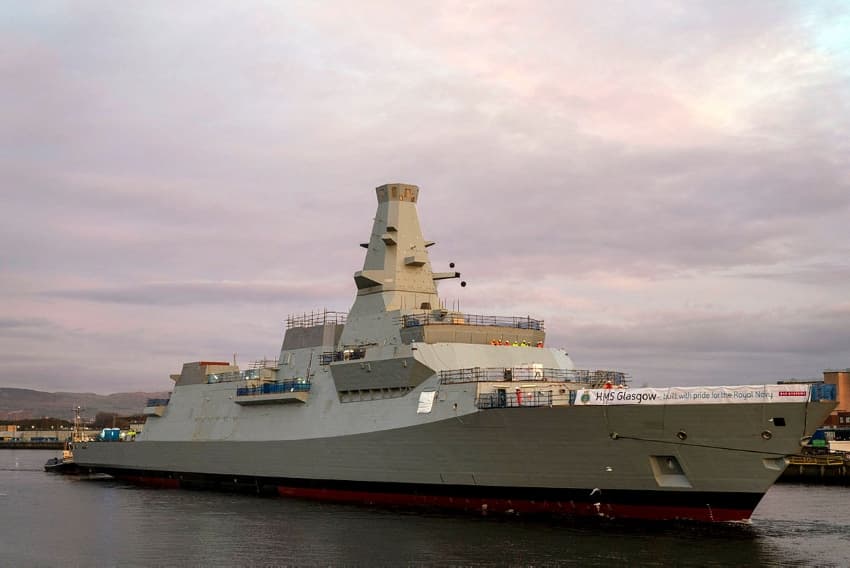
The Royal Navy's Type 26 HMS Glasgow. (UK MoD Crown Copyright)
To enhance the destroyers’ force protection and force projection capabilities across the vast oceanic spaces, the RCN is looking to lace together layers of autonomous uncrewed systems across all domains, particularly to provide defensive ‘screens’ to shield the ships.
Destroyer defensive layers
Vice Admiral (VADM) Angus Topshee, Commander RCN since May 2022, has been driving his navy towards delivering this new force structure as soon as possible.
“We absolutely need to be moving towards a hybrid navy,” VADM Topshee told DSEI Gateway.
The River-class destroyers’ capabilities are a key driver for adopting the hybrid model, the admiral explained, because the ships can carry in their vertical launching systems a mix of local, area, and ballistic missile air-defence systems plus land-attack/anti-ship strike weapons.
Yet an operational implication of such a high-end capability fit is that the RCN must create mass to defend the destroyers, as they will be primary targets for adversaries.
“The reality of naval warfare is the first effective salvo wins the battle.... So, how do I better protect that ship?”
VADM Topshee asked.
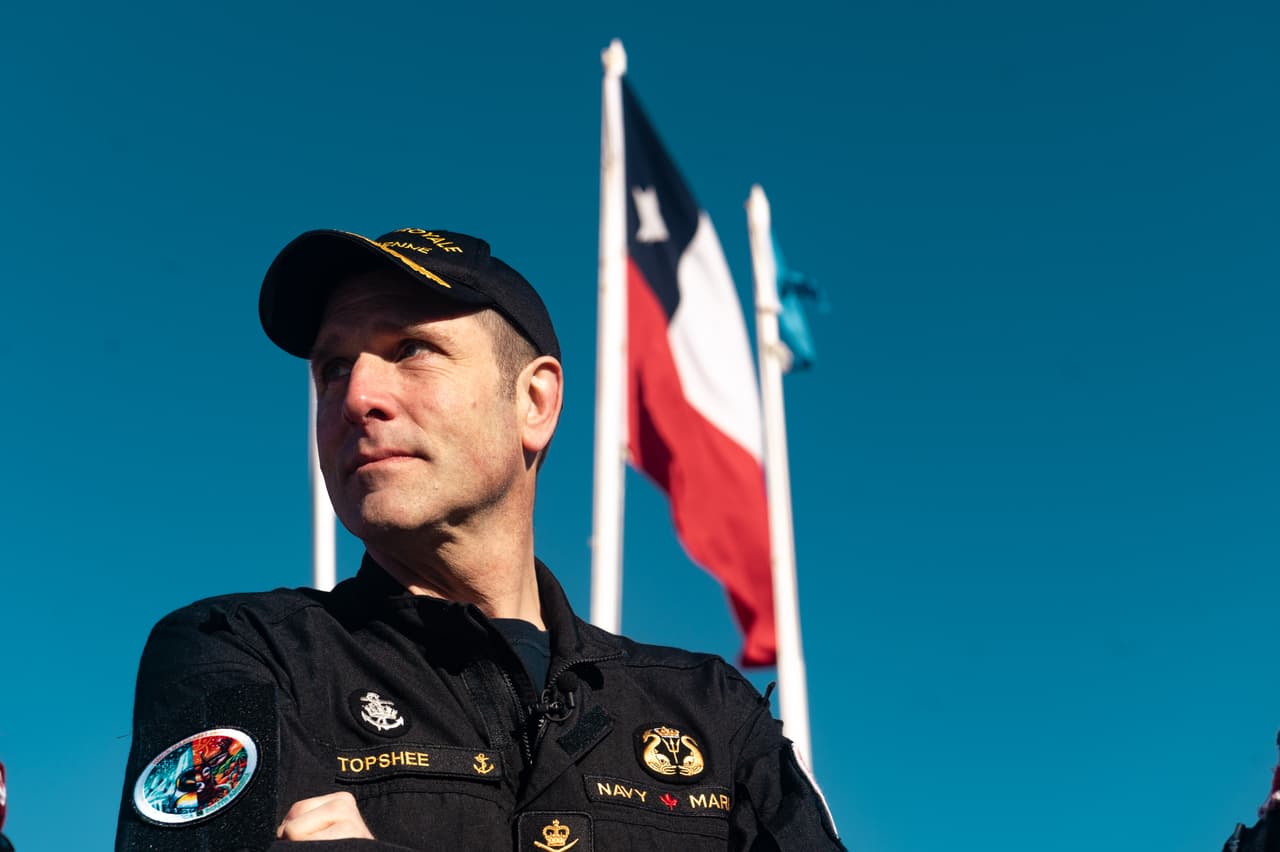
VADM Topshee, Commander RCN. (Department of National Defence, Canada, 2025)
The RCN’s answer is to build a massed, layered, defensive ‘shield’ around the destroyers – particularly, using large optionally crewed surface vessels.
Deploying several such vessels alongside the destroyer, with those vessels bringing sensors and effectors, adds capability to the fleet. Crucially, it also complicates adversary targeting by presenting a greater number of platforms to address, the admiral explained.
“[An adversary] can’t just try and figure out ‘which one’s the one I really want?’”, he said.
The option to use such surface vessels in crewed or uncrewed mode augments operational flexibility, too. For example, using the platforms without crew onboard, in fully autonomous mode, offers value in allowing the vessels to conduct tasks against certain risks in a manner that otherwise would not be attempted, VADM Topshee said, noting too that the option to operate with no crew may change risk calculations for some tasks.
The next defensive layer would involve the large uncrewed surface vessels carrying and co-ordinating a series of smaller uncrewed systems, in all domains, to provide protection for the destroyers against inbound uncrewed system attacks, VADM Topshee said.
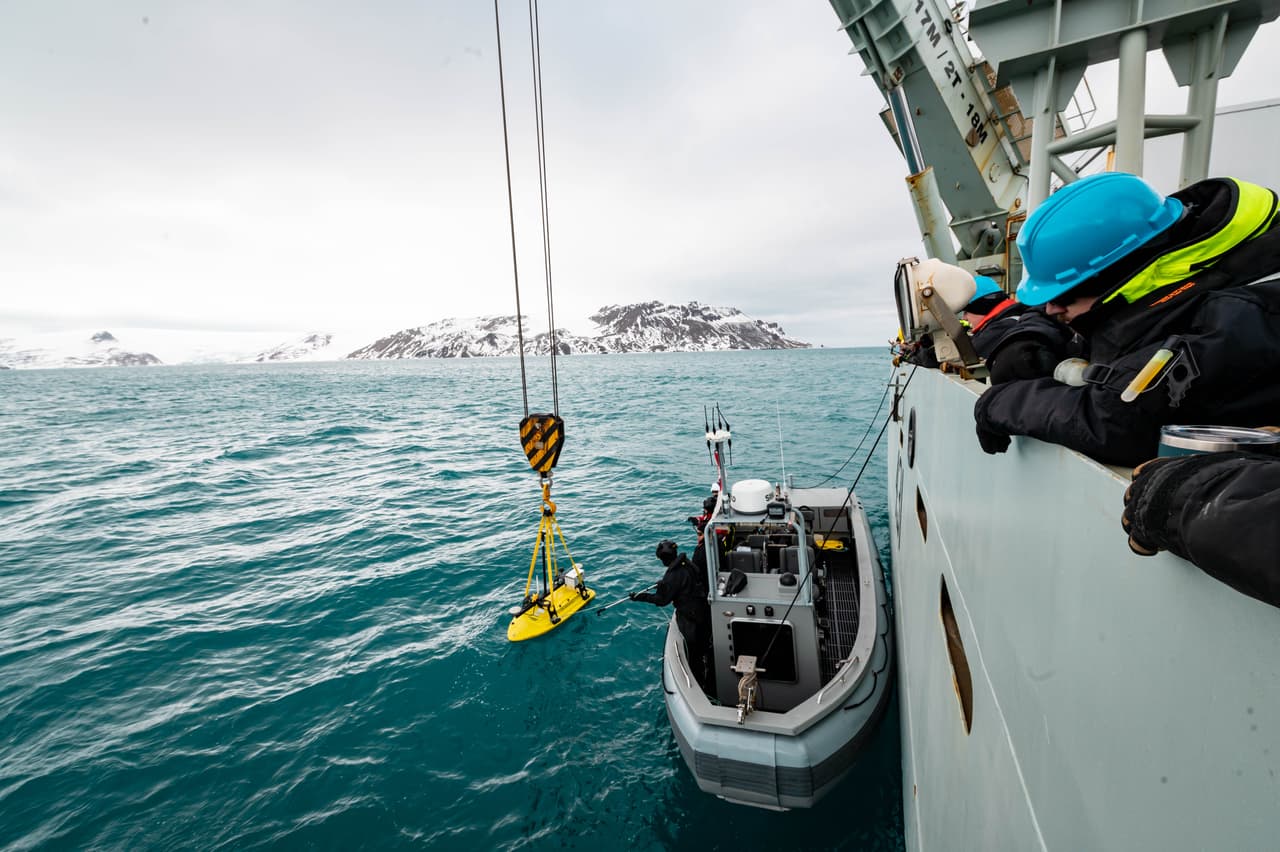
An Echoboat-160 USV launched from the Royal Canadian Navy HMCS Margaret Brooke. (Department of National Defence, Canada, 2025)
Undersea deterrence
The RCN anticipates using a similar force structure to build undersea presence, surveillance, and deterrence around its future submarine. This capability is being delivered under the Canadian Patrol Submarine Project, which is in its final procurement stages.
In the Arctic, for example, the navy sees its future submarine as being the cornerstone of a layered set of ‘nodes’ that includes a network of uncrewed systems and seabed arrays delivering sensing capacity and capability.
“We need that sensor network to tell us what’s there”, VADM Topshee said. “I don’t want to patrol with a submarine: I want to be able to deter with a submarine, and have the knowledge from other platforms.”
Canada’s coastline covers over 250,000km. “To patrol all of that maritime environment, I want to do so with remotely operated platforms and with sensor networks that are fixed and mobile, and then have the submarine cued on to where it needs to go”, he explained.
Naval warfare evolution response
Naval warfare is evolving rapidly, with the admiral commenting that: “People keep telling me, ‘ships are doomed because, with all these drones developed [in the Russo-Ukraine war], why would you even build ships anymore?’”
Yet, he argued, naval warfare history has illustrated that surface ships have proved to be conceptually durable and operationally flexible despite the emergence of various technology threats.
For example, surface ship concepts have evolved over time to counter emerging threats in all domains – air, surface, and sub-surface (torpedo) – with the modern-day destroyer representing the amalgamation of defensive responses to each of these emerging threats. Yet in tandem, such concepts have retained the capacity to deliver core surface ship tasks, from surveillance to escort to diplomatic engagement.
Summarising how this evolution relates to the use of uncrewed systems and the River-class destroyers, VADM Topshee explained: “I think what we’re going to see is those hybrid vessels are going to become the defence against uncrewed systems. They’re going to act as a screen.”
Effectively, this ‘hybrid’ operational model creates a reciprocal relationship between high-end, crewed platform capabilities and uncrewed systems. In this framework, crewed platforms counter high-end threats and enable uncrewed operations; meanwhile, uncrewed systems counter one another to augment the fleet’s overall output. All of this is managed within a single, integrated, multi-layered operational framework.
In this context, VADM Topshee argued that many surface ships are likely to become ‘drone carriers’ to some degree. The Type 26 design delivers a dedicated, high-end, ASW-focused ship; however, it also provides significant capacity to enable the RCN to generate uncrewed system outputs from the River-class to support various tasks.
“Having walked Glasgow [the RN’s lead Type 26] and seen the size of the combined mission bay and hangar, all I could picture in there was every conceivable type of drone under the water, on the water, and in the air that we might want to operate.”
VADM Topshee
Co-operation to build output
Other NATO navies, including close RCN partners, are already starting to put M/UMT operational concepts and plans into practise.
The RN, for example, is underway with uncrewed system capability procurement for the first phase of its ‘Atlantic Bastion’ plan, under which integrating M/UMT is designed to deliver ASW force multiplication around the Greenland-Iceland-UK (GIUK) Gap and elsewhere across the North Atlantic.
The RN aims to be deploying operational sensors for this phase, ‘Atlantic Net’, in 2026. The RCN, and other NATO navies such as the Royal Norwegian Navy, have expressed interest in participating in Bastion in some way.
Introducing uncrewed systems into the RCN presents opportunities for industry to provide design, technology, and capability across different elements including platforms; sensors and effectors; and integrators and enablers.
From the RCN’s perspective, VADM Topshee said: “There’s no doubt we’re going to be a hybrid force. The challenge we’re going to have to work through is how does that become real in an environment where communication could equal death?”
“Autonomy becomes incredibly important for when you don’t have the communications link,” he said, adding, “There are other means of communication we can use that will solve some of those problems we can’t see right now.”
VADM Topshee mentioned quantum technology, as an example.
The RCN has not yet tested quantum technologies within its uncrewed capability development. However, some NATO navies have, including the RN.
In October 2025, it deployed an Infleqtion Tiqker quantum optical atomic clock onboard its MSubs-manufactured testbed extra-large uncrewed undersea vehicle. An RN statement noted that such technology can help maintain platform precision, navigation, and timing, reducing external communications needs.
NATO developed as, and remains today, a collaborative alliance. Whether building uncrewed capabilities, their operational concepts, or the enablers that enhance their effective use, NATO navies like the RCN will be able to work in bilateral, multilateral, and alliance contexts to generate and integrate the massed presence and effects that uncrewed systems offer within hybrid force structures.
Dr Lee
Willett
Independent naval writer and analyst
Dr Lee Willett is an independent defence and security writer with extensive experience covering international issues, specialising in naval affairs. His work appears in leading publications including Janes and Naval News. He has previously held roles at Janes and RUSI.