
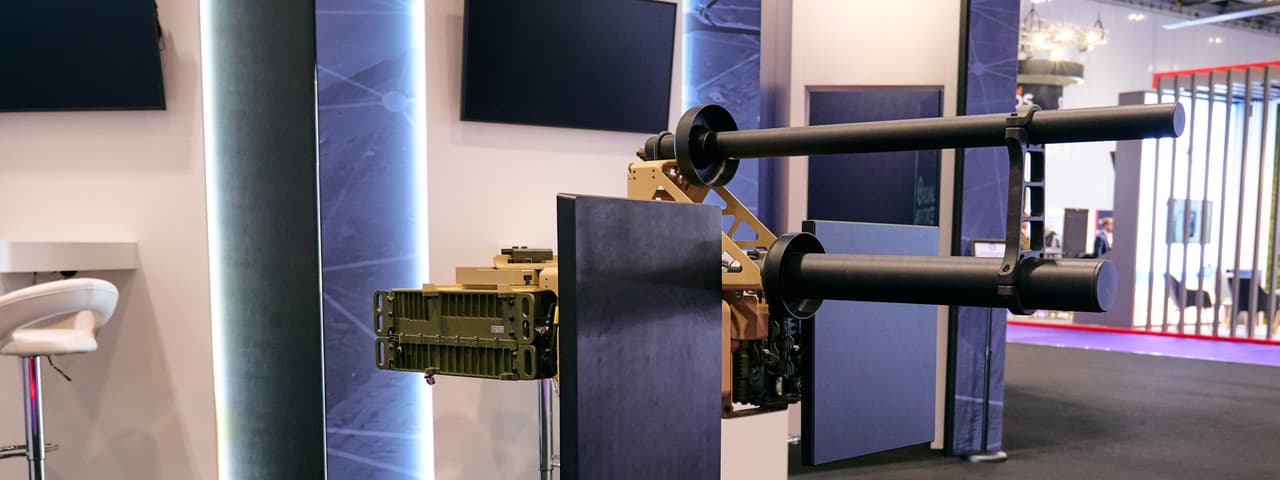
C-UAS on display at DSEI UK 2025.
UK launches competition for C-UAS technologies
Grants of up to GBP1.25 million will be awarded to development projects at varying levels.
06 MAY 2026

By
Victoria
Hanscomb
Editor, DSEI Gateway
The UK is calling for new counter-UAS (C-UAS) technologies to help protect its military sites and critical national infrastructure, including the country’s prisons.
Announced by the government on 5 May, the competition requires systems that can detect, track, identify, decide, and defeat aerial threats, while minimising collateral damage.
The platforms may be standalone or have the capacity to integrate into a wider C-UAS solution.
The government aims to fund a variety of projects across different technologies, markets, technological maturities, research categories, and locations. These include industrial research and developmental projects.
A share of up to GBP5 million is available to fund the projects, with each grant worth between GBP300,000 and GBP1.25 million. This funding will be supplied by Innovate UK, part of UK Research and Innovation.
How will the projects work?
Two separate types of submissions are being accepted based on technical maturity and use-case. The first requires systems at technology readiness level (TRL) five or above, which can protect defence sites and critical infrastructure. These technologies must be “cost-effective and scalable”, and ready for deployment by 2028.
The second submission type is calling for technologies that are at an early-stage of development – up to TRL four – which prevent illegal UAS activity around prisons. These systems must be ready for deployment by 2030.
Submissions for the competition are due by 3 June.
The selected projects will last between eight and 12 months, with work beginning from 1 September. The projects must be carried out in the UK, unless pre-approved by Innovate UK.
“There are growing risks of UAS ingress to defence sites, critical national infrastructure, airports, schools, and public events,” the government said.
“With a limited number of UK-based suppliers of C-UAS technologies, national capability is a vulnerability and given the rapidly growing global market there is significant opportunity for domestic growth.”
This latest competition follows several other C-UAS efforts from the UK, including a request for information in March to identify capabilities for the Royal Navy and a call in January for solutions at TRL eight and above.
Victoria
Hanscomb
Editor, DSEI Gateway
Victoria Hanscomb is an Editor at DSEI Gateway, reporting on the defence industry. Her previous experiences as an Editor include covering the international security market and pharmaceutical sector.