

(Shutterstock)
Pentagon outlines 2027 budget requirements
The proposed budget represents a 42% increase from FY2026.
30 APR 2026

By
Victoria
Hanscomb
Editor, DSEI Gateway

By
Olivia
Savage
Editor in Chief, DSEI Gateway
The Pentagon and the individual US services have unveiled their 2027 spending requirements, with 52% of the requested budget allocated towards buying hardware, including munitions, aircraft, tanks, and ships.
If approved, the budget request “will be the largest investment in military capabilities in over a generation," Jules Hurst III, the acting Under Secretary of War, said on 21 April during a Pentagon briefing.
"This budget allocates over USD750 billion... just in capability development and procuring weapons systems."
Ahead of the detailed breakdown of the Pentagon’s funding requirements, in April the US administration asked Congress for USD1.5 trillion for its total 2027 defence budget – a 42% increase from 2026.
According to the Pentagon’s detailed budget request, priority investments include USD18 billion to operationalise the Golden Dome homeland air defence system, USD74 billion on drone and counter-drone technologies, and more than USD75 billion on enhancing “space superiority”.
To put these fiscal requests into perspective, the UK’s 2026 defence budget totals GBP62 billion (USD83 billion).
Aside from the top-line Pentagon spending requirements, the individual services have also outlined their budget requests.
For the US Army, USD253 billion is being requested, in total, to fund three key areas: procurement, research, and personnel.
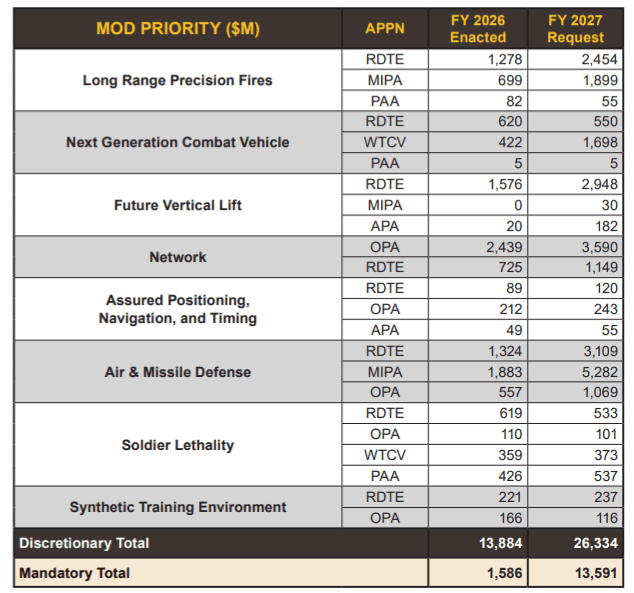
A screenshot of the US Army's top-line capability priorities
A central theme of the budget is “transformation”, which includes “aggressively” reforming the acquisition process to deliver technology to the warfighter faster, according to the US Army.
Priority capability requirements include the following: long-range precision fires; next-generation combat vehicle; future vertical lift; network; and soldier lethality, among others.
Aside from the army, the US Navy has requested a budget of USD377.5 billion, representing a USD70 billion, or 23% increase, from 2026.
The budget is focused on “restoring American maritime dominance”, with a total USD150 billion focused on procurement.
This includes an allocation of USD65.8 billion to purchase 18 battle force ships and 16 auxiliary vessels. Additionally, these funds will look to continue the ongoing procurement of the Columbia-class and Virginia-class submarines and will support the design and development of the navy’s new large surface combatant, the BB(X) battleship, first announced late last year.
A further USD34.4 billion is dedicated to procuring 123 aircraft, including 47 F-35 fighters, while USD22.6 billion is being requested to purchase munitions.
John Phelan, Secretary of the Navy, said: “This is a strategy-driven budget. It's not about business as usual – it's about making generational investments in real, usable capability for our warfighters."
Meanwhile, the US Air Force and US Space Force have requested a “significant boost” to their budget, asking for USD338.8 billion – a record-breaking amount. This is split between USD268 billion for the US Air Force and USD71 billion for the US Space Force.
The total represents a USD92.5 billion – or 38% – increase compared to 2026. According to the air force, the budget is designed to “sharpen readiness” and modernise its capabilities.
Specifically, the proposal earmarks USD7.4 billion to purchase 38 F-35 stealth fighters and USD3 billion to accelerate the development of the F-47 fighter. For the space force, USD6.7 billion has been requested to strengthen satellite communications, and USD21.6 billion – a 158% increase from 2026 – to continue investment in space control.
Olivia
Savage
Editor in Chief, DSEI Gateway
Olivia Savage is the Editor in Chief of Clarion Defence & Security, organisers of DSEI and other defence events. Previously, she was a Senior Defence Journalist at Janes, specialising in electronic warfare, uncrewed systems, and space.
Victoria
Hanscomb
Editor, DSEI Gateway
Victoria Hanscomb is an Editor at DSEI Gateway, reporting on the defence industry. Her previous experiences as an Editor include covering the international security market and pharmaceutical sector.