
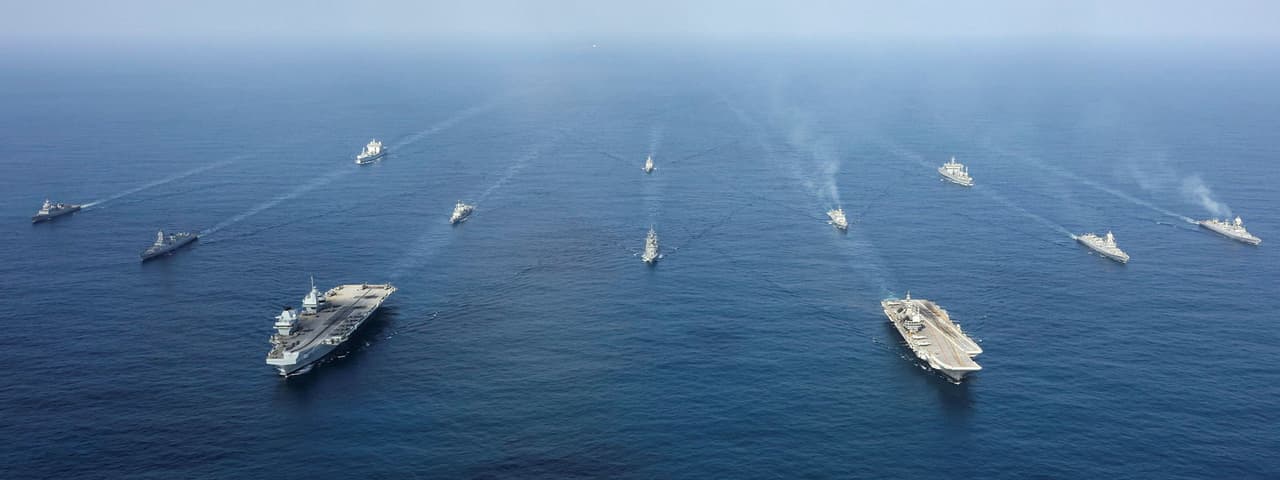
NATO forces participating in the UK’s Carrier Strike Group 2025, joined by ships from India and Japan. (UK MoD Crown Copyright 2025)
Global defence spending hits record levels in 2025
The rise was largely driven by Europe, which now represents 21% of global defence spending.
25 FEB 2026

By
Benjamin
Howe
Defence Journalist, DSEI Gateway
Global defence expenditure hit a record USD2.63 trillion in 2025, up 6% from USD2.48 trillion in 2024, the International Institute for Strategic Studies (IISS) think tank has revealed.
Released on 24 February alongside its annual ‘The Military Balance’ report, the data shows that when adjusted for real-terms growth, spending increased by 2.5% globally.
The US remains the top military spender, allocating USD921 billion, followed by China (USD251.3 billion). However, China’s defence spending is estimated to equal USD531.4 billion when purchasing power parity is considered.
Despite spending significantly less than the two biggest players, this year’s figures reflect a strong push among European countries to raise defence spending to deliver new capabilities and bolster industrial resilience.
Considering this, Europe’s share of global defence spending increased from 17% in 2022 to 21% in 2025. Seven of the top 15 global defence spenders are based in Europe, including Russia.
Much of this rise can be attributed to the commitments of the continent’s largest economy – Germany – which suspended debt rules in March to enable greater defence spending.
For much of Europe, the primary motivation behind increased defence spending remains the threat from Russia, which now spends 7.3% of its GDP on defence.
However, a sharp rise in Russia’s defence spending in 2024 (56.9%), was followed by a real-terms rise of just 3% in 2025, with economists highlighting weaknesses in the country’s economy after four years of war.
Responding to this continued threat, many European countries have planned multi-year or future increases in their defence expenditure to reach NATO’s new 5% spending target by 2035. This includes 3.5% of GDP on core defence spending and 1.5% of GDP on security-related expenditure such as infrastructure.
The UK, for example, plans to begin increasing its defence expenditure to 2.6% of GDP by 2027 before meeting the NATO target in 2035. Although the government has not outlined its plan for achieving this yet.
Meanwhile, the EU has relaxed rules around member state deficits to enable greater defence spending over the coming years, while standing up a new USD150 billion loan system called the Security Action for Europe (SAFE) instrument for joint procurement.
Benjamin
Howe
Defence Journalist, DSEI Gateway
Benjamin is a UK-based Journalist working for DSEI Gateway, having previously worked as a Content and Community Manager on Clarion's digital products.