
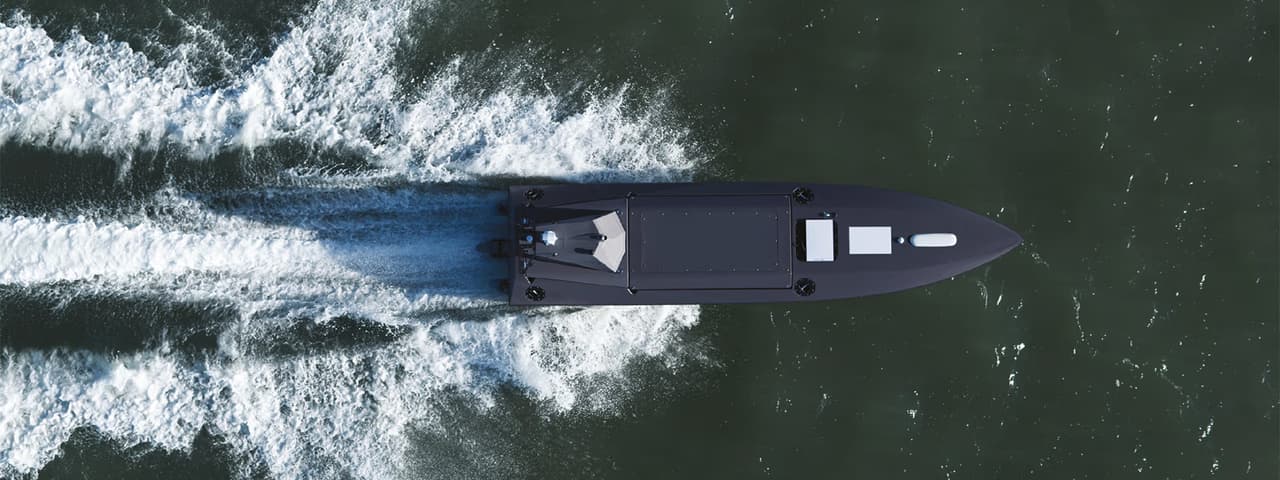
K3 Scout USV. (Kraken Technology)
Tech Quarterly: Kraken Technology – the SME rewriting maritime production
Kraken Technology features in DSEI Gateway’s Tech Quarterly as the UK scaleup building attritable USVs at automotive scale for NATO countries.
01 JUL 2026

By
Kate
Tringham
Freelance Defence & Security Journalist
In less than six years, UK-based Kraken Technology has evolved from a startup of three staff to a scaleup of nearly 200, delivering operational uncrewed surface vessels (USVs) to NATO customers on both sides of the Atlantic.
At the same time, it has established major manufacturing partnerships with defence companies such as Rheinmetall and Anduril Industries and built a manufacturing model aimed at producing autonomous vessels at volumes more commonly associated with the automotive industry.
The company’s success is centred on an expanding portfolio of high-performance, modular and scalable maritime uncrewed vessels built with carbon-fibre composite materials. The most well-known of these is its flagship attritable 8.4m long K3 Scout USV – 20 of which were delivered to the UK Royal Navy to support its ‘Hybrid Navy’ transition under Project Beehive.
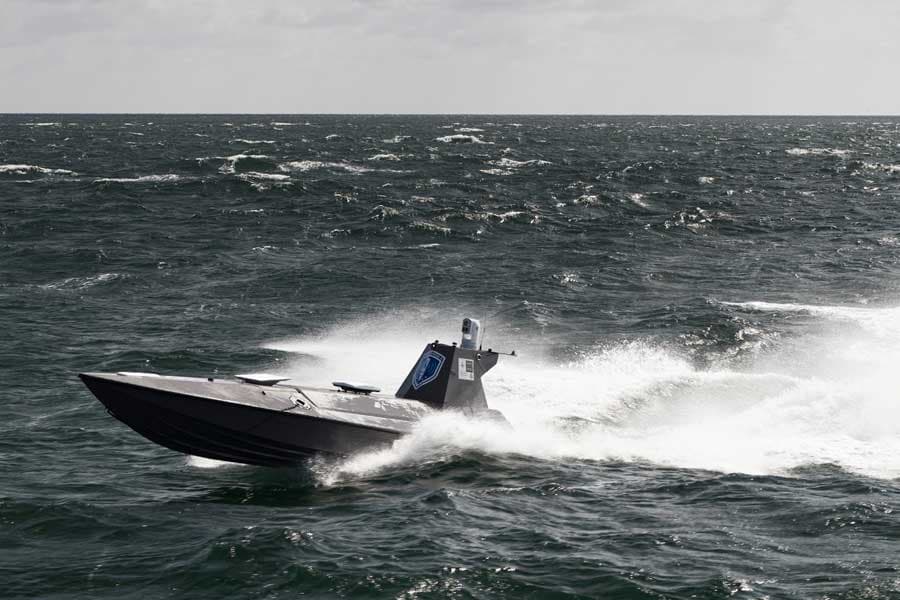
K3 Scout USV. (Kraken Technology)
To meet growing customer demand for the K3, Kraken Technology’s UK facilities now have the capacity to scale up to 1,000 units annually – with a similar number able to be produced in Germany.
Speaking to DSEI Gateway, founder and CEO Mal Crease said Kraken Technology’s growing reputation has been built on delivering operational capability quickly. “Ultimately, you’re judged on execution,” he said.
“If we say we’re going to deliver something, we deliver it. We don’t talk about it – we get it done, and we don’t stop until it does what we said it will do. And I think that is respected by the customer and operators.”
From civil to defence
Before founding Kraken Technology in 2020, Crease and several members of the leadership team built their reputations in the world of offshore powerboat racing. Through Vector Martini Racing and later Jaguar Vector Racing they spent two decades developing expertise in advanced composites, high-performance powerboat marine design and electric propulsion technologies, setting multiple world records along the way.
A combination of “timing and circumstance” catalysed a strategic pivot to defence, Crease said. “Racing was severely impacted by the COVID-19 pandemic, so we had to look at where else we could deploy our skill sets and our knowledge,” he said. The outbreak of war in Ukraine also became a focal point, “because they were using small, fast boats which is something we knew a lot about”.
Contract milestones
The company’s first major breakthrough came in 2023 when it won a development contract with US Special Operations Command’s (USSOCOM) Science and Technology (S&T) Directorate to advance its K4 Manta uncrewed surface/subsurface capability.
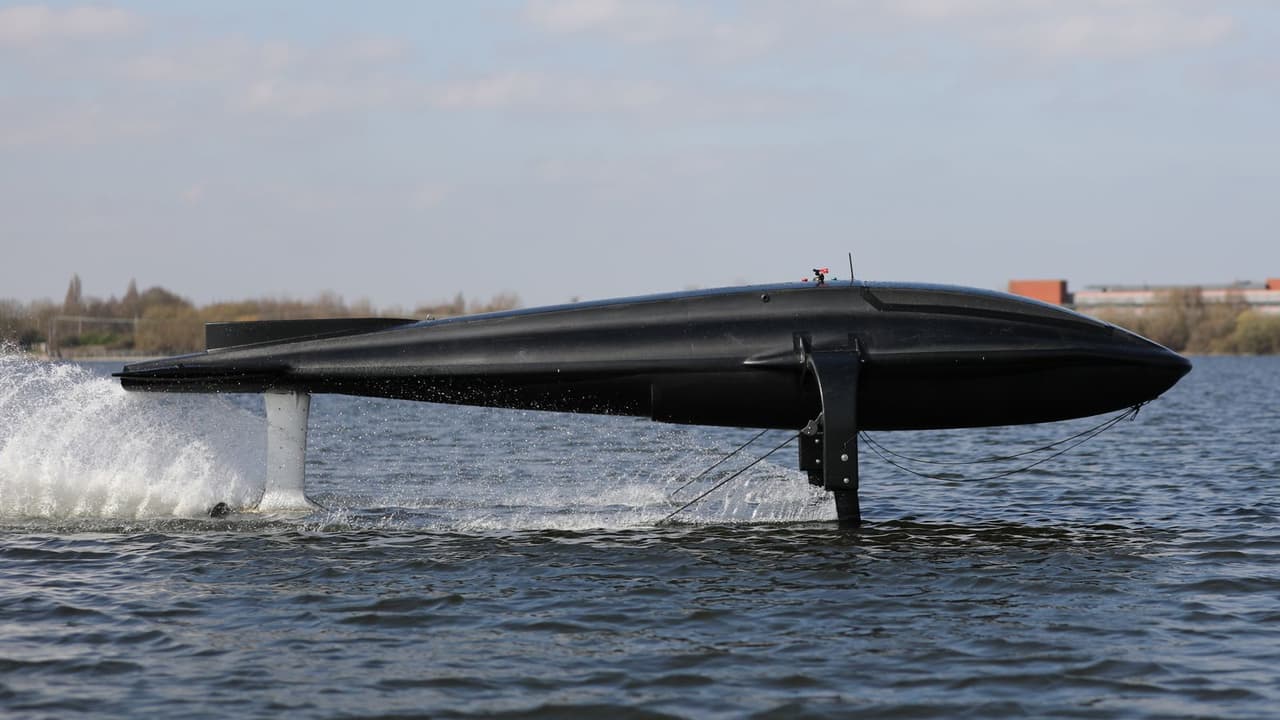
K4 Manta USV. (Kraken Technology)
The Manta is an innovative hybrid uncrewed platform combining high-speed hydrofoiling performance with the ability to transition underwater for covert operations.
Through successive USSOCOM S&T phases, Kraken Technology progressed the concept from paper studies to operational demonstrations, ultimately securing an ‘Other Transaction Authority’ agreement in 2025, worth up to USD49 million.
The agreement will enable Kraken Technology to accelerate the development of Manta from technology readiness level (TRL) six to nine by 2027, Crease said.
For Kraken Technology, the award – one of its most significant to date – was a major validation of both its technology and delivery model.
While Kraken Technology was developing Manta, which Crease describes as a “relatively exquisite platform”, another customer signal was emerging.
We kept hearing from customers that they also wanted something they could buy now, that worked, and was attritable and affordable. So, we translated that into the K3 Scout, which is basically a low-cast, high-performance, modular, interoperable, scalable maritime ‘truck’.
Founder and CEO Mal Crease
The design underwent 10 iterations in seven months before securing its first NATO customer in early 2024. The company cannot disclose the customer’s identity. More than 200 K3s have been sold to date, with the USVs understood to be operating across Europe and North America. Meanwhile, the UK recently confirmed plans to deploy its new fleet of K3s in the Strait of Hormuz.
Open architecture by design
Crease attributes much of the K3’s appeal to the company’s decision to adopt an open-systems architecture. Customers receive a baseline autonomy capability and command and control environment but retain the flexibility to integrate sovereign software, mission systems, and payloads.
“Our entire position is agnostic. We want to work with everybody – we’re not trying to vertically integrate the tech stack,” Crease said.
That philosophy extends to payload integration. Kraken Technology has standardised a modular payload architecture and is currently developing more than 30 payloads in collaboration with defence primes and technology partners, creating what Crease describes as a rapidly growing “business within a business”.
That approach is increasingly resonating with defence customers seeking interoperability across allied forces, Crease said.
Accelerated demand
The dual-use nature of the technology has been an important factor in attracting investment. In June 2025 Kraken Technology secured simultaneous investment from the NATO Innovation Fund (NIF) and the UK’s National Security Strategic Investment Fund, enabling it to scale production, accelerate R&D, and expand internationally.
Further recognition followed in May 2026, when Kraken Technology was one of 13 companies awarded accelerated contracts under the UK defence ministry’s Commercial X initiative, aimed at supporting future UK ‘defence unicorns’.
Scaling through partnerships
As demand for its platforms has grown, Kraken Technology has pursued a deliberate strategy of partnering with established industrial players rather than building extensive international infrastructure alone.
Our business model has consistently been to partner with very strong established operations that can help us fast-track the heavy lift of infrastructure. Partnering well is inevitably a faster and more cost-effective way for us to scale and create overnight presence.
Founder and CEO Mal Crease
In August 2025, it formed an alliance with NVL Group, now part of Rheinmetall. Production of the K3 Scout has now begun at Rheinmetall’s Blohm+Voss site in Hamburg, with initial capacity for around 200 vessels a year and scope to scale to 1,000 units annually as demand grows.
In April the company teamed with Anduril Industries for domestic manufacturing and integration of its platforms in the US, helping to accelerate the awareness of the company in the country in “a very short period of time.” This was followed in May by an alliance with Canadian shipbuilder Davie to co-produce USVs in Canada.
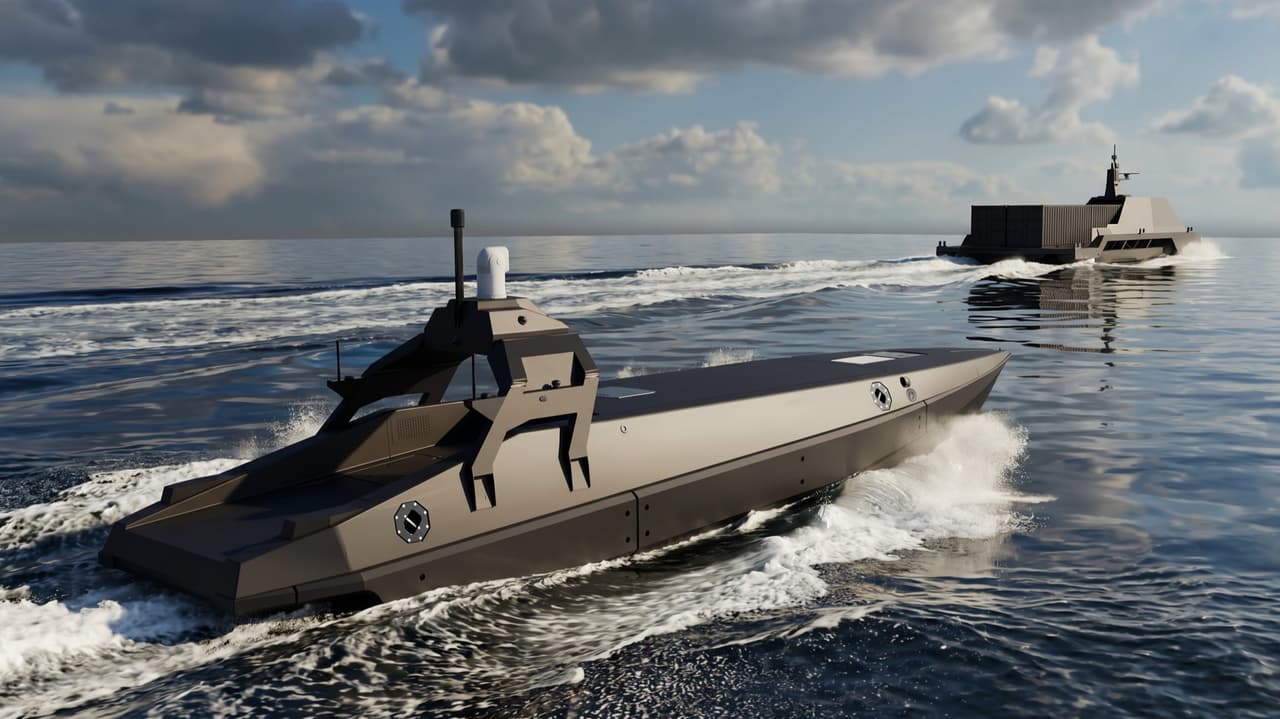
K5 (left) and K7 Sabre (right). (Kraken Technology)
"Boat-in-a-box"
Crucial to Kraken Technology’s scaling trajectory is its innovative approach to production. Rather than traditional shipbuilding, the company utilises modular engineering concepts modelled on supercar production lines. This “boat-in-a-box” and “factory-in-a-box” concept enables the company to build one K3 Scout – comprising fewer than 400 components – a day, assembled by semi-skilled labour using virtual factory quality assurance.
This model enables manufacturing capability to be established quickly in-country through licensed facilities and joint ventures.
By the end of 2026 the company aims to have established operational manufacturing capability across four continents, with facilities in Germany, North America, the UK. It also plans to expand into Asia-Pacific, the Baltics, and the Middle East.
Looking ahead, Kraken Technology’s roadmap continues to expand. Alongside the operational K3 Scout and maturing K4 Manta programme, it is preparing first customer deliveries of the larger, heavily armed 11.1m K5 USV in the coming months. The company also expects to complete engineering development of the K7 Sabre – a medium USV of around 26m designed for longer-range transit with heavy containerised payloads – before the end of 2026.
Kate
Tringham
Freelance Defence & Security Journalist
Kate Tringham is a freelance defence and security journalist specialising in the maritime domain. She has previously held roles at Janes, where she was the EMEA naval desk lead and former editor of Janes Navy International.