
Capita
From platforms to people: how AI-enabled training can build military advantage
AI is reshaping the economics of military training, but are the UK’s Armed Forces keeping up?

By
James
Quilter
Senior Contributor, Clarion Defence & Security
The UK cannot match its adversaries on numbers or output. It can beat them on training. This is where AI comes in. Applied well and imaginatively, it can keep the UK ahead of bigger rivals.
AI-enabled military training is no longer a future concept. Through Project Selborne, Capita and its partners are already helping the Royal Navy use adaptive learning, synthetic environments and data-driven assessment to accelerate training and improve readiness.
And as defence increasingly looks to AI to train personnel faster, more effectively and at greater scale, the lessons from live programmes like Selborne offer a practical blueprint for wider adoption.
But are the UK Armed Forces adapting fast enough to exploit it?
This question underpins ‘Technology’s integration in the British Armed Forces’, a new Council on Geostrategy (CoG) policy paper mapping AI integration across UK military training.
In it, Commodore Jo Deakin, Royal Navy Deputy Director People and Training, highlights the strategic necessity: "Technology is not a replacement for human judgement, but a force multiplier. It enables faster and better-informed decision-making in complex environments."
AI can change not only the quality but the cost and speed of specialist training. And fielding a trained person faster, improves efficiency and returns more operational time.
AI's three transformational applications
The CoG report identifies three areas where AI delivers immediate impact on military readiness.
All three sit within Project Selborne, the Royal Navy's GBP1.3 billion 12-year partnership delivered by Capita as prime contractor, in partnership with Raytheon, Fujitsu, and others under the Team Fisher consortium.
For Capita, the programme demonstrates that industry can integrate AI into training safely, at scale, and within the security and accreditation constraints of a live defence environment.
Here’s how:
1. Precision training through adaptive learning
AI-powered adaptive learning shifts training from a one-size-fits-all approach to one based on precision.
How does this look in practice?
The Royal Navy is piloting Obrizum, an AI platform that assesses trainees for both knowledge and confidence. It identifies what areas require revisiting and what trainees can skip, creating a tailored pathway for each learner.
Rather than every trainee progressing at the same pace, this system continuously assesses individual performance and adjusts. So, a trainee struggling with a concept receives additional support; one who masters it moves ahead.
Capita Managing Director Project Selborne Adrian Morley says: “The AI algorithms work out which areas the individual has high knowledge and high confidence in and therefore doesn't need to go back to.
“High knowledge but low confidence, they would need to revisit. And high confidence but low knowledge, so really confident with their answer, but it's wrong, and so definitely needs to go back to that knowledge material."
2. Intelligent adversaries and dynamic scenarios
AI can generate adversaries that adapt to the trainee in real time, replacing the scripted or human-played role of conventional simulation.
Conventional simulators have a ceiling on variety. Sooner or later, the system will hit a pattern, and the trainee will unconsciously work towards solving it. The real world is more random.
Capita
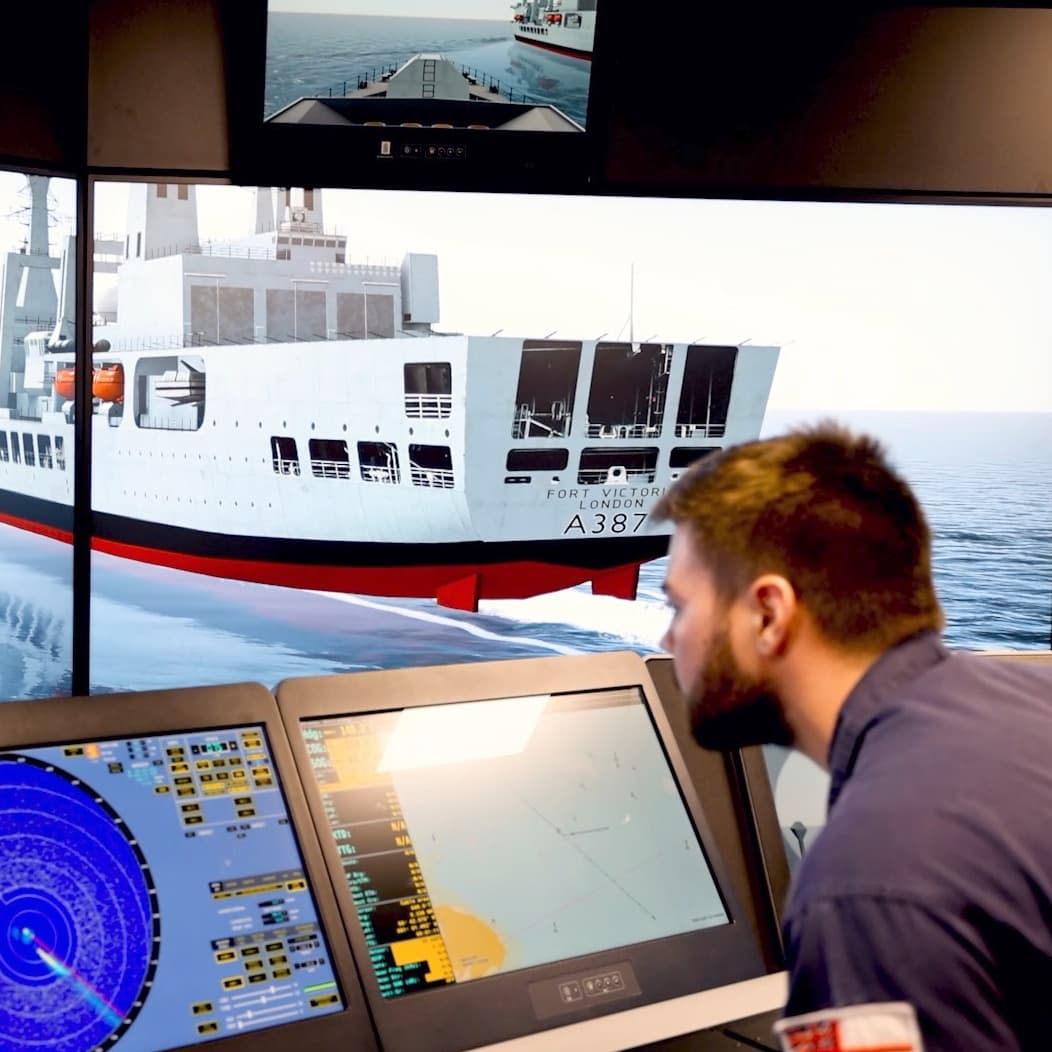
Royal Navy officers are practicing a RAS (Replenishment At Sea) drill, a naval procedure that allows warships and supply ships to transfer fuel, ammunition, provisions, and personnel while both vessels are moving at speeds of 12 to 16 knots.
The UK operates advanced synthetic training across all services.
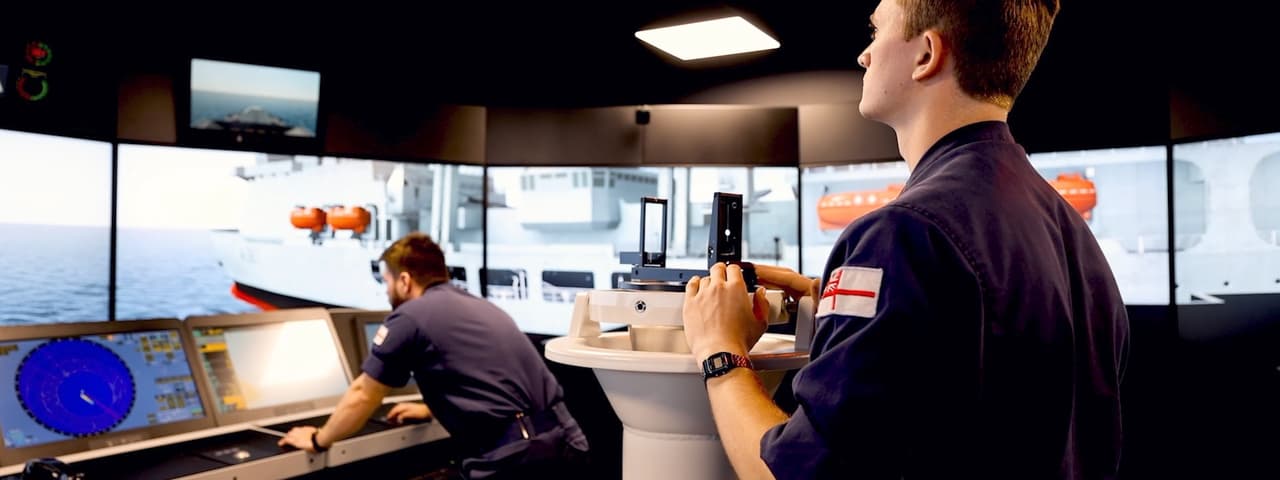
For the Royal Navy, under Selborne, crews preparing for deployment to the Middle East can practice navigating the Strait of Hormuz in a virtual reality simulation before reaching theatre. Selborne's bridge simulators allow crews to conduct complex manoeuvres that would be dangerous with real ships.
While Project Vulcan sits with the British Army. Its Ground Manoeuvre Synthetic Trainer (GMST) system provides a realistic synthetic training environment for Boxer Armoured Fighting Vehicles and Challenger 3 tanks.
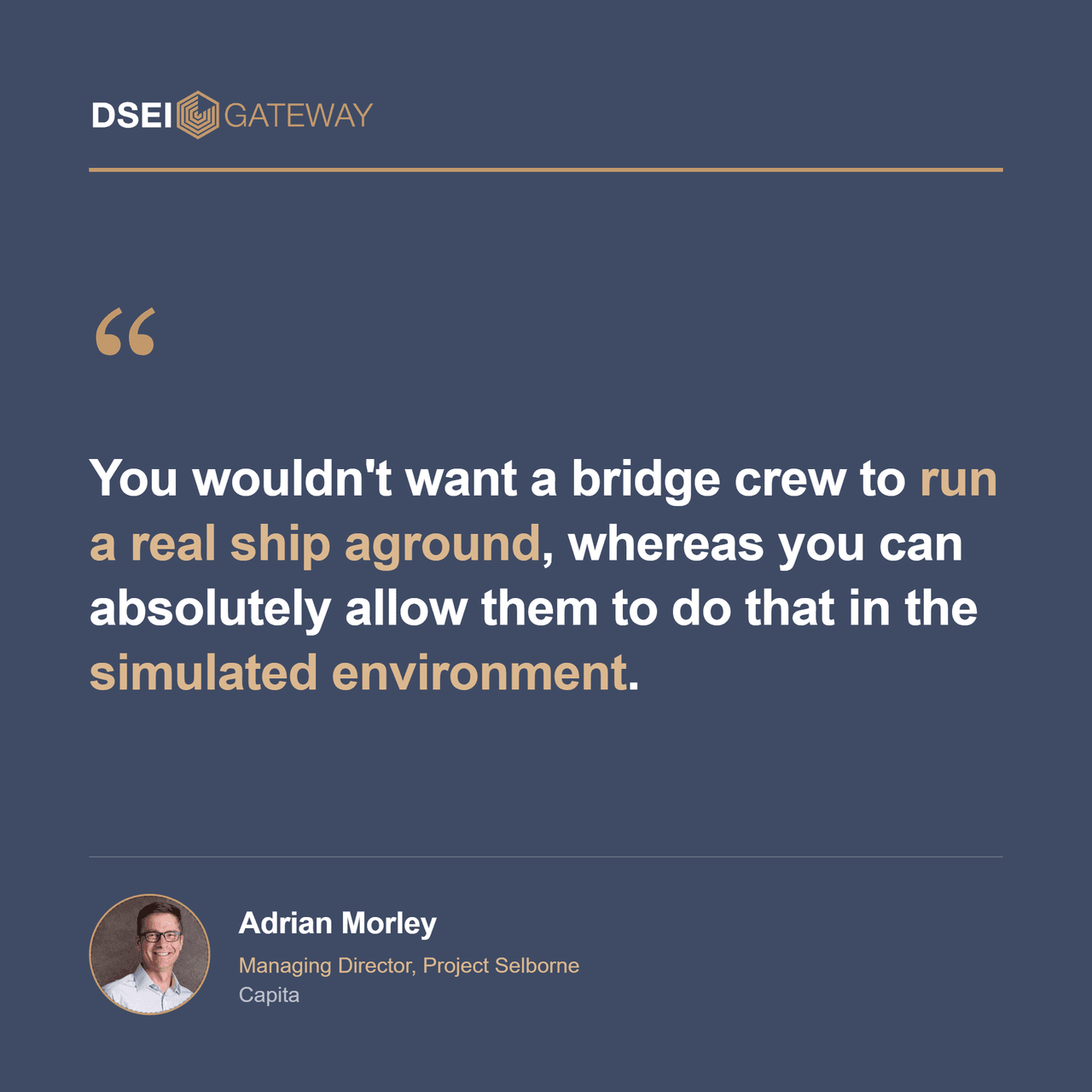
Morley explains the safe-failure principle. He says: "You wouldn't want a bridge crew to run a real ship aground, whereas you can absolutely allow them to do that in the simulated environment. Teams practise hundreds of scenarios before live exercises. The cost savings and capability gains compound."
AI-driven white forces replace human role-players, adapting in real time to trainee actions and creating unpredictable variety. The AI analyses trainee decisions and flags where the cohort is making the same mistakes.
3. Training design acceleration and industry augmentation
"[Capita CEO], Adolfo Hernandez, has long said, that AI will kill all 15-minute tasks,” says Morley. He adds that the MoD process governing military training design is “a quite robust set of processes and procedures to go through. Now you can block a lot of that up into 15-minute tasks, which is ripe for AI to do.”
Efficiencies are not all about time. Raytheon's Mainstay platform (part of Selborne) uses natural language processing to extract key learning points from thousands of pages of technical documentation automatically.
Morley describes the practical impact of this: "Take all publications applicable to a piece of training equipment such as a diesel generator on a frigate, and allow students to ask, 'What are the 10 key learning points?' and it'll draw those out very quickly."
AI also strengthens real-time performance assessment. Commanders and instructors receive dashboards showing individual and unit progress, enabling rapid intervention where needed. Automation with AI frees subject matter experts from administrative work, allowing them to validate strategy and correctness.
The barriers to implementing AI are real but not insurmountable
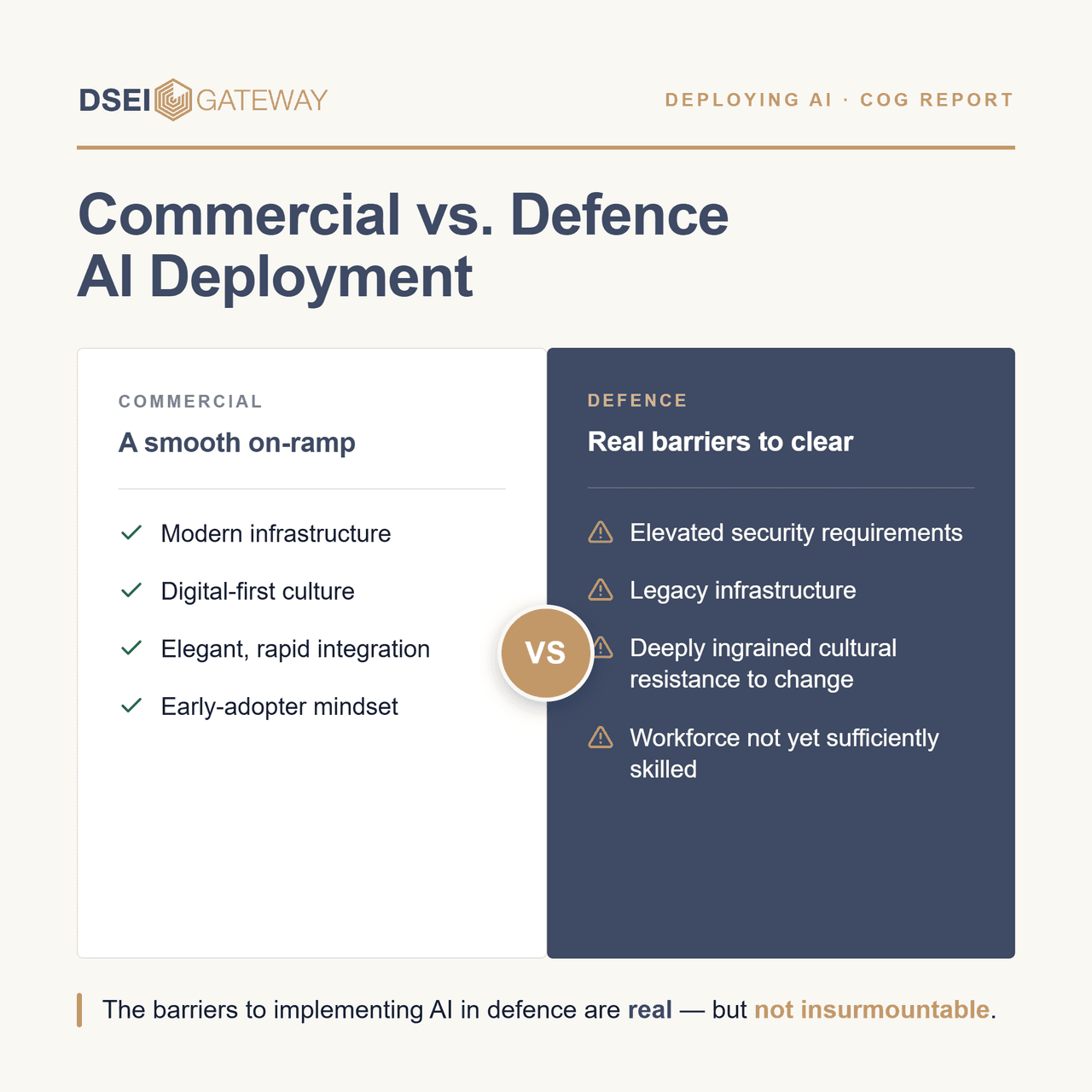
Deploying AI into a live defence environment is not the same as deploying it commercially. The CoG report identifies the barriers: elevated security requirements, legacy infrastructure, and a public sector that tends toward late adoption.
The cultural dimension may be the hardest. The report describes "a deeply ingrained cultural resistance to change" across the armed forces, compounded by a workforce not yet sufficiently skilled to exploit the tools becoming available.
A fundamental shift, it argues, must be initiated from leadership and permeate to individual sailors, soldiers, and aircrew. Without it, investment in technology risks being underutilised or actively resisted.
The security reality is equally concrete. Bringing AI platforms into operational use on official sensitive material requires passing through the requires clearance through multiple MoD cybersecurity accreditation layers.
Building on strong foundations
But the UK already has the foundations on which to build. Significant investment in synthetic training environments, virtual reality and simulation is in place across all three services. The question is how to layer AI into what exists rather than start from scratch.
The CoG report makes some key points on this. Firstly, the UK Defence Innovation body, launched in July 2025 with a ring-fenced annual budget of at least GBP400 million, is tasked with exactly that: creating a pathway from prototypes to deployable capabilities at what the government has called "wartime pace". Its Rapid Innovation Team focuses on commercially available solutions, which is where AI training tools largely sit.
Secondly, at the research end, the CoG report said UK’s Defence Science and Technology Laboratory collaborates with AUKUS partners and the US Air Force Research Laboratory on AI integration into live military environments, including threat detection on Royal Navy ships.
These initiatives are running now.
The industry partnership imperative
Traditional defence procurement cycles of five years cannot keep pace with AI development.
Morley points to the structure of Selborne as a model. Rather than committing to a fixed programme on day one, the 12-year contract is broken into discrete modernisation blocks, each co-created with the Royal Navy before being contracted separately. The client retains flexibility throughout. As Morley puts it, it keeps the contract evergreen. That architecture, he argues, is what AI adoption requires.
Commodore Deakin frames the strategic case: “Collaboration with industry, particularly through Selborne with Capita, has been instrumental in delivering training change. By combining Royal Navy expertise with industry nous, we can accelerate adoption, improve readiness, and prepare personnel for the changing character of warfare.”
The advantage of training smarter
What will the UK Armed Forces look like in five years if effective AI implementation is achieved?
In 2024, the World Economic Forum said the most advanced AI achieved an 87% success rate in tasks it had not encountered before, in contrast to the best human performance of 85%. The likelihood is this trend will continue.
As a result, readiness accelerates. Personnel reach operational units faster and with deeper competency. And as Morley puts it: "If a sailor completes a course a week early, that's an extra week of operational availability across a career."
AI-driven adaptive learning means a geographically dispersed force can access advanced training without the cost and logistics of concentrating people in one place.
The UK cannot out-produce its adversaries on numbers alone. But it can out-learn them. That advantage not only rests on speed of its training but how smart that training is.
James
Quilter
Senior Contributor, Clarion Defence & Security
James is a UK-based writer for Clarion Defence & Security. His background spans journalism, editorial leadership and content strategy. He has worked for leading B2B titles and global brands including EDF and X (formerly Twitter).