
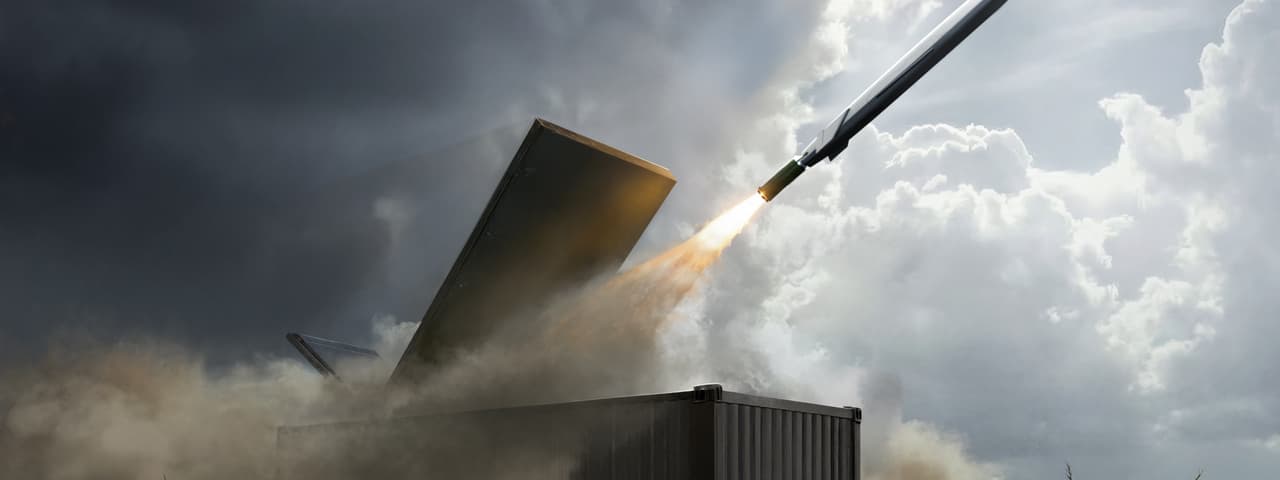
Destinus Ruta B3 Container Launch
Turning prototypes into arsenals: the model Europe needs
The joint venture between Destinus and Rheinmetall can point the way past the prototype trap and into scalable production, writes Desintus CEO Mikhail Kokorich
09 JUN 2026

By
Mikhail
Kokorich
CEO, Destinus
There is a distinction that is rarely covered in big defence industry announcements, one that decides everything: the difference between developing a system and possessing an arsenal.
To be clear, a system is a demonstrated capability. Whereas an arsenal is that capability produced in volume, replenished under pressure, and available in the quantities a real conflict consumes. Europe, across most of its long-range strike portfolio, has the first but not the second.
This is not an engineering failure.
European laboratories and design houses already produce world-class precision weapons. The issue is in the industrial layer, the step that converts proven design into sustained output.
Too many European systems live permanently between prototype and inventory: impressive on a test range but absent in the magazine where it matters.
Where sustainable deterrence lives
The portfolio splits into two halves that do not meet. At one end sits sophisticated cruise weaponry, precise and capable, but produced in small numbers with replenishment cycles measured in years.
At the other are expendable effectors. These are cheap and numerous, but without the range, payload, or resilience that conventional deep strike requires. Between them lies the layer where sustainable deterrence actually lives: to cruise strike at meaningful range, using something that is produced at a scale and cost that allows it to be held in depth.
In Europe today, that middle layer barely exists.
Building product families, not one-offs
Closing that gap is not a matter of designing yet another excellent missile. It is a matter of how a system is conceived in the first place.
Europe has a habit of launching a fresh, disconnected program whenever a new requirement arises, each with its own qualifications, supply chain, and learning curve, none of which compound.
The alternative?
Build coherent product families that evolve along a shared technological and industrial backbone. So that investment in one generation carries directly into the next.
Evolving across generations, on one industrial foundation
That is the principle behind our own strike line, and it goes beyond any one programme.
A single propulsion philosophy and a single production logic runs across Destinus’s product range. This covers everything from the validated baseline now in service and the longer-range successor entering industrialization, to the deep-range variant designed for targets that require reach measured in thousands of kilometres.
One product family, evolving across generations, on one industrial foundation. The aim is layered operational relevance combined with the ability to build the same way every time.
The one metric that truly matters
Modern strike weapons are not determined by the headline unit price or by range alone.
The relevant measure is cost-per-effect. In other words, what a system imposes on an adversary set against what it costs to field, multiplied by the scale at which it can be produced. Viewed through this light, Europe’s established cruise-strike inventory is too expensive for the depth of deterrence it currently needs.
Building those volumes on legacy systems alone enforces a budgetary burden very few finance ministries can sustain. And the systems would still arrive too slowly.
This is what we mean by efficient mass: scalable, affordable combat capacity, produced inside Europe, improved in months rather than decades.
Range and precision still matter but they no longer decide outcomes on their own. What does is whether a continent can produce relevant systems at scale, sustain them over time, and replenish them faster than they are spent.
How we have structured production in our partnership with Rheinmetall
Supply chain sovereignty is too often reduced to the location of final assembly. It is not. It is the whole stack: design authority, critical components, propulsion, guidance, and the supply chain beneath them all.
A production base that is free of external export-control encumbrances and free of dependency on politically misaligned suppliers is the first thing a defence ministry verifies. And it is the thing that determines whether a system can be offered to allies on European terms at all.
This is the logic that shapes how we have structured production in our partnership with Rheinmetall.
The division of responsibility is clear. Design authority, core technology, and the configuration baseline remain with us. Industrial qualification, supplier infrastructure, and serial-production depth come from the partnership.
Not the story people expect to hear
Manufacturing speed alone is not enough. Production scale without control of the design is a liability. The aim is to do both simultaneously.
That structure is worth explaining, because it is not the story people expect: the one of a newcomer trying to displace an incumbent.
It is the two halves of the problem coming together to form a solution: one of Europe’s great manufacturing houses supplying the industrial layer, and a younger company supplying the speed, simpler design logic, and faster iteration cycle that much of the sector has lost.
Each side does what it is genuinely best at. That combination is precisely what changes the European deep-strike picture. The missing middle layer is not built by industrial weight alone. Nor by start-up agility alone. It is done by combining them.
That is the model the rest of the continent will need to adopt if it is serious about turning prototypes into arsenals.
The value of a hard environment
'Battle-proven' is a soundbite the defence industry likes. But it has become almost decorative. The real value is not the label. It is the loop behind it: deploy, gather operator feedback, redesign, retest, adjust production, deploy again, under genuine operational pressure rather than range conditions.
Industrializing an operationally proven architecture is fundamentally different from scaling a concept that only exists on paper. A system forged under real-world pressure carries far sharper lessons.
Europe needs a new industrial model
Yes, Europe does need defence spending. But more than that, it needs a different industrial model. Deterrence at scale rests on stockpiles, replenishment, production elasticity, supplier ecosystems, software that updates, lessons that provide feedback and cost-per-effect discipline.
Industrial scaling is not the unglamorous background to deterrence. It is deterrence.
The future of European defence will not belong to whoever designs the most advanced individual system. It belongs to whoever can build those systems at scale, iterate them quickly, and sustain them over years.
Deep strike, in the end, is not a phrase to invoke. It is an industrial capacity to build or fail to build: the hard reality that separates system capability from an active arsenal.
Mikhail
Kokorich
CEO, Destinus
Mikhail Kokorich is CEO of Destinus, a European manufacturer of advanced defence systems operating across six EU Member States.