

(Shutterstock)
Demystifying the European Defence Agency: opportunities for industry
DSEI Gateway explores the role of the agency as a hub for industry opportunities, during a period of rapid change for European defence.
16 APR 2026

By
Benjamin
Howe
Defence Journalist, DSEI Gateway
EU member states are moving to revitalise their defence industrial bases as part of a broader push to bolster regional security.
A key driver of this effort is the European Defence Agency (EDA), the mandate of which is – arguably – somewhat misunderstood. It has a roughly EUR50 million operating budget, but oversees nearly EUR1 billion in external projects.
To provide clarity, DSEI Gateway spoke with Carl-Johan Lind, Policy Officer for Industry Engagement and EU Policies at the EDA, who explained how the organisation operates and where opportunities lie – particularly for smaller companies.
First off, it helps to clarify how the EDA fits into the EU’s wider defence ecosystem.
Origins and structure
The EU’s defence and security architecture is highly complex. The roles, responsibilities, and funding sources for its sub-organisations vary significantly and often overlap.
Here is a simplified breakdown of the key entities that help to drive defence growth for EU member states:
- The European Commission: through the Directorate-General for Defence Industry and Space, the commission is primarily focused on fostering defence cooperation at a strategic level
- The European Defence Fund (EDF): receives its funding and priorities from the commission
- The European Defence Industry Programme (EDIP): a EUR1.5 billion commission initiative to strengthen the European industrial base through a series of grants
- The EDA: receives its funding and priorities directly from EU member states, acting as a facilitator for member state collaboration for defence
(Shutterstock)
The EDA was stood up in 2004 to support the collaboration of EU member states in defence and security. This followed decades of attempts to cultivate closer ties on defence cooperation between member states, many of which are also NATO members.
Along with acting as the primary organisation to promote R&D, it also serves as a project management office to drive European defence growth and investment.
There are three functional directorates within the EDA, Lind explained, including the Industry, Synergies and Enablers Directorate (ISE); the Research, Technology and Innovation Directorate (RTI); and the Capability, Armament and Planning Directorate (CAP).
These directorates play distinct roles in shaping defence cooperation, and each offers different touchpoints for industry.
ISE
Lind’s department – the ISE Directorate – primarily focuses on industry engagement and enabling activities, including acting as the military interface with EU regulation and policies, standardisation, and training initiatives.
For example, the directorate supports efforts to increase interoperability and harmonise requirements.
To translate these broad responsibilities into practical support, the directorate has created several tools aimed at reducing barriers for industry.
The B2B Platform
One such tool is the EDA’s free ‘B2B Platform’ – established in 2019 – to facilitate defence industry networking.
It was designed so that all companies – including SMEs and startups – can securely search for potential partners.

(Shutterstock)
After registering for the platform, companies can publish requests to collaborate or respond to the requests of others.
Using IdentiFunding, companies can perform an initial self-diagnosis to see if they or their solutions are eligible for EU-level funding or investment.
It also importantly allows companies to identify EU funding schemes available for defence-related projects.
Currently, around 27 civilian and defence-related EU funding streams are visible on the tool, Lind explained.
RTI
If the ISE Directorate lays the groundwork for industry participation, then the RTI Directorate represents the next stage of the journey: moving promising ideas towards real‑world capability.
RTI oversees a vast research and technology framework, shaping priorities, coordinating multinational projects, and ensuring that innovation is channelled into areas where member states have identified genuine operational need.
It does this through its agenda of ad-hoc projects as well as some indirect management of EDF projects when requested by member states.
HEDI
Sat under the RTI, but operating a stand-alone framework, is the Hub for EU Defence Innovation (HEDI).
Established by the EDA in 2022, it aims to accelerate concepts into active defence capabilities at rapid pace, something which Lind says is of particular interest to SMEs.
Its has four components which help to achieve its overarching aim, comprising:
- Defence Frontier Insights, a monitoring tool that scouts civilian and defence sectors to identify promising technologies
- An ‘Innovation Forge’ that supports European innovators in developing solutions to concrete military challenges, facilitated through phase-based challenges and validation in realistic environments
- The European Defence Innovation Network platform, which shares best practices with innovators
- European Defence Innovation days, which showcases industry capabilities to military and procurement officials

(European Defence Agency)
Broadly, HEDI aims to foster greater cooperation by increasing engagement with member states and industry to drive defence innovation.
However, the EDA initially found that HEDI failed to move the expected number of technologies into operational use and is now actioning what it calls ‘HEDI 2.0’.
HEDI 2.0 is expected to deliver greater cooperation, with a faster transition from research to deployment while also fostering closer links between member states and innovators.
Essentially, it focuses more on practical testing and improving connections between member states and innovators. Although it's unclear what new approaches and tools are being deployed to achieve this.
CAP
Moving to more strategic, top-level level planning is the CAP Directorate.
It’s tasked with coordinating the European-wide development of defence capabilities, through initiatives such as the Capability Development Plan and the Coordinated Annual Review on Defence.
These are essential initiatives that define the military capabilities required to strengthen European defence, and the projects and cooperation opportunities that industry can engage with.
One of CAP’s most influential avenues for coordinated capability development is the Permanent Structured Cooperation (PESCO) framework.
PESCO Projects
PESCO Projects are binding defence initiatives between member states to jointly develop and deploy military capabilities – with some backing by the EDF.
According to PESCO, 74 projects are currently active, ranging from uncrewed systems to navigation, quantum technologies, cyber, and beyond.
The EDA helps to manage the PESCO Projects to facilitate member state involvement and limit duplication, such as with NATO for example.
When viewed collectively, PESCO sits alongside the aforementioned tools, hubs, and initiatives attempting to encourage joint capability development across Europe.
Separate initiatives
While not linked to the EDA, the EU has several other initiatives intended to help boost development and industrial growth, particularly for SMEs.
One of the most notable is the EDF Work Programme, which has EUR1.5-2 billion earmarked annually to fund defence technology and capability projects.
EU Defence Innovation Scheme (EUDIS) sits within this wider Work Programme, specifically aiming to bolster innovation and lower the barriers to entry for SMEs and non-traditional defence companies.
To deliver on this it hosts events (such as hackathons), launches thematic and open calls, provides business coaching, and offers options to meet with private equity investors. It also manages a targeted business accelerator unit.
In 2026, EUDIS is allowing Ukrainian companies to access these tools and opportunities.
The second initiative in this vein is a new pilot instrument – ‘AGILE’ – designed to provide SMEs, startups and scale-ups with funding to both develop new products and facilitate their path to market.
Notably, AGILE aims to reduce the time-to-grant significantly for companies to four months, while also reducing the cashflow pressures they often face due to the defence sector’s traditionally long procurement cycles.
Initially, it will provide funding for 20 to 30 projects, with the EU aiming to have the programme fully operational by 2027.
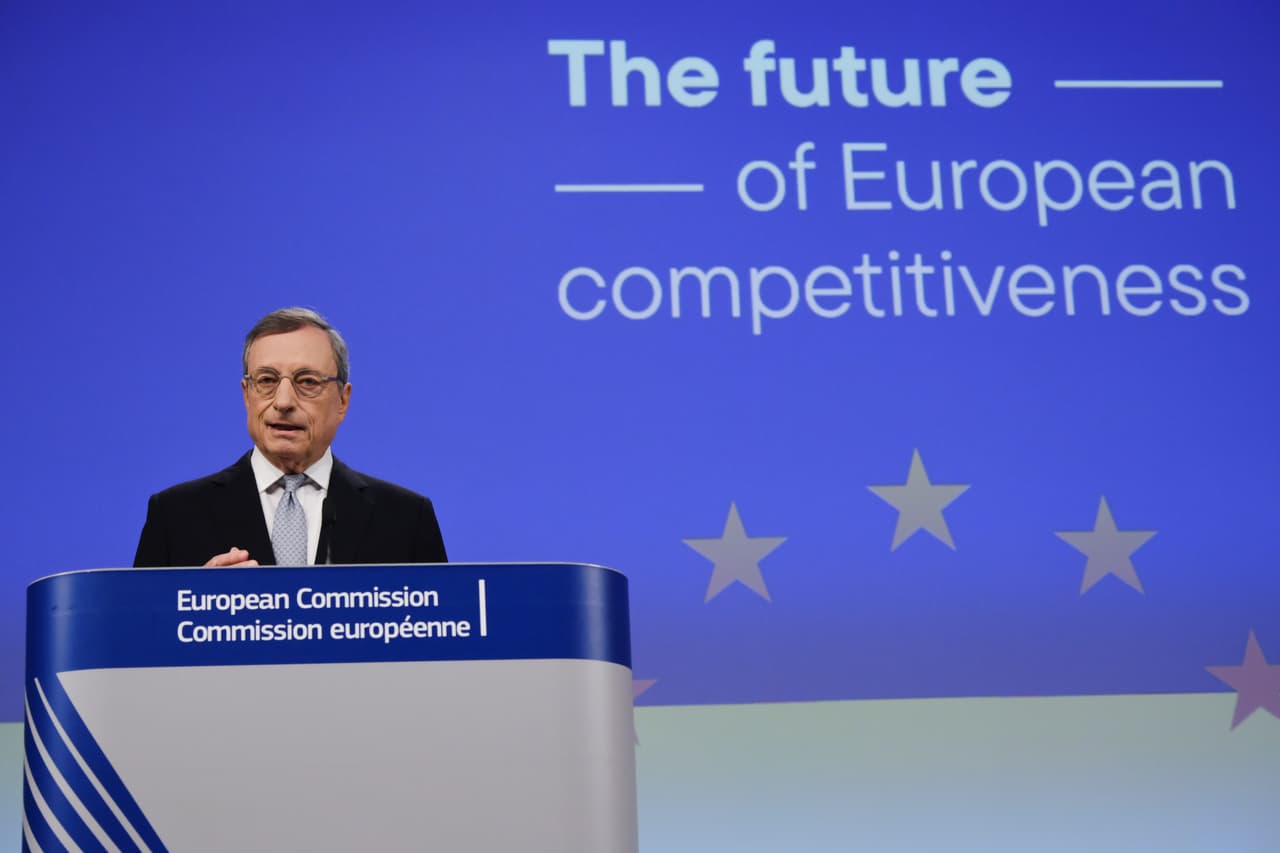
Mario Draghi, former European Central Bank President. (Shutterstock)
Supporting SMEs
Collectively, these tools and initiatives promise many different entry points into the EU defence market for smaller companies. They are, in many ways, a response to a range of issues raised by both the EU and industry.
One such issue, Lind explained, is that small companies sometimes “feel that they lack the support of their [national] ministries of defence”, whether in providing broader market access or supporting emerging R&D projects.
There is also an ongoing problem for defence companies when it comes to accessing private capital and wider investment, as highlighted in former European Central Bank President Mario Draghi’s report on EU competitiveness.
“The risk here is that these companies go elsewhere, so we are addressing this issue, and we will see more to come on this front.”
Lind
He was unable to give specifics on what additional measures might be taken at this time but said “we really want to support building this ecosystem in Europe”.
Looking to the future
Going forward, companies can expect accelerated efforts to grow the EU defence industry, especially through improving access to European private finance.
However, the sheer volume of initiatives aimed at boosting growth and military capability is created a fragmented landscape for small companies. With new programmes launching frequently, navigating the ecosystem is only likely to become more challenging. The EU must do more to provide clarity on the most effective entry points for SMEs.
Nevertheless, it is promising to see the EU take a greater role in driving defence investment.
“Defence industrial issues have become central to conversations and initiatives at EU-level,” Lind said, with the EDA at the centre of helping to develop a more streamlined and accessible defence ecosystem.
Benjamin
Howe
Defence Journalist, DSEI Gateway
Benjamin is a UK-based Journalist working for DSEI Gateway, having previously worked as a Content and Community Manager on Clarion's digital products.